
Reverse Engineering an Impeller Made Easy with Geomagic Design X

Product: Geomagic Design X
Industry: Industrial Machinery and Heavy Equipment

When small business owner Matthew Percival of 3D Rev Eng was contracted by Dependable Industries, a pattern and tooling shop in Vancouver, British Columbia, to assist in the reverse engineering of a power generation Francis Runner casting, the full power of Geomagic Design X was put to the test.

Percival had a very finite, one-day window of time to 3D scan the part. There was no drawing to confirm against, so he had to be able to work quickly and accurately. The working runner that was being reversed engineered was on its last repair cycle and needed to have a replacement casting ready in one year. The scan data was acquired in about four hours using a hand held scanner.

The deep narrow pockets of the hydraulic passages limited the scanner’s range and made complete data acquisition impossible. With about 85% of the part scanned, Percival knew he had enough to make a complete CAD model using the software from 3D Systems.

CAD model using the software from 3D Systems.

“For me, Design X is the obvious software choice. The ability to generate solid models directly on the scan data is priceless.”

Matthew Percival of 3D Rev Eng

Using the data live on site, Percival was able to create sketches and smooth lofted surfaces between the two sides of the acquired data and conform it to the casting using hands on methods in Geomagic Design X. Doing this revealed a number of interesting details to the customer:

  • The center axis of the impeller was no longer square to the
  • vanes which results in an unbalanced and inefficient part
  • The cast surfaces were badly worn and out of typical tolerance
  • The volume of each cavity was inconsistent
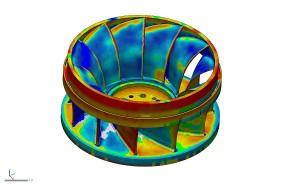
The impeller Scan inside Geomagic Design X

Design X easily overcame these issues. Percival was able to generate sketches on the blade, as well as an accurate smooth surface that he could revolve around the extracted revolution axis. The surface was then trimmed to match the profile and revolved to obtain the proper count of blades. Comparing this data live with color deviation maps to the scan data, Percival was able to ensure that accuracy was within the client’s requirements.

The problem of the part not being on the center axis was easily fixed, since Design X allowed Percival to redesign with design intent. He was able to model the part by extracting the profile, generating a sketch and adjusting the revolution axis to the proper design intent. Lastly, he merged the model and extracted the radii from the scan data, applying it to every blade. Once the model was complete in Design X, he used the software’s LiveTransfer technology to send the entire feature-based solid model into Solidworks and saved it as a native sldprt file for the client.
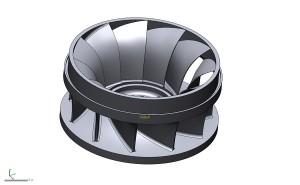
Using the CAD tools in Design X and the product knowledge provided by the customer, Percival was able to recreate the entire runner as a solid model true to design intent.

Cost savings in decreased downtime of hydro power generation plant

$ 20,000 per day *

Average cost to traditionally reverse engineer a runner

$ 3,800 and 4 days

3D Rev Eng cost

$ 2,500 and 2 days

Cost to manually produce foundry tooling from traditional reverse engineering data

$ 35,000 and 5 weeks

Cost to CNC cut foundry tooling from CAD data made in Geomagic Design X

$22,000 and 3 weeks

Cost savings in finish machining and balancing of a casting made from CNC tooling

$ 3,500

Cost savings and power generation efficiency resulting from highly-accurate hydraulic passages and balancing

UNLIMITED

Conclusion

The successful completion of the Francis Runner project has opened the door for other impeller projects for Percival and 3D Rev Eng. These projects include aquaculture impellers, mining impeller blades and Pelton wheels. Geomagic Design X allows Percival to quickly use complex shapes and surfaces to produce models within hours, which would otherwise have taken weeks.
Node-Audio Evolves Hi-Fi Sound with 3D Printed Speakers

Product: SLS Printer
Industry: Consumer products

Nearly every piece of high-fidelity (hi-fi) equipment seeks to claim live-performance sound quality, yet many of these products are manufactured very similarly to their box speaker counterparts. The HYLIXA loudspeaker by Node-Audio represents a true departure and hi-fi industry breakthrough, made possible by using selective laser sintering (SLS) 3D printing to produce a distinctive, complex cabinet structure. According to David Evans, industrial designer and co-founder of Node, this revolutionary new speaker was not only produced with 3D printing; it was inspired by the capabilities additive manufacturing makes possible.

Seizing the opportunity to create a high-value product

Industrial designers Ashley May and David Evans entered the hi-fi world because they saw an opportunity to do something that had never been done. With access to a 3D Systems SLS 3D printer in their production facility, they put their heads together to devise a high-value, high performance product that took advantage of the additive process.

“It was like a fresh start for us as designers,” says Evans. “We’ve always known how to design things so they could be manufactured in a particular way, whereas this sort of threw everything out the window and opened up our imaginations to what was possible.”

SLS, or selective laser sintering, is an additive manufacturing technology that fuses powdered materials together in a self-supported build style. Because of this layer-by-layer manufacturing process, it is possible to achieve far more complex and organically shaped components than conventional manufacturing methods allow.

Using 3D sound simulations to iterate the ideal design

With the industrial design component under control, Evans and May enlisted the help of an acoustic engineer to guide the technical development of a new loudspeaker. Their vision was to create a loudspeaker that produces audio quality that rivals a live experience, with beautiful, sculptural aesthetics.

The development process began with 3D designs from Evans and May that then ran through specialized 3D audio simulation software to inform the next iteration. As the simulation output began to confirm the next-level sound the team was after, they began to prototype and refine further, until finally arriving at Node’s flagship product, HYLIXA.

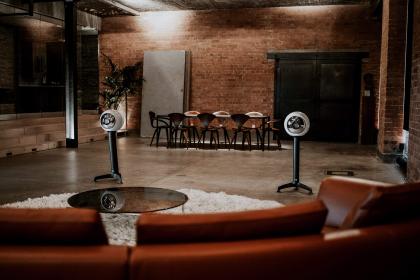
HYLIXA speakers feature a conical cabinet with a patent-pending helical transmission line that spirals for 1.6 meters around the cabinet interior. This line is fed by a dedicated bass driver and releases the sound through a circular vent around the mid and the tweeter. Because the rounded cabinet is designed and manufactured as a single piece, there are no edges to produce diffraction (a disruption to sound precision). This results in smooth sound travel and an enhanced listening experience. According to a review on the hi-fi music gear website The Ear, “the [more complex] the music gets, the better [HYLIXA] sounds, which is the opposite of what you get with most speakers.”

HYLIXA loud speakers by Node Audio

Maximizing technology in design and production

Production and prototyping for the HYLIXA speakers are done on a 3D Systems sPro™ 60 SLS printer. The speakers, which are sold in a set of two, are each printed separately within the printer’s 381 mm x 330 mm x 460 mm build volume. Evans says the team maximizes each build by nesting the other components within the speaker cabinet.

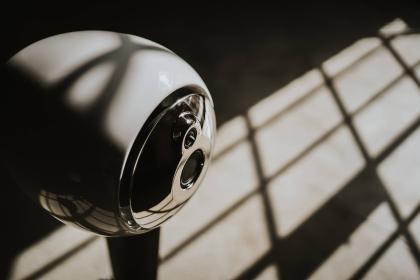
The cabinet and front baffle components of HYLIXA are printed in DuraForm® GF, a glass-filled engineering plastic that delivers an excellent surface finish that is machinable and paintable. As the primary display piece of the speakers, Node puts the HYLIXA cabinets through a methodical post-processing regimen to evacuate all material from the pieces and prepare the surfaces for whatever finishing the customer requests. 

“We learned through the prototyping process that DuraForm GF actually worked very well acoustically,” says Evans. “It has almost a ceramic-like quality to the touch, which helped us both structurally and sonically. As designers, we could freely exploit SLS production to create the internal structure, but also design something that looked as beautiful as it sounds.”

“Every component that we 3D printed, we’ve done for a reason,” says Evans. “We’ve used the technology to benefit the product in one way or another, and pushed to take everything to the absolute limit.”

Close up of SLS produced loud speaker HYLIXA

Reception in the industry and future products

After launching HYLIXA in 2019, Node sent several pairs of speakers to hi-fi industry experts for their unbiased take. In addition to descriptions such as “radical,” “unusual,” and “seductive,” publication Hi-Fi+ praises the speakers for “an almost unbelievable ‘out of the box’ sound” with “an exceptional dynamic range.” 

“The feedback has been even better than we first hoped, to be honest,” said Evans. Having now earned credibility within the industry, Node has more up its sleeves and is looking to grow. Evans says what’s to come is still “very top secret” at the moment, but Node remains committed to its process. 3D printing will be an integral part of the company’s strategy to differentiate itself by doing things that haven’t been done before.

Learn more about this story here.

An encounter between prehistory and high technology, where Artec Leo comes face to face with a dinosaur skull

Product: Artec Leo
Industry: Academic

Dinosaurs – Creatures that have inspired study and research for centuries, and continue to intrigue millions of people around the world today. For the preserved remains of a triceratops roaming the Earth in prehistoric times, modern technology has attributed a status few dinosaur fossils have achieved: digital immortality.

Originally discovered in 1891 near the village of Lance Creek, Wyoming, the skull of this herbivore was exhibited at the Smithsonian Institution in Washington, D.C. until the late 1970s. He was then loaned to the CU Museum, where he now resides; the current museum was literally built around this skull.

“The Smithsonian estimated how much it would cost to tear down that wall, pull this thing out and return it, because they own it, and it was so expensive and risky that no one wanted to do it,” says Nick Conklin, Application Engineer II of Artec’s certified partner Gold, 3D Printing Colorado. This means that the skull, in principle, stays where it is, but with 3D scanning technology, there are now previously impossible possibilities.

When Conklin and his partner David Cano first visited the University of Colorado Museum of Natural History in January this year, it was for sale by a Artec Leo 3D scanner. “As we entered, we saw the skull of the triceratops and thought, ‘Hey, that would be a really cool scan, we should do it sometime!'” conklin recalls.

With each scanner that sells 3D Printing Colorado, training is included. But for Dr. William Taylor, curator of archaeology at the university, already familiar with Artec 3D scanners, another add-on was suggested.

“Dr. Taylor had already used artec Space Spider a lot, so instead of training, he decided to bring the Leo to one of his classes,” Conklin says. “He wanted us to show his students what can be done with Leo and scanning technology.”

Thus began a project of prehistoric proportions, to digitize a dinosaur skull completely.

“For 30 or 40 minutes, at one of Dr. Taylor’s night classes, I was scanning the skull of the triceratops while talking to the students, explaining what he was doing, so it was a great apprenticeship,” Conklin says. This skull scan quickly caught CU Media’s attention.

“The university’s media was everywhere, and they wanted to take pictures and videos of a dinosaur being scanned,” says Cano. “Once they found out about this, they invited us back, and this time instead of a teaching experience, it was more of a movie photo shoot,” Conklin adds.

During his second scan, something helped a lot in the session, a ladder. “With the ladder, I was able to get some details that had slipped away from me before, so it was much better,” Conklin says.

The scan took a total of 30 minutes, while the scan processing was completed in artec Studio3D software in two hours.

Using Leo, most of the surfaces were near the ground. “I was able to get everything except the top peaks from the ground with my normal range and range of motion,” Conklin says. “With his large field of view and the ease with which Leo gets the data, it was very easy. I wasn’t just scanning, as I was talking and explaining what I was doing.”

As easy to use as recording a video with your mobile, Artec Leo comes with a screen, which means you can see if you’ve captured all the areas and fill in the ones that could have been left. 3D replication is generated in real time as you scan, so you can focus on the work, how in this case, scan while demonstrating PhD students on a ladder.

“With another scanner I could have done it, but it would have been harder, I would have had to pay more attention to everything. But with Leo and how well he tracks, I was able to divide my attention between class and quality data collection. It’s definitely the best tool for this job.”

Conklin says that being able to access the skull with a ladder made the data obtained much better, as he was able to scan both the back and top of the skull and from all angles. “I liked the end result a lot more,” he says. “My biggest concern was that it’s an irreplaceable piece of archaeology, and if anything had happened to him. I don’t even want to think about it.”

Thanks to this scan, in addition to having a 3D model of the museum star, many other companies and faculties can find educational and professional opportunities. In essence, what inspires the team is the ability to do something that was previously impossible.

“Especially now that everyone stays at home, you can work from home and do whatever you want from a 3D file, such as performing simulations or conducting research,” Conklin says.

“Supporting research that would not otherwise be possible is another reason why this is important, in addition to the fact that anyone, anywhere in the world can start researching from this copy.”

From measurements to research, from global accessibility to preservation, opportunities are limitless. “Even maybe for the CGI for the next Jurassic Park movie, or video games,” Conklin suggests. “I’m excited to think about it!”

“Just to see how history is done and preserved, to see how the world changes, how something that would have been destroyed over time or for any other reason can be preserved, time passes for all, but if we can digitize things, we can go back in time eternally.”

Today, what the home of the skull has been considering is using scanning to make a mold and then create its own copy on the Smithsonian, now that they have the exact measurements of the entire skull, something they had never had before. “I don’t think we could have done it without the 3D scan,” says Conklin, who is happy to fulfill his childhood dream of wearing the archaeologist’s hat for a day. “I’ll tell you what,” he adds. “If you build a replica of this dinosaur skull from my scanning data, I’ll bring my future grandchildren to see!”

“I would like to go a step further and see what we can do with the museum in terms of digitization and help them in the long run,” Cano stresses.

easyJet Cuts Aircraft Damage Assessment Time by 80% with Geomagic Control X

Product: Control X
Industry: Aerospace

If you’ve flown anywhere in Europe in the past two decades, chances are good that you’ve flown on easyJet. This leading European low-cost airline brings travelers to more than 30 countries on 600+ routes safely and conveniently, all while offering some of the lowest fares across the continent. How do they do it? With a focus on safety, simplicity, and operational efficiency. easyJet’s engineering organization epitomizes this ethos by putting safety at the heart of everything it does and innovating to continually improve performance and reduce costs.

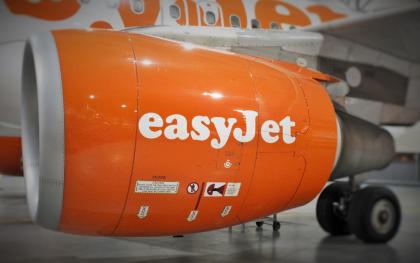
easyJet assesses aircraft damage faster with Geomagic Control X

Minimizing Aircraft on Ground Time

One of the most important ways that easyJet can minimize delays and keep ticket prices low is reducing Aircraft on Ground (AOG) time. Unplanned AOG events happen when any of the company’s 298 Airbus aircraft are damaged or experience mechanical failures, and can be very costly — not to mention inconvenient to passengers. It’s clear that the faster a damaged aircraft can be checked, the better it is for the airline and its passengers. 

“One of our biggest challenges is to try and reduce the AOG time of aircraft and maintain accurate records when damage occurs,” said Andrew Knight, Fleet Structures Engineer at easyJet. While rare, hail, bird strikes, and other events can potentially damage the wings and fuselage and require inspection before flying again. Checking damage from these types of events has traditionally been a low tech, manual, and time-consuming process that requires maintenance staff to assess aircraft damage using manual measuring tools such as rulers and vernier calipers. Worse still, interpreting the extent of any damage using this technique is highly subjective and not repeatable between staff members. easyJet’s structural engineering team went looking for a modern solution to speed things up and provide more accurate, traceable results.

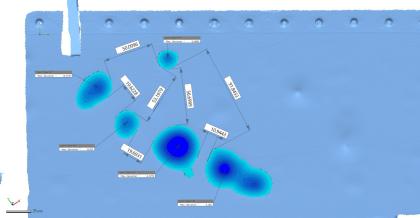
3D scanned deviation location using Geomagic Control X

Repeatable, Accurate, Mobile 3D Inspection

“We’ve been looking for a system that is easy to use for the maintenance engineer but has the ability to provide more in-depth reports if required by support staff. It must be accurate, repeatable and most of all, mobile, as AOG events can occur anywhere within our network of 136 destinations across Europe,” Knight continued. “The biggest challenge was the software side because it needed to be a simple, easy-to-use interface to obtain a basic damage report, but powerful enough to provide more in-depth details in the support offices. 3D scanning should provide us with accurate, fast damage assessment with repeatable results independent of the experience of the user.”

For these reasons, easyJet turned to 3D Systems reseller OR3D, a UK firm with expertise in 3D scanning and Geomagic software. Robert Wells, a 3D scanning expert at OR3D, reported that “based on easyJet’s requirement to quickly scan large areas — such as the entire wing length of an Airbus A320 — on the tarmac, we recommended a portable handheld 3D scanner. And we knew Geomagic Control X™ was the right software because they needed an automated way to assess dents that was easy for their staff to learn and use.” With this solution, performing a damage assessment on the roughly 70 feet (21 meters) of an A320’s flaps takes just a few hours, compared to several days with wax rubbings on tracing paper, saving easyJet tens of thousands of Pounds/Euros per damage event.

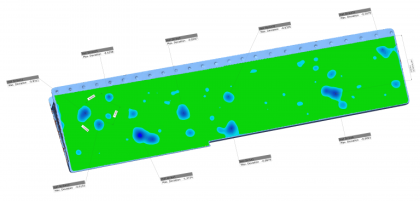
Geomagic Control X inspection shows dent locations to easyJet quickly and accurately

Instant Reporting for Fast Documentation

Once the scans are complete, easyJet engineers can get damage reports from Geomagic Control X software on the spot. They don’t need to load CAD models or align the scan data to anything else in the software, and they don’t need to have deep metrology expertise to get reliable output. Control X uses its CAD engine to automatically create idealized geometry that meets standards for surface continuity that are defined by Airbus, and measures the scanned aircraft against that idealized geometry to provide instant results. Within minutes, easyJet engineers have a consistent, repeatable, and thoroughly documented initial damage report that lets them decide what repairs, if any, are needed before the aircraft can be placed back into service.

Powerful 3D Inspection That’s Easy to Learn

easyJet has embraced Control X for large-scale damage assessments because it’s so accessible for busy engineers with many other responsibilities. Knight remarked on this specifically, saying “engineers will not use the system if it is too complex and requires in-depth software knowledge and/or extensive training.” Control X fulfills these requirements better than any other scan-based inspection software because it’s intuitive, easy to learn, and powerful enough to handle complex measurement scenarios. Anyone familiar with using 3D software can pick up Control X and get results in a matter of minutes, with the flexibility to measure what they need to, without pre-programming or inflexible macros.

What does this new, modern approach to damage inspection mean for easyJet? “We have estimated an approximate 80% savings in time to perform assessments using the 3D systems we currently have with a potential 80% savings in currency terms,” says Knight. There are additional benefits beyond reduced AOG time and better decision-making regarding repairs as well: keeping detailed damage reports, complete with accurate scan data, can help the company years from now when it comes time to sell or return aircraft to their leaseholders.

easyJet’s use of Control X is another example of how simple, intuitive inspection software helps companies ensure quality everywhere by empowering more people to measure more things in more places. Learn more about Geomagic Control X today.

×