
 admin
admin 
Last Wednesday, February 17, we had our first virtual 3D workshop given to teachers, coordinators, researchers and directors of the different institutions in the country

Goaltech aims to contribute to the development of clients and partners. Our purpose with the institutions is to support them in all their digitization processes so that they can bring the best tools to their students, with academic packages that are best adapted to achieve their digital transformation.
We thank all the participants and we hope to continue conducting this type of workshop with you. If you are interested in our participation in your institution, please send us a message and we will get in touch as soon as possible so that we can continue working together.
Product: TEAMCENTER
Industry: Aerospace and Defense
Using the Teamcenter solution for Reporting and Analytics, ATK pulls information from multiple enterprise systems, providing intelligent insight for smarter decisions.
ATK is a premier aerospace and defense company with approximately 17,000 employees working throughout the United States, Puerto Rico and internationally. The company develops and manufactures highly engineered materials and products that support mission-critical applications for its defense, aerospace, and security and sporting customers.

ATK’s business objective is “Innovation Delivered.” To fuel innovation, the company has fully embraced a product lifecycle management (PLM) strategy across its divisions and value chain. Siemens Digital Industries Software solutions – NX™ software, Tecnomatix® software and Teamcenter® software – form the foundation of ATK’s PLM strategy, which spans the product lifecycle. “Our use of PLM extends from portfolio management, to gathering requirements, and then using those requirements throughout all the organizations inside ATK, and even our supply chain outside of ATK, to deliver products that meet our customers’ needs,” explains Jon Jarrett, director of engineering processes and tools at ATK.
ATK’s PLM database contains a wealth of product and process data, yet it is just one source of information that managers tap as they carry out their programs. Other relevant data resides in financial systems, the company’s enterprise resource planning (ERP) system, the company’s scheduling system, and so on. With critical business information segregated in “silos,” it had become difficult to answer common business questions such as, “What is my first-pass yield?” or “How many documents are needed to support this program and will they all go out on time?”
ATK had been answering such questions by assigning a person to comb through the relevant databases, contact the appropriate people, and prepare a report. Some of thosead hoc reports required as many as 80 hours to generate. And while the company was able to get answers to specific questions this way, managers were not able to use data easily or proactively. In fact, many had created their own spreadsheets and other documents for tracking programs and processes. “People were doing duplicate work and there was no consistent format for those documents,” says Jarrett. “And people were constantly being pinged for information. Those interruptions are very detrimental to productivity. We wanted more efficiency in getting the data out, and we wanted it displayed in a way that everyone could benefit from.”
A business intelligence (BI) solution – software designed to identify, extract and analyze data – seemed to be what ATK needed. The company’s first use of a BI solution for PLM data, however, was a failure. “We went down the path with a certain BI solution to pull PLM data, but it couldn’t understand PLM data models or security rules,” says Paul Nelson, PLM architect at ATK. “We didn’t want people to see data they shouldn’t have access to. We wanted to be able to mine that data for gold, but not make it a free-for-all.”
Next, ATK tried the Teamcenter solution for Reporting and Analytics, which turned out to be a much better solution. Not only is Reporting and Analytics able to work with the Teamcenter data models and security rules, companies can utilize it to extract information from multiple sources, including commercial applications like ATK’s financial systems as well as home-grown programs. In addition, with Reporting and Analytics, users can aggre-gate data from multiple sources into reports and dashboards. Users can explore varying degrees of lower-level data to understand project specifics or higher-level data to get the big picture. ATK’s reports and dashboards typically contain three categories of information – for executives, managers and individual workers.
“Using Reporting and Analytics, we can quickly pull out data that helps us run our business,” says Nelson. “We’re getting gold out of that data now. It’s unlocked, and it can be presented in a way that people understand immediately.” For example, ATK has established a Science and Engineering dashboard that is accessed through a SharePoint portal. “With just a glance, people can see that screen is red or green, and know the status immediately.”
A dashboard showing costs and schedules is displayed continuously on a big-screen TV in a well-traveled place where everyone can see it. In addition to dashboards, ATK has used Reporting and Analytics to develop a number of highly useful reports. This work is done by Tim Gleason, an ATK software engineer, who is now handling a volume of work that required four people previously. “Tim can barely keep up with all the requests for reports, which come from managers and occasionally even from customers,” says Jarrett. “But we used to have four people doing this work. Now it’s just Tim. The others have been reassigned.” Reporting and Analytics’ tools allow Gleason to create reports much faster than anyone could previously, and he appreciates the fact that he can easily arrange the information in any format anyone requests.
A great example of the kind of “gold” that ATK now easily mines from its business systems is one called the “Automated Requirements Volatility Metric (ARVM)” that draws from Teamcenter System Engineering data. “One of the predictive metrics established by the International Council on Systems Engineering (INCOSE) to determine program success is how often requirements change during the life of the program,” explains Nelson. “You’re not going to have a successful program if you’re trying to hit a moving target. The ARVM reports track how many of those baseline requirements are changing on a monthly basis. If they are changing more than a certain threshold, the screen turns red. It’s a way for a program manager to monitor the health of the program.” ATK did track this information in the past. In fact, they had assigned one person to gather data and provide the monthly report. That person has been reassigned.

Other reports used at ATK include one that lets people see all the items they have due within a certain timeframe. “Typically people just get the hammer when they’re behind. This shifts the focus from firefighting to being proactive,” says Nelson. Another report shows managers how many documents must still be completed for a given program. By combining information from the PLM system and the scheduling system, this report can also tell the manager exactly how many hours are needed to complete that work.
In general, the deployment of Reporting and Analytics has made everyone, from executives to engineers, more efficient, according to Jarrett. “People are not being bugged all the time, and they’re not having to do their own Excel reports,” he says. “We are saving thousands of hours this way.” Another advantage of the Teamcenter solution is that information is more current. With reports that formerly took up to 80 hours to create now avail-able automatically, many reports are generated on an hourly, daily or weekly basis rather than monthly. This real-time visibility helps drive data integrity and accuracy. Finally, ATK is seeing its executives take greater advantage of the information in the company’s enterprise systems. “Sure they could do an advanced search of a database, but they are too busy for that,” Nelson explains. “If you break down the barriers, as we have done by giving them a dashboard that’s very graphical and user-friendly, you get more leadership engagement with the data.”
Product: DMP Print
Industry: Medical
NuVasive saw an opportunity with additive manufacturing (AM) back in 2015. The orthopedic device company recognized that the unique capability of AM to produce complex and optimized shapes could open new avenues in its design and manufacturing of minimally invasive, procedurally integrated spine solutions. The only snag was that no one at the company possessed AM experience.
NuVasive knew that it needed to partner with a service and manufacturing provider for the AM process. The result of that ultimate collaboration was that NuVasive quickly capitalized on the advantages of AM, going from design to market in just over one year with the 2017 launch of Modulus®—now a full implant line.
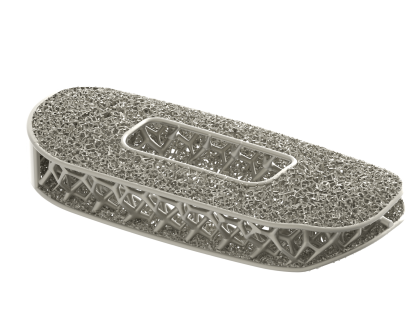
Even accounting for the talent and expertise housed within the NuVasive team, hard work combined with strategic innovation allowed the company to successfully design, qualify and bring to market an optimized family of AM implants in 14 months. If this were a subtractively manufactured product, this would be no surprise: NuVasive has a 180,000 square-foot manufacturing facility in West Carrollton, Ohio, where it performs traditional manufacturing day-in and day-out. AM is another story, and the novelty of the approach to the company and its workforce presented unique challenges.
Realizing that they needed outside counsel, NuVasive first identified several topline criteria for selecting its AM expert. The quality and reliability of the available 3D printing technology were both non-negotiable. The company needed software application support to effectively manufacture a novel device. Lastly, it sought a partner that had credibility within the AM industry and could grow alongside NuVasive.
“We were not willing to take any risks in this regard,” said Jeremy Malik, Director of Product Development at NuVasive.
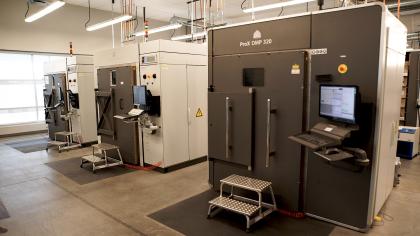
After conducting thorough research, NuVasive chose 3D Systems, with its Direct Metal Printing (DMP) technology and team of application engineers and AM experts, to commercialize Modulus.
The design philosophy behind the Modulus line was to utilize new technology in a meaningful way to deliver a final product that is innovative, as opposed to new. According to NuVasive, the company’s goal was to provide the optimal spinal implant without making significant tradeoffs in the process.
The Modulus line balances porosity with load sharing, and each independent SKU is optimized for improved radiolucency. This was achieved through topological optimization, an algorithm-based design strategy that removes excess material that serves no structural or functional purpose. A component that has been topologically optimized is lighter-weight with no adverse impact on strength. In the case of the Modulus line, topological optimization also facilitates better imaging characteristics across all shapes and sizes of implants, giving surgeons a better view into bone fusion during follow-up. In addition, the optimized lattice structure provides a fully porous architecture that creates an environment conducive for bone in-growth.
“We wanted to do things we couldn’t do before,” Malik said. “There is more to this device than simply utilizing a new technology to bring it to market; we used new technology to help drive improved clinical outcomes for patients.”
Together, the two companies generated a number of file iterations for different ways that the desired devices could be printed, and 3D Systems provided critical industry expertise on print strategies, metallurgy and residual powder removal, among other unfamiliar but impactful AM aspects.
“We didn’t know what we didn’t know,” Malik said. “3D Systems helped educate us on the additive process and worked with us to iron out our process beyond just the printing. We had a lot of open dialogue, and that communication was key to our success.”
Through the process, NuVasive leveraged 3D Systems’ Customer Innovation Centers (CICs). These facilities, and access to the expertise housed within them, provide an ecosystem of AM solutions that include design and manufacturing capabilities, along with premium hardware, software and materials. Covering everything from application development and frontend engineering, to equipment validation, process validation, part qualification and production, 3D Systems’ CICs help companies with various experience levels accelerate innovation through additive technology.
From design to production, NuVasive was able to capitalize on what the technology had to offer in terms of improved functionality without making large initial investments.
The two companies also collaborated beyond design optimization to achieve a qualified AM production workflow. Notwithstanding NuVasive’s track record in earning FDA clearance on products made with traditional manufacturing, using a new process introduced unique regulatory challenges.
According to Malik, NuVasive addressed those issues by leveraging 3D Systems’ data on manufacturing reproducibility in order to bolster its justifications in its FDA submission.
“3D Systems had customers who cleared devices through FDA in the past, so we knew we partnered with someone who had in-house expertise to help us navigate these requirements,” he said. “That was a nice safety net.”
Fast forward to today, NuVasive is a spine leader in AM with a fully 3D-printed family of FDA-cleared spine implants on the market. The Modulus line is the result of thoughtful design, and balances the benefits of porosity and performance requirements of interbody fusion devices.
In the end, it took NuVasive roughly 14 months to go from concept to commercialization with its Modulus product line. Although this is a fairly standard timeline for traditional manufacturing processes, the company was excited that it was able to maintain the same pacing in its first application of AM.
“It is a significant undertaking to build your production process in addition to designing and building your product,” Malik said. “We were proud we had the ability to develop both, and relied on 3D Systems to help build out our datasets and justifications in order to get us to market.”
As to product manufacturing and deployment, 3D Systems provides supply chain flexibility and fulfills volume production orders internally or through certified partners, as well as helps customers transition to additive production at their own facilities through knowledge and technology transfer.
NuVasive is beginning to do its own titanium 3D printing in-house, and is using DMP technology for R&D prototyping, as well as to better understand how the machines work to continue refining its production process.
“It’s been a huge improvement for us to have that capability on site,” Malik said. “Now we have a legitimate, scalable manufacturing process and the ability for continuous improvement in the future.”
Product: HandySCAN 3D
Industry: Machinery and Industrial Equipment
The EADS (European Aeronautics, Defense and Space Company) is an international leader in the aerospace, defense and related services sectors. The company has been using Creaform’s portable 3D measurement products for several years.
More specifically, EADS uses HandySCAN as the MetraSCAN optical CMM scanner to digitize tools and composite parts (carbon/epoxy resin) and to develop comparisons between parts and CAD files. To perform probes, EADS uses the HandyPROBE optical CMM scanner. In addition to VXelements, creaform system data acquisition software, EADS also uses the VXtrack module to perform dynamic measurements, as well as VXlocate, a software module developed through a partnership between Creaform and EADS.
As part of a study on the possible geometric distortion of carbon fiber composite parts, and with the help of a HandySCAN 3D device, EADS scanned 1,000 mm x 800 mm tools, as well as 650 x 300 mm parts, in order to evaluate possible deformations after manufacture.

First, EADS scanned the tools to verify that they met the CAD plan.
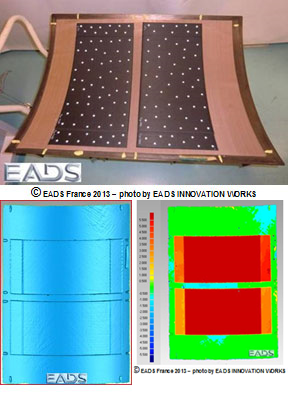
Two of the parts made with this tool were then scanned and the results compared.
The second step was to use very powerful simulation tools to calculate the distortion of the parts before they were manufactured, with the aim of comparing the files of the scanned parts.
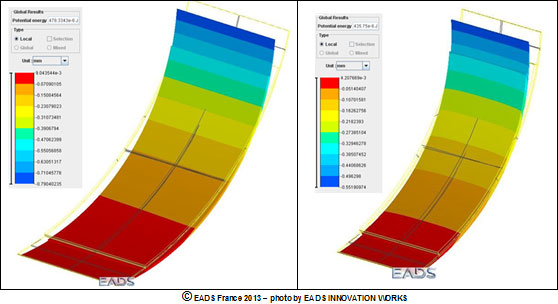
The results obtained by EADS allowed to validate the simulation software, developed to optimize the manufacturing range by identifying appropriate parameters and processes.
This project could have been carried out with a peripheral projection scanning system, but the system of these characteristics that EADS possesses cannot be used on such wide surfaces, and the process is much more complex when the two sides of the composite parts are to be measured. In addition, a CCM scanner could have been used, but this option had several drawbacks, as unique measurements had to be made which, in turn, lead to a much longer acquisition time.
“The Creaform system allowed us to quickly scan metal tools and carbon fiber composite parts. Many of the systems available on the market do not work very well with these composite parts, since they are dark in color and sometimes quite bright. The fact that the equipment was portable allowed us to perform measurements at the same manufacturing plant,” explained Catherine Bosquet of EADS’ Healthcare Engineering Department (NDT &shm).
“Before using Creaform systems we used peripheral projection equipment, as we acquired a HOLO3 system more than 15 years ago. We also tested some of the available systems (Konica Minolta, Metris, Steinbichler, Aicon, Kreon Technologies, Ettemeyer, GOM), but Creaform’s 3D measurement solutions convinced us thanks to their rapid acquisition and configuration, ease of use, performance in measuring many types of surface states and portability. He is in charge of the management, strategic direction and development of the entire Creaform Group, as well as its offices around the world.”