

Product: MJP Print
Industry: Medical and Forensic
Despite their tuxedoed appearance, penguins aren’t always well mannered. In the aftermath of one particular penguin scuffle among endangered African Penguins at Mystic Aquarium, Yellow/Purple (AKA “Purps”) was found to have a nonfunctional flexor tendon in her ankle. Much like an injury to a person’s Achilles heel, damage to a penguin’s flexor tendon leads to pain and difficulty in motion.
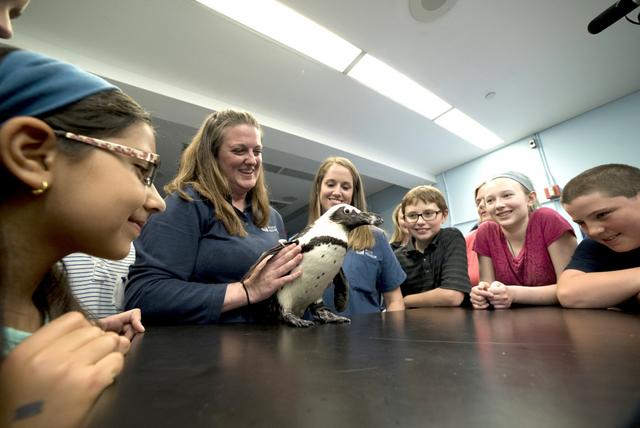
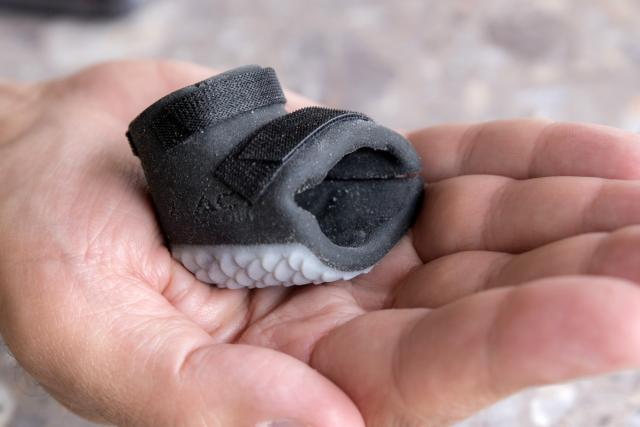
Once Purps’ injury was identified, the veterinary staff at Mystic Aquarium took action with a handmade boot to immobilize, protect and support the damaged foot. Yet the animal care team knew more modern solutions were available that would not only be more durable and less cumbersome for the small bird, but also require less time than handcrafting the boot. Mystic Aquarium’s Chief Clinical Veterinarian, Dr. Jen Flower, proposed 3D printing.
The aquarium took this idea to Mystic Middle School, which had recently acquired a 3D printer through ACT Group, a local 3D Systems partner, and the rest is history. Working as a team, Mystic Aquarium, ACT Group and the middle school students came together to design and 3D print a new boot for Purps. With anatomical guidance from Mystic Aquarium’s veterinary staff and technical training from the professionals at ACT Group, the students led the design and manufacturing process using 3D Systems’ end-to-end solutions.
In a workshop facilitated by ACT Group, the students started with 3D Systems’ Geomagic Capture® 3D Scanner to scan an existing cast of Purps’ foot and then imported the data into Geomagic® Sculpt™ software where they customized the file with details like treads, hinges and closures.
“The students amazed us in how quickly they picked up the software,” said Nick Gondek, Director of Additive Manufacturing and Applications Engineer, ACT Group. “It was rewarding to provide them with a technology that could keep up with their ingenuity, and to watch their creative thinking, imagination and intuitiveness lead this process.”
Once satisfied with the design, it was 3D printed on 3D Systems’ multi-material ProJet MJP 5600 3D printer. This printer enables both flexible and rigid materials to be printed and blended simultaneously at the voxel level for custom strength and elasticity. The resulting boot achieved the intended effect in durability, weight and fit, enabling Purps to walk and swim like the rest of her peers.
Product: Artec Eva
Industry: Automotive and Transportation
Jason Heard doesn’t lose a wink of sleep. Of the hundreds of high-performance chassis that he and his partner Jack Fisher have created over the years, not a single one has ever failed.
When it comes to what can go wrong on a car, especially as it’s racing across the landscape or around a track at breakneck speeds, aside from a major crash, most of what can happen isn’t life-threatening to the driver.
Whether a blown engine, an electrical system failure, or a transmission breakage, these events are rarely fatal. A chassis failure, on the other hand, is almost sure to be lethal.

That’s what makes modern high-performance chassis design such a demanding field. If the design is too lightweight, strength and safety are compromised. But if more material, or stronger ones, are used excessively, then performance is bound to suffer.
Achieving the ultimate strength-to-weight ratio in every project they bring to life is what Southern California chassis design specialists at Tekk Consulting Inc have been doing for years now.
Their pristine reputation in the industry as the guys who “just get it done” means booking clients months in advance and a steady flow of projects from private clients as well as the heavy-hitters in the industry, including several major OEMs, and others.
But it wasn’t always that way. Back in 2018, with more than a decade of chassis design under their belt, Tekk Consulting Inc had reached a point where even though the technical aspects of their work were unquestionably faultless, they were constantly in a race against the clock to complete their projects while maintaining the high standards they’re famous for.
At the time, adding more clients wasn’t possible, and that meant not being able to take on the volume of projects necessary to push to the front of the pack in the insanely competitive industry of chassis design.
So Jason and Jack sat down and scrutinized their workflow from A to Z. They began looking for ways to make it tighter and faster, without sacrificing quality even in the least. One of the first things they focused on was how they were measuring auto bodies, parts, and components.
The traditional method of using calipers, tape measures, and rulers was how they guaranteed that the dimensions were accurate beyond a doubt. But it’s a painfully slow process, slapping on hours and even days to every project.
When they ventured online, they started reading about auto customizers and shops using 3D scanning to replace manual measurement methods. It was saving them hours on each project, they read. One search led to another, and they found their way onto the Artec 3D website.

There the Artec Eva caught their eye. A lightweight handheld 3D scanner, Eva captures millions of points every second, in minutes creating high-accuracy 3D models of auto parts and countless other kinds of objects. So, they picked up the phone and reached out to their local Artec dealer, Artec Ambassador Rapid Scan 3D, to arrange an onsite demo.
Rapid Scan 3D’s Chris Strong recalled the visit, saying, “During the demo, we scanned an off-road vehicle to capture data of the roll cages along with the suspension. These are some of the essential areas that need precise measurements for designing and fitting Tekk Consulting’s custom parts. Some of the challenges of their work include undercuts, suspension that’s in the way, and surfaces that can be difficult to reach or measure. But with Artec Eva, it was obvious right away that they can easily capture all the data they need, including those surfaces that would be tedious and time-consuming to acquire via manual measurement.”
As Heard put it, “That was it. In the first 15 minutes of the demo, we knew that we’d found our answer. So we bought it then and there. Didn’t need any training, it’s that easy to use. We didn’t even take a peek at the manual. We just bought it and then spent the rest of the afternoon scanning everything around the shop. By the end of the day, we had our workflow down pat.”
Since that moment, Tekk Consulting Inc has used their Artec Eva every day, on hundreds of projects including Brad Deberti’s @ThePerformanceTruck, work for the top 10 automakers, as well as all kinds of classics, muscle cars, multiple SEMA projects, and more.
Heard explained, “If you ask anybody who’s anybody in this business, they’ll tell you this: your reputation is your lifeblood. For whatever reason, if that goes out the door, you might as well hang up your hat and call it quits. That means no cutting corners, because safety is everything, and never ever bite off more than you can chew.”
He continued, “Our Artec Eva gives us the power to do more and do it better than we ever did before. With no sacrifices in accuracy or safety. In fact, now we can digitally capture whatever autobody structures or part geometries come our way, no matter how complex. Fast and precise.”
Heard outlined his scanning workflow with Eva:
“For parts and components, I built a little lazy Susan (turntable) that I scan the parts on. If they’re shiny at all, I use a bit of baby powder or spray-on diffuser. That adds something like 1/5000th of an inch in surface coating, so it doesn’t affect the scan quality at all.”
He continued, “Then I just scan the part, two passes for one side, two passes for the other, just to make sure I’ve gotten everything. Then for the machine parts of the component, to get the exact spacing between bolt holes, and the holes themselves, for example, I just draw those in Geomagic Design X after measuring with a micrometer. It’s super easy and crazy fast this way.”
“When we’re scanning autobodies and cabs,” Heard said, “we typically scan in one major ‘geometry pass,’ which means grabbing the big structure. After that, we’ll come back and scan chunks here or there. Then we align these with the scan from the first pass. After this we process the scans in Artec Studio.”
He explained his process in Artec Studio software: “I use the Eraser tool, which lets me easily swipe out anything I don’t want. The base of the lazy Susan, any props, etc. Depending on how much time I have, sometimes I do an auto-alignment, or do it manually, and then after everything’s aligned, I’ll do a Global Registration, etc.”
“But on big cabs and structures, I don’t do Global Registration, I just stick to Sharp Fusion, because that works perfect to keep everything together, looking as sharp as a tack.”
After that, they export the scans over to Design X/SOLIDWORKS 2020, where they start drawing the chassis.
Eva made it possible for Tekk Consulting Inc to maximize the space within the truck (@ThePerformanceTruck), “where the chassis tubes are so perfectly laying against the skin of the truck,” and it also means having extra space within the cab, so your head is far enough away from the chassis itself. As a safety factor, in Heard’s words, “That’s huge.”
In the unfortunate event that the car or truck were to roll over, you always want to have enough distance between you and the chassis. With Eva, they have been able to maximize that to the fullest. “And that’s an epic plus for us. It’s a direct result of having a perfect scan of the body of the car or truck, which then lets us design a chassis that fits it like a glove.”
Every auto customizer who’s ever needed CAD files from an OEM knows about the at-least-occasional frustration of waiting and waiting for them to arrive. To make it worse, when project deadlines are looming closer, and clients are calling you every day, that’s when patience wears thin.
As Heard put it, “If we had to wait around for CAD files before getting down to work, there’s no way we’d be able to achieve the tight deadlines we have, no way. So now we don’t have to wait. We just scan it ourselves, whether it’s a Porsche or a Toyota or a batch of parts, whatever.”
He went on, “And when we compare our scans with Eva to the CAD files that eventually show up? Wow! You wouldn’t believe how closely they match up. Every time. At first we were surprised, but after hundreds of projects, we’ve gotten used to it. Now we don’t even wait for CAD files. We just scan and get down to work. That alone has saved us days of waiting.”
As far as working with classic cars go, rarely if ever do such CAD files exist. That’s when 3D scanning can be a pivotal factor in moving forward on a project. Heard explained, “With Eva, I can scan parts or entire bodies of classics. Then that scan is mine. And it’s perfect to a T.”
He went on, speaking of the possibilities, “I can transform it however I want in Geomagic, 3D print or CNC mill it, or sell it online to one of thousands of shops around the world doing this kind of work. Shops with one, two, or three guys who are fabricators or builders that put out maybe 10 to 20 cars a year, that’s 90% of the industry right there.”
In regards to factory tolerances as part of the manufacturing process, these are also apparent when 3D scanning cabs and bodies straight from the assembly line. According to Heard, “It’s a known fact that CAD files from the OEM don’t take into account manufacturing tolerances. They just don’t.”
He elaborated, “If you’re working with an American car, you could have a 1/4” deviation, and that would be acceptable. On a really expensive foreign car, for example, it’ll be maybe 1/8”. Our scans with Eva are so much tighter than that. So when we see differences between the 3D scans and the CAD files, we take those tolerances into account.”
In terms of being able to scan more in one day than he could ever measure by hand, Heard weighed in, “To give you an example, just yesterday morning I scanned the front suspension for a brand-new Raptor, 360 degrees, everything. Then I scanned five different race seats, added in the mount geometry, and now the scans can be brought into any CAD file when we’re drawing a chassis, so these seats will be perfectly mounted.”
Tekk Consulting Inc has embraced 3D scanning with Eva so fervently that they’ve begun selling their scans online via their digital marketplace at DIYoffroad.com. Over the years they’ve been contacted by hundreds of auto customizers and chassis designers in dozens of countries around the world. And the market is only growing bigger with time.
Heard has been recommending Artec Eva to everyone he can in the industry, without pause. In his words, “I’m totally fine with sharing what we do here. Including details about the amazing tech that we’ve been using. A huge thanks to our Eva, we are where we are today, with a backlog of work and the ability to pick and choose our projects.”

Jason Heard envisions a future where, “Every auto shop and designer is going to have their own 3D scanner and 3D printer. The market is already moving in this direction. That’ll mean specialists around the world creating digital assets, using them right there in their shops, or selling them online to other guys.”
He explained further, “An example of what that can look like is this: some guy in Italy takes his Eva and scans a brand new Ferrari, or a classic one, along with whatever parts he wants, fenders, bumpers, etc., and then even hours later he bundles everything together into one package, or customizes it and turns it into a wide-body kit.”
Another facet of the high-performance design work that Tekk Consulting Inc does is Finite Element Analysis (FEA) on scanned components, usually through the thin-shell approximation. This entails capturing the precise dimensions of parts and then analyzing their mechanical strength and stiffness, or how much they can bend and what that deflection looks like in CAD. This process allows them to redesign a component to address a failure point, while ensuring the component performs the same as, or better than, before.
In the past that required hand measuring these components, which often took hours, including double-checking and re-measuring.
But now with their Eva in hand, they’re precisely capturing such parts in minutes. From control arms to swivel joints, roll bars to entire suspensions and more. No re-measuring or second-guessing needed.
Heard explained why that’s so crucial, “It doesn’t matter how amazing your FEA is, if the data going in is flawed, even by just a fraction of an inch, that’s a recipe for disaster. There’s no way you’re going to accurately be able to mathematically bend and twist those components to prevent failure and increase performance. No way.”
He continued, “Our Eva has been such a game-changer for us in this. Now I’ll take a bunch of parts and scan them in before lunch. By the end of the day, we’ve done all our analysis and everything is smoothly on schedule to create the final design.”
To summarize the impact that Eva has had on their work, Heard added, “When you’re trying to build a race car and you have a phase that used to take you 14 to 16 hours in the past, and now it takes you just 2 to 3 hours, that makes a massive difference to us, and that’s not even touching on the accuracy and safety angles of what 3D scanning with Artec Eva has given us.”
Product: NX CAD
Industry: Electronics and Semiconductors
Leading lithography machine maker uses certification to work more effectively and improve quality with NX CAD
Employees are every company’s true capital. Making the most of this capital requires continuous development in every area of competence. High-tech company ASML is more aware of this than most other firms. Working on staff development to bring know-how to the highest possible level – and keep it there – is common practice at ASML.ASML is one of the world’s leading manufacturers of chip-making equipment. The company invents, develops, manufactures and services high-tech lithography, metrology and software solutions for the semiconductor industry to enable ever smaller, cheaper, more powerful and energy-efficient semiconductors. This results in increasingly powerful and capable electronics that enable progress within a multitude of fields, including healthcare, technology, communications, energy, mobility, and entertainment. ASML is a multinational company with over 70 locations in 16 countries and employs more than 14,000 people. The company uses NX™ software from product lifecycle management (PLM) specialist Siemens Digital Industries Software for computer-aided design (CAD).

Knowledge development encompasses more than traditional expertise, it also incorporates knowledge of the software used in product development. But how do companies determine if the right knowledge is available and whether it is being applied? “Knowledge and skill are influential in two important ways,” says Denis Loncke, group leader, mechanical development of the wafer stages, ASML. “First, they help users perform their tasks faster and, second, they improve the quality and stability of the NX CAD data, including models, assemblies and drawings.” ASML machines are utilized to the greatest extent possible and kept up-to-date by ASML technology experts during their life-span. “That means the NX CAD data has to be rapidly understandable to all engineers. This is achieved through a structured process and correct usage of the NX design software,” notes Loncke.
To determine whether knowledge and skills are at a sufficiently high level and being applied correctly, ASML needed a measurement method. “Our Siemens Digital Industries Software training manager came up with the idea of introducing certification,” says Loncke. “We thought an exam would be too perceived as a performance review.” Instead, ASML’s top management wanted to help employees develop and progress within the organization. The case studies that allow employees to earn certification are jointly developed by Siemens Digital Industries Software training staff and key engineers from ASML. These incorporate specific software features that ASML uses on a daily basis. Skill assessment matrices are also written entirely in collaboration to eliminate different interpretations of the assessment.
“For an initial pilot project, nine engineers were invited to participate in a certification process,” says Loncke. “The results varied greatly and were, in some cases, really sub-standard. However, it was always clear to those taking part that the result in itself was not relevant. It serves as an intake, so that appropriate training can be provided for the focused development of knowledge and skills.” Certification exercises and assessment matrices are divided into a number of modules: Teamcenter® software integration for NX, NX modeling, NX assemblies and NX drafting. Each user must score a minimum number of points on each module. If the minimum score is not achieved, training is required.
Because roles within projects can vary strongly, approximately 750 employees at ASML will be eligible for certification. The remaining NX users work at the concept level and do not create NX CAD data used in product development.
Processing these numbers requires considerable effort. “Within ASML, we took care of coordinating certification of internal staff,” says Loncke. “We proposed a date to everyone on which they could take the three-and-a-half-hour certification, within a four-week deadline. Some flexibility was required, but all involved did their utmost to make this work.” As a result, all certification could be completed in the short period between October 2013 and April 2014. Certification of so-called “farm-out” companies started in April 2014. These farm-out companies take care of certain development tasks for ASML. Siemens Digital Industries Software is responsible for all planning and implementation, including the financial arrangements. “Siemens Digital Industries Software has taken a lot of work off our hands.” says Loncke.
Training requirements are met with Siemens Digital Industries Software’s standard training offering. No ASML-specific components are included. Many farm-out companies have been asking for employee certification of their own accord in a proactive approach that emphasizes the quality of their cooperation with ASML.

One-off certification is not sufficient to secure and embed practices and knowledge in the organization. “We won’t be checking the engineers’ daily output to see whether they’re working according to the defined processes,” says Loncke. “These should be second nature. With NX Checkmate validation tools, we do have a control model available, but this is geared towards standards compliance of models and drawings. Guaranteeing that processes are fully embedded will be realized by repeating the certification every two years.”
Reactions from participants and management have been extremely positive. Even very experienced users who trained to pass the certification test remarked that they had learned a great deal. “Certain people scored 100 percent in all areas,” says Loncke. “They have been lauded for this. Their NX knowledge and skills perfectly match the job they have to do.”
Responses from certification participants have also included proposals for improvement of the roll-out of new versions of NX within ASML. In addition, input on the operation of NX has also been collected. This input has been evaluated by Siemens Digital Industries Software representatives and addressed in the development of NX.
The key benefit of certification is increased productivity. “We already knew the indica-tors before and after certification from the pilot,” says Loncke. “After training and recertification, engineers were, on aver-age, 50 percent more efficient with NX and Teamcenter.” That metric was specifically derived from exercises not completed on time, and the use of prolonged work-arounds. “After the training, exercises were completed within the allocated time and engineers went straight for the best solution using the right features,” Loncke continues. “We have calculated the return on investment and arrived at a business case that unequivocally supports the value of training.”
Product: Tecnomatix
Industry: Aerospace and Defense
Global aerospace engine supplier deploys Siemens solution to identify production bottlenecks and lower costs
GKN Aerospace Engines, a business line of GKN Aerospace, needed a better tool to plan and optimize their production process and production equipment investment, a tool that would aid in strategic planning, and handle real life complexity to accurately predict lead times and consider variation. GKN Aerospace needed a new avenue to meet customer delivery expectations and identify any existing problems that could be solved before they became unmanageable. In addition, some value streams share production resources between different products, which cause crossing material flows. The production complexity and the daily base decision making, impact the lead time, and created an opportunity for a simulation-based approach, to support a continuous improvement. This led GKN Aerospace to believe that discrete event simulation would perfectly support the company’s different initiatives.

Recognizing a clear need to make their cur-rent processes more efficient, while also considering expected future production volume increases, GKN Aerospace decided to conduct a pilot program using Plant Simulation in the Tecnomatix® portfolio. Plant Simulation enables users to define a virtual model of a production plant, with all its characteristics and inter-dependencies, and use it to simulate actual production. Tecnomatix is a part of the Xcelerator™ portfolio, a comprehensive and integrated portfolio of software and services from Siemens Digital Industries Software.

“We started to use Plant Simulation as we needed a better strategic planning tool to analyze and plan production capacity,” says Alexander Hall, MOM-MES Architect, GKN Aerospace Engines Business Line, TI-IS. “Given the combination of increased fore-casted production volumes and the complexity of our production process, we have realized that the static capacity analysis tools we were using were not accurate enough.”
The Plant Simulation pilot project was conducted at GKN Aerospace’s plant in Kongsberg, Norway. This plant was selected for the pilot, as production volumes of their TEC/TRF product family were expected to grow significantly, creating the need to conduct a production analysis and adjust the product system to the new expected volume. The engineers in the Kongsberg plant possessed basic experience with discrete event simulation tools before starting the Plant Simulation project. One of their main goals in this virtual production project was to analyze value streams (value stream is GKN Aerospace’s terminology for a product family and its production process) and identify potential problem areas (bottlenecks, which machines are not being properly utilized, etc.) for improvement.
Production simulation with Plant Simulation can consider the effect of variability, an important factor that strongly impacts plant performance. In Kongsberg they have planned and unplanned variability. Examples of unplanned variability include machine failures, lack of material from suppliers, and non-conformance. In an environment with a lot of uncertainties, the simulation is a robust production digital twin that takes into account these issues and, in turn, improves decision making in the areas of machine investment and process improvement. Simulation is also a major component of GKN Aerospace’s digitalization initiative.


GKN Aerospace created a simulation model with Plant Simulation, simulated real-life historical production scenarios to validate the model accuracy, and used the model to test future production volume increase scenarios and options. In addition, the capability of Plant Simulation to visualize the production process in a dynamic 3D environment was powerful as it helped GKN Aerospace’s employees to better understand the layout, production process and material flow.
The Plant Simulation pilot project had three main targets: evaluate the applicability of Plant Simulation for GKN Aerospace, pro-duce a simulation template that will ease the use of the simulation tool in other pro-duction sites and analyze the expected volume increase in one of the plant product families (or value streams). All three targets were met successfully with Plant Simulation.
Another, somewhat unplanned benefit, obtained from the Plant Simulation pilot was that it gave GKN Aerospace a better understanding of how production related data is handled within the company, allowing them to identify several potential areas of important improvements in systems integration and data flows.
Finally, all the insights obtained with Plant Simulation were gained through the creation of a realistic production digital twin model without interfering with the actual production.
“We have a lot of planned and unplanned variability in our plant,” says Ragnhild Hansen, technology/project engineer, GKN Aerospace Kongsberg site. “For example, handling non-conformance is an unplanned activity that has a strong impact on our pro-duction performance. Plant Simulation helps us analyze the impact of variability on the plant performance, as otherwise it’s almost impossible.”
Martin Asp, MOM-MES Architect, GKN Aerospace Engines Business Line, TI-IS says that GKN Aerospace’s production system is very complex and includes variability in both volume and product mix. “It’s a system within a system , with a lot of interdependencies, which makes it challenging to analyze without a suitable tool,” he says. “As such, we have found Plant Simulation is a tool that can handle this complexity and highlight beneficial insights.” GKN Aerospace also used the unique capability Plant Simulation possesses to represent material flow paths and volume with the Sankey Diagram to help demonstrate to their management team the complexity and many interdependencies of GKN Aerospace’s production and material flow. In a Sankey Diagram, the width of a line represents the volume (material or technicians) flowing or moving in this route (a similar concept is common in train or subway maps). An example for the importance of material flow paths analysis is the single heat treatment work cell, which supports several value streams.
Plant Simulation showed GKN Aerospace’s production team that facility equipment breakdown and maintenance was impacting production of their leading turbine rear frame product by only four percent, which contradicted their original projections. On the other hand, Plant Simulation revealed that manual production impacts 72 percent of the lead time, clearly showing where optimization can be most impactful for GKN Aerospace. “We realized we needed to change the static production analysis we were doing to a dynamic one, so we started to use Plant Simulation,” says Mikael Carlsson, MOM-MES Manager, GKN Aerospace Engines Business Line, TI-IS. “We decided to include non-conformance processes in our simulation model. Predicting lead times for rework orders is a challenge for our business. Using different scenarios in Plant Simulation we can see the impact on lead time of different types of rework. By using Plant simulation we were able to identify a bottleneck caused by rework in combination with main production flow. We resolved this by adding a new workstation.” With Plant Simulation, GKN Aerospace can simulate an entire production line and come up with concrete conclusions to potential performance improvements. Such a dynamic simulation considers pro-duction and material flow dependencies between machines and production cells.
“We found the capacity and utilization results obtained with Plant Simulation were 30 percent more accurate than our previous methods,” says Hansen.
The Plant Simulation pilot project provided GKN Aerospace with a software tool that can handle its strategic target to reduce pro-duction lead time with the expectation it will ultimately result in a competitive advantage since Plant Simulation assists with testing and validating production scenarios, saving time and money.
GKN Aerospace also used Plant Simulation to calculate production capacity and visualize the material flow. The simulation also helped easily identify bottlenecks as GKN Aerospace can run Plant Simulation for any production period (for example, one week). Plant Simulation also helped GKN Aerospace plan production shifts and answer operational questions. “Following the comprehensive Plant Simulation pilot we have conducted in our Kongsberg plant in Norway, we were convinced that Plant Simulation can be used to create a simulation model of our aerospace engines pro-duction processes,” says Karl-David Pettersson, SVP Engineering & Technology, GKN Aerospace Business Line. “It helps us optimize production processes, better utilize our production assets, validate the material flow, reduce WIP and determine when we have to purchase new production equipment to increase production capacity.”
The project was carried out with the support of Siemens consultants, which helped GKN Aerospace to ramp up with Plant Simulation. At some point, a simulation need arose from their U.S. production site as GKN Aerospace was planning to change the product flow and wanted to understand the impact on the delivery to customers. GKN Aerospace engineers built a simulation model to support this, on their own, with-out the help of the Siemens consultants, which was a good sign for the GKN Aerospace ramp up with simulation skills.
Jonas Steen, Director of Technology Insertion Information Systems, GKN Aerospace Engines Business Line, concludes, “GKN Aerospace Engines Business Line produces complex products with exceptionally high quality requirements in a low volume, using very expensive equipment, which is sometimes used for various products. The combination of all this creates a very complex production scenario, such that only an advanced simulation tool like Plant Simulation can handle this complexity.”
To have a more successful buy in of the innovative methodology Plant Simulation offers, the project team made sure to involve the plant production people in the activity. Such an example is the involvement of Daniel Bryn, a shaft value stream manager in the plant, who believes Plant Simulation is an essential means to reduce production lead time, which is a strong initiative. An example of an important simulation need that came from his value stream is the analy-sis of the paint shop area. As the paint process includes a lot of diversified pro-duction processes, it’s not completely straightforward to understand the flow and dynamics within this area, and there was a feeling that only the people that worked there can really understand and optimize it. He asked to analyze how to increase the rate of shafts processed in this area, without increasing the man-power, and indeed, such a simulation was done, revealing promising insights.
In another simulation project for this value stream, they evaluated the intro-duction of an entire automated cell for shafts (robotics material handling, auto-mated turning milling machine, etc.). Plant Simulation helped analyze how the new machines would impact the production sequence, helped compare it to performances of similar machines they already had, and showed how this would impact the existing machines in the line. This activity also proved that GKN Aerospace can reuse a simulation model from one value stream to another.

Plant Simulation also provides value with customer-related scenarios, allowing GKN Aerospace to showcase their innovative production process. “Plant Simulation can be used to show the customer an active production line or a planned concept of a production line in a very dynamic and visualized manner that highlights GKN Aerospace’s innovation,” says Bryn.

As a result of this pilot project, GKN Aerospace can use Plant Simulation in various areas, such as supporting lean manufacturing. Plant Simulation helps GKN Aerospace better understand their value streams and the vast amounts of data the company isn’t fully utilizing. The pilot project also offered GKN Aerospace significant transparency into their production facility and allowed them to better under-stand their processes. Plant Simulation is used both for completely new processes and value streams (greenfield areas), but also to support (continued) improvement of existing production processes. In addition, a few new potential simulation initiatives with Plant Simulation were identified, such as shop floor production space analysis, operational process planning, supporting bid processes and others.
GKN Aerospace also has some thoughts on how they can use Plant Simulation to cope with the new challenges the COVID-19 pan-demic presented. For example, the production digital twin created with the simulation can be used for a lot of virtual reviews and reduce face-to-face interaction of employees. Also, the visualization and simulation of a production line helps to understand the production flow, almost as if you’ve visited the line.
“We have learned that Plant Simulation is a great simulation tool that supports our expected production volume change,” says Pettersson. “It certainly proved its value.”