
Recreational vehicle manufacturer digitalizes concept of camper van

Product: Solid Edge, Teamcenter
Industry: Automotive and Transportation

Using PMI has turned deriving individual variants into configuration. It has reduced the time required by 65 percent.

Stefan Ziegler, Head of Industrialization R&D,

Freedom and comfort combined

Camping has been a popular outdoor recreational activity and a mode of accommodation for decades. In many countries, it is a substantial contributor to the tourism industry. The activity offers some of the most affordable lodging options. According to the Statista platform, about seven percent of all tourists visiting Germany in 2020 preferred camping over hotel accommodation. As the use of tents has significantly decreased over the past decades, recreational vehicles (RV) such as caravan trailers and motorhomes have become more popular. They provide campers with home-level comfort such as living areas, kitchen facilities and bathrooms.

Located in the spa town of Bad Waldsee in Southern Germany, Hymer GmbH & Co KG (Hymer) is among the pioneers of RVs. The company produced its first caravan trailer in 1957, followed by the first German motorhome in 1961. Hymer has become a household name emblematic for an entire vehicle category in Europe. The company is part of the Erwin Hymer Group and also designs and manufactures trailers under the Eriba brand. The Erwin Hymer Group belongs to the Thor Industries family of companies, uniting the vast majority of European and North American RV manufacturers.

Hymer has become an innovation and technology leader in the motorhome segment, combining innovation with Swabian virtues such as attention to detail and quality and made in Germany workmanship standards. “The five centimeters (two-inch) side walls combining aluminum skins on closed-cell PU provide insulation comparable to 80 centimeters (2 feet and 7 inches) of brick wall,” states Frank Heinrichsen, marketing manager at Hymer.Hymer engineers in all European locations use Solid Edge for CAD.
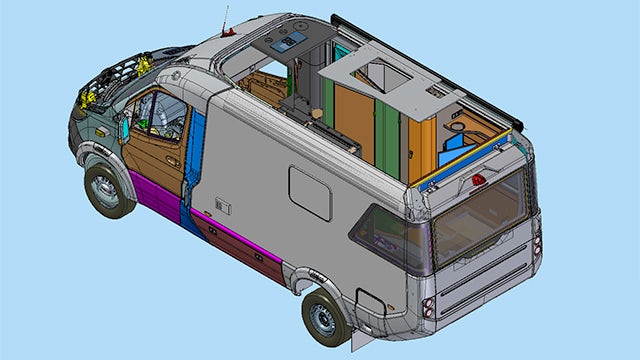
Hymer engineers in all European locations use Solid Edge for CAD.

Fully digitalized product creation

Hymer engineers designed the VisionVenture, a concept camper van, by weaving a digital thread along the entire product design process. As in all their designs, they created a comprehensive digital twin of the vehicle using software from the Siemens Xcelerator portfolio, the comprehensive and integrated portfolio of software, hardware and services.

For computer-aided design (CAD), Hymer engineers in all European locations use Solid Edge® software. For VisionVenture, they imported models that an external industrial designer had created using NX™ software. “Solid Edge has a supportive user interface, so it is easy to learn; new colleagues only require minimal training,” says Stefan Ziegler, head of industrialization research and development (R&D) at Hymer. “At the same time, this 3D CAD software has everything we need to create a comprehensive digital twin of the vehicles, including powerful tubing capabilities.” In Hymer camper vans, fluid tubing and electrical harnesses play a key role. For designing and routing those, they rely on the Solid Edge Xpress Route 3D routing application.

The design engineers verify the structural integrity of our designs using finite element modeling (FEM) analyses. For everyday basic verifications, they use the capabilities of Solid Edge. More in-depth stress analyses are outsourced to The Team Technology (TTT), an automotive lightweight construction department in the Erwin Hymer group. They use Simcenter™ 3D software for FEM analyses. This two-stage verification process establishes a knowledge gain during the early phases of product design, reducing the number of physical prototypes required.The design engineers use the FEM capabilities of Solid Edge to verify the structural integrity of their designs for everyday basic verifications and outsource more in-depth stress analyses to a specialized internal department in EHG (The Team Technology; TTT) using Simcenter 3D.
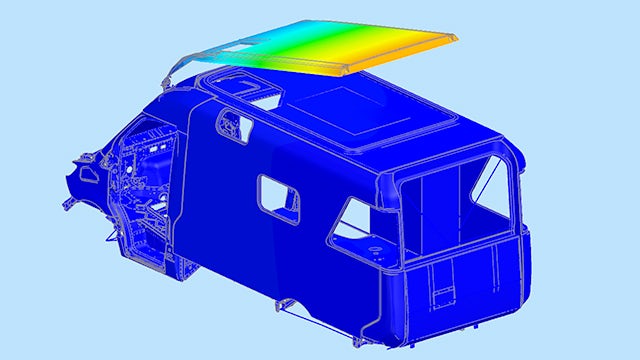
The design engineers use the FEM capabilities of Solid Edge to verify the structural integrity of their designs for everyday basic verifications and outsource more in-depth stress analyses to a specialized internal department in EHG (The Team Technology; TTT) using Simcenter 3D.

Virtual prototyping

Hymer uses Teamcenter® software to build prototypes of their vehicles in virtual reality (VR). Teamcenter visualization concept capabilities are provided as an add-on to the Teamcenter lifecycle visualization suite. The caravan experts import the digital twin created using Solid Edge and build digital mockups of the entire vehicle or a part of it to detect and resolve issues.

Ergonomic design verification is vital and using VR gear is an easy way to reveal if the solutions designed are practical. “By using the digital mockup capabilities of Teamcenter visualization, we can identify and resolve issues before they become costly problems,” says Heinrichsen. “Virtual prototyping helped us reduce physical mockups and prototypes by 80 percent.”

Teamcenter VR uses the JT™ file format in viewing and analyzing 3D designs. Importing design data from Solid Edge does not require any data preparation or conversion because the geometry information is received in the JT data format.

Hymer engineers generally use the JT data format for all exchange of geometry data between different software products. For many purposes, most of the information carried in native CAD data is not required. In most cases, geometry information is all that is needed and historical data would merely be a ballast. “We do not need three days for data translation and cleansing anymore,” explains Ziegler. “Using the JT data format, we can import and consolidate geometry data in minutes versus days, even if they originate from different software systems.” This is frequently needed when bringing together Hymer’s mechanical and wire harness designs created using different software products in one model using Teamcenter Visualization.

Additionally, using JT for model data exchange does not require users to be equipped with CAD software to view 3D designs using the free JT2Go viewer. This eases collaboration with suppliers and external partners based on rich design data.Hymer engineers use Rapid Author for Teamcenter to create electronic instructions for assembly lines.
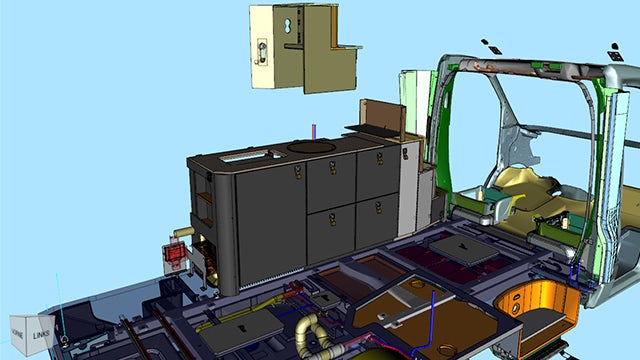
Hymer engineers use Rapid Author for Teamcenter to create electronic instructions for assembly lines.

One digital twin, many uses

Hymer engineers use Rapid Author for Teamcenter to create all documentation. They benefit from its work instruction component to create electronic instructions for assembly lines.

“Workers were enthusiastic about the dynamic assembly instructions using 3D models,” says Ziegler. “They particularly liked the ability to turn models to better see things often hidden in drawings.”

This also helped accelerate onboarding and training new employees in production. In engineering, Siemens’ solution partner ISAP AG supports Hymer with software training. For marketing and sales, Hymer engineers create life-like and often animated renderings. These are also based on 3D model data from Solid Edge in the JT data format.

These effects are even stronger if there is only one digital twin, even if a product comes in numerous variations, as Hymer caravans and motorhomes usually do. “Everything we create starts out as a 150 percent model that must be reduced to a 100 percent model to fit individual requirements,” says Heinrichsen. Hymer engineers have recently started enriching their models with product and manufacturing information (PMI). “Using PMI has turned deriving individual variants into configuration,” Ziegler confirms. “It has reduced the time required by 65 percent.”

Using the digital twin created in Solid Edge as the single source of truth for all these purposes enables all data to be bot ubiquitous and associative. This allowed Hymer to eliminate distributed information silos and some notorious sources of error associated with this data separation. Additionally, after modifications, everyone involved can immediately resume work on the basis of valid, up-to-date information.Hymer engineers create life-like and often animated renderings for sales and marketing based on 3D model data from Solid Edge.
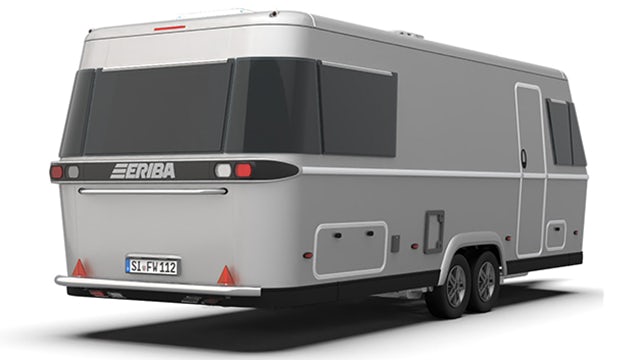
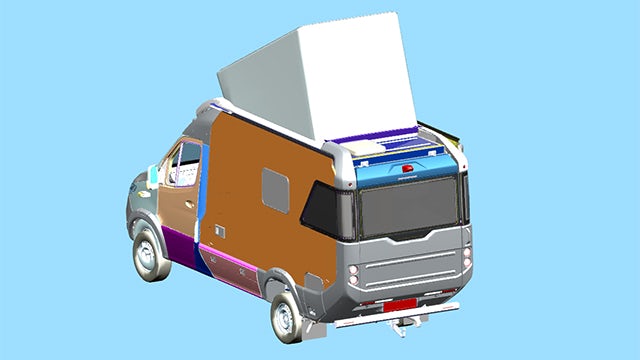
Hymer engineers create life-like and often animated renderings for sales and marketing based on 3D model data from Solid Edge.Users that are not equipped with CAD software can view 3D designs by using the free JT2Go viewer. This eases collaboration with suppliers and external partners based on rich design data.
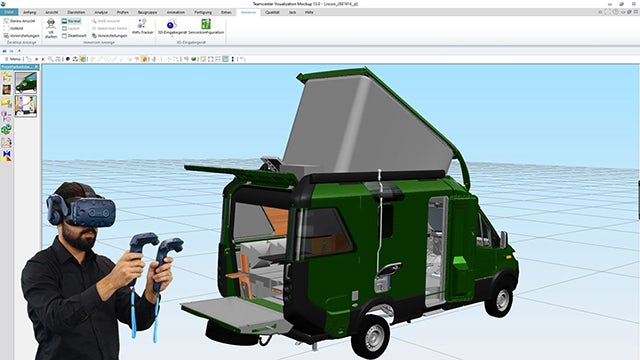
Users that are not equipped with CAD software can view 3D designs by using the free JT2Go viewer. This eases collaboration with suppliers and external partners based on rich design data.Hymer reduced physical mockups and prototypes by 80 percent by using the digital mockup capabilities of Teamcenter Visualization for design verification.

Hymer reduced physical mockups and prototypes by 80 percent by using the digital mockup capabilities of Teamcenter Visualization for design verification.

Virtual prototyping helped us reduce physical mockups and prototypes by 80 percent.

Frank Heinrichsen, Marketing Manager,

How 3d measurement technologies can improve quality control in the hypercar market

Product: HandySCAN
Industry: Automotive and Transportation


“The Creaform solution is highly accurate, easy to use and well-suited to a production line environment. Having the system ready at hand gives us the flexibility and response time we need to quickly investigate measurement and quality issues as they arise.”

Swedish design and visionary technical solutions: that’s the way Koenigsegg works.

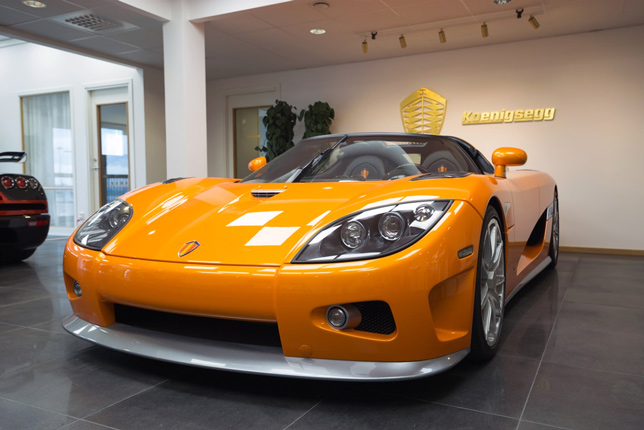
The Swedish company Koenigsegg Automotive AB is the market leader within the elite hypercar market, developing and hand-building advanced artisan vehicles since 1994.

The journey of Koenigsegg, since its inception, is truly incredible. It all started on August 12, 1994 when a young man, aged 22, set out to realize his childhood dream. He was a young man fuelled by passion, ingenuity and mind-bending will. Christian von Koenigsegg had just made up his mind to live his dream and start his own car company. The odds were stacked against him. It was a now or never moment. His idea was to create a sports car that he felt did not currently exist and one which he believed would be desired—two essential necessities for success, Christian felt.

The concept: A lightweight mid-engine car with a detachable, storable hardtop. The car would also feature a wrap-around screen for good visibility and aerodynamics as well as short overhangs with two large intercooler intakes on the side of the car, located behind the mass centre to aid high-speed stability. The car would look and feel good with the top up or as a roadster—transformed in minutes with the hard top neatly tucked away inside the car. Christian envisioned a car with a timeless appearance that aged like good wine. This was a mid-engine car concept that did not exist at the time.

Every Koenigsegg created since then now includes this simple, but effective, DNA attuned to Christian’s original vision.

Five production models with as many Guinness production car records later, Koenigsegg has exploded onto the international scene and is here to stay. When Christian is asked what his greatest achievement is, he says without hesitation: “Living the dream!”

Measurement tasks and equipment

The day Koenigsegg got in touch with Creaform, the company was using rental services for measurement tasks. A four-meter Romer Arm with scan and probe heads or a Leica Tracker together with PolyWorks were employed. The measurement and scanning systems were primarily used for root cause analysis on the production line, comparing physical parts to nominal CAD as well as for fixture set-up, commissioning and reverse engineering tasks in which handmade parts were replaced by and CAD data produced using Catia V5R19 for production tooling and manufacturing.

Frequent functional downsides of the rental equipment, substantial expenses and time constraints as well as the goal to have in-house 3D measurement skills, brought Koenigsegg to start looking for alternatives on the market. Creaform’s Swedish reseller, MLT Maskin & Laserteknik AB, went to Koenigsegg for an on-site demonstration of Creaform’s 3D measurement technologies.

“After benchmarking all available measurement systems, we felt that Creaform products and solutions fitted best with our demanding requirements and environment. Being less sensitive to movements during scanning and probing, the Creaform’s solutions are better-suited to a production line environment,” explained Jon Gunner, Technical Director at Koenigsegg. “We decided to invest in the HandySCAN 3D scanner and portable optical CMM HandyPROBE from Creaform and the CAD and inspection software called PolyWorks.”

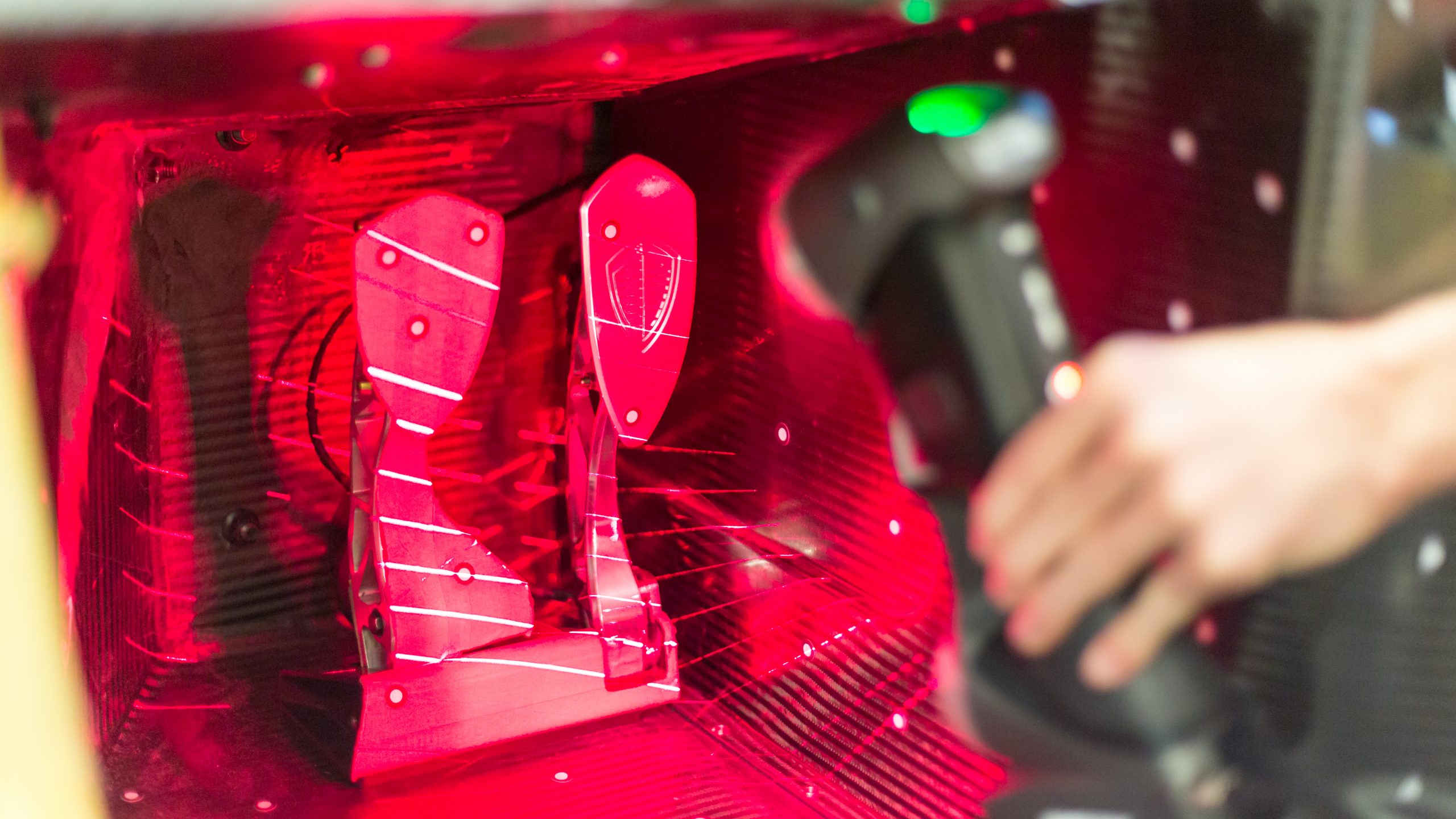
HandySCAN 3D metrology-grade scanners can capture up to 480,000 measurements/s with an accuracy of up to 0.030 mm.

The handheld HandySCAN 3D laser scanners provide breakthrough accuracy and resolution as well as significantly high measurement rates—all in a single, portable device. They can be used in all phases of the product life cycle: from conception, through design, manufacturing up to documentation, maintenance and repair purposes.

Free of any rigid measurement setup, HandyPROBE offers unmatched flexibility and a wider measurement volume than other portable CMMs.

The HandyPROBE portable CMM arm-free measurement system is the alternative to traditional measurement arms. The HandyPROBE is a wireless, triangulation–based CMM that offers complete freedom of movement and can be used for single or repeated measurements of various parts. The CMM is tracked by C-Track optical tracker. C-Track sensors also ensure the exact position of the HandyPROBE, perform continuous image acquisition and transmission, provide lighting of reflectors, manage exchanges with the computer, and store sensor parameters.

Both systems benefit from the integrated TRUaccuracy technology, which ensures highly accurate measurements when operating under real working conditions—regardless of vibrations, instabilities or thermal differences in the work environment.

How Creaform technologies intervene

The HandySCAN 3D scanner and the portable CMM HandyPROBE are now primarily used at the Swedish company for automotive quality control, measuring assemblies and components, and validating them to CAD as well as for root cause problem solving, reverse engineering and jig calibration. For jig calibration, Koenigsegg uses, for example, the probing system HandyPROBE to accurately adjust the nominal hard points. Then, users scan with the HandySCAN 3D scanner the parts once they are held by the jig as a validation process against the CAD data. This allows the company to trim the jig if a nominal offset should be required.

Free of any rigid measurement set up, HandyPROBE offers unmatched flexibility and a wider measurement volume than other portable CMMs

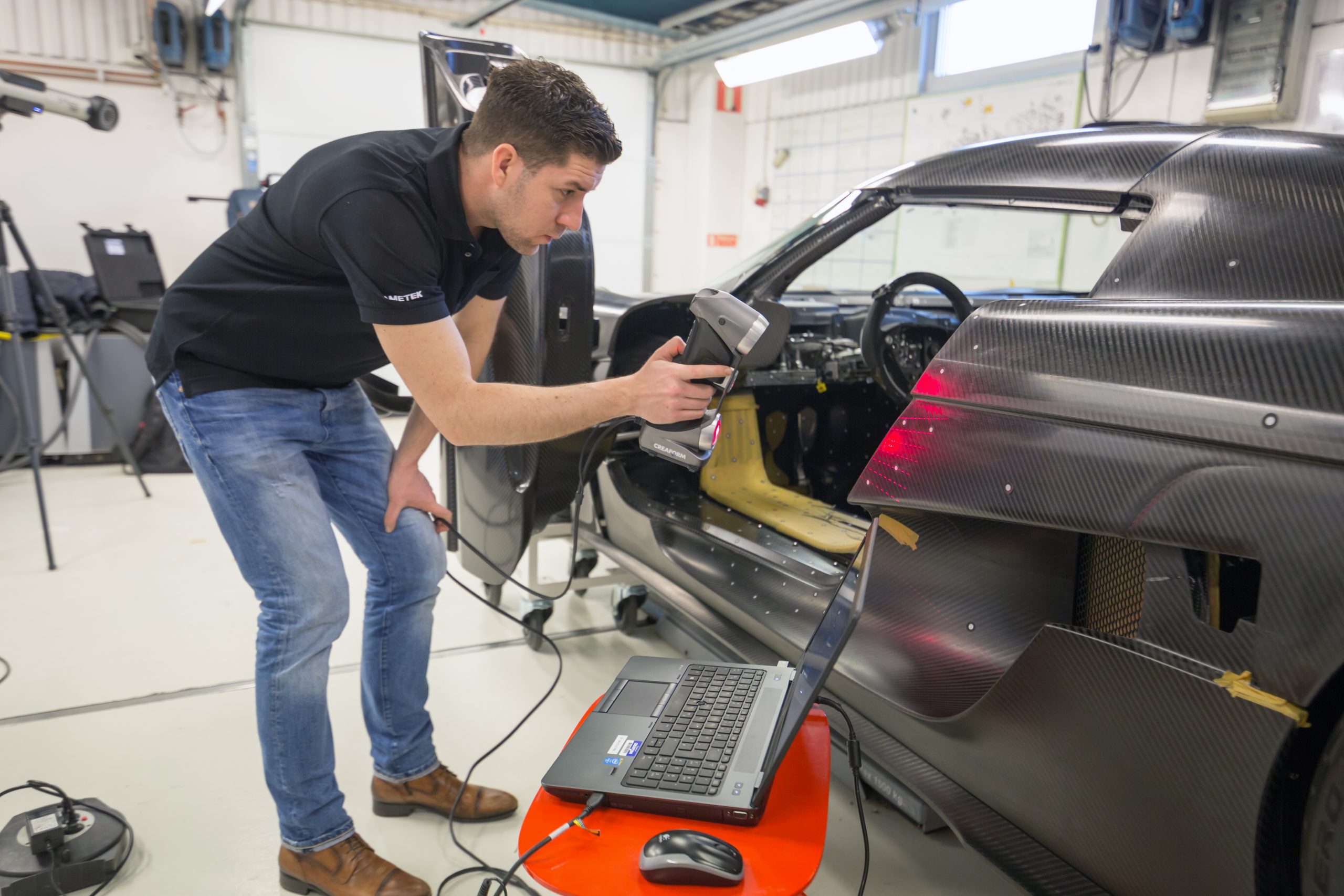
For quality control or engineering projects, HandySCAN 3D enables users to reduce turnaround times and increase profitability. Shown above scanning the body of a Koenigsegg Regera.

Jon Gunner is happy with the in the Creaform systems: “Already six months after the purchase, I estimated that we were halfway to gaining a return on our investment based on third-party rental fees and improvements to production quality. Creaform’s solutions are highly accurate, easy to use and ideal for a production line environment. Having the system ready at hand gives us the flexibility and response time we need to quickly investigate measurement and quality issues as they arise.”

With NX, ÀNIMA delivers a new level of innovation, including a visually striking electric motorcycle

Product: NX CAD
IndustrY: Automotive and Transportation

We needed a cost-effective solution that suited our technical needs and worked for both Windows and Mac OS X. We were also looking for a solution that would allow us to grow by extending our potential with Teamcenter in order to monitor and manage projects in all their phases. We found these characteristics in NX.

Joan Sabata, Partner and Director

“Helping companies to innovate through design”

ÀNIMA Barcelona (ÀNIMA) is an industrial design firm founded in 2002 by Diego Quiroga and Joan Sabata. From the beginning, ÀNIMA has combined creative talent with entrepreneurial energy to help customers improve product design and new product development. The mission and values of ÀNIMA are summed up in its motto: “Helping companies to innovate through design.”

Today, ÀNIMA comprises a multidisciplinary staff of industrial designers, engineers and experts in marketing and innovation who work with a large network of international experts. This allows ÀNIMA to provide its services to companies from a wide range of industries, including automotive, sustainable mobility, machinery, industrial and personal equipment, electronics, medical products, bathroom fittings, lighting and furniture.“Helping companies to innovate through design”

The search for a high-performance CAD system

The designers at ÀNIMA were highly-experienced at modeling solid objects in three dimensions. However, they began encountering more and more projects that demanded increasing use of advanced surfaces. In addition, the company wanted to expand its client portfolio into industries in which a high-performance computer-aided design (CAD) system was crucial, enabling it to develop more complex designs. ÀNIMA concluded that its current CAD system was inadequate, and the search began for a replacement.

To begin its search, ÀNIMA consulted engineering and product lifecycle management (PLM) specialist, Análisis y Simulación (AyS), a partner of Siemens Digital Industries Software. ÀNIMA explained its needs and long term plans. AyS studied the situation carefully, taking into account both the company’s design process as well as the specific requirements of each of its departments. The selection phase included the evaluation of specific tools for advanced surface design and solid modeling in 3D. Some candidate systems were discarded because they did not support the Mac OS® operating system software from Apple.

During the selection process, ÀNIMA soon realized that a comprehensive tool was the most economical option, because it meant buying only once and maintaining a single system. The company also wanted a CAD system that avoided the problems of compatibility between different brands of software, so as to eliminate wasting time translating file geometry.

After attending several meetings and software demonstrations, ÀNIMA chose NX™ software from Siemens Digital Industries Software. ÀNIMA considered NX to be a comprehensive product development tool, calculating that its use could save the company up to 50 percent of its planned investment in the software. ÀNIMA also valued the tight integration of NX with the digital lifecycle management system, Teamcenter® software, also from Siemens Digital Industries Software. ÀNIMA plans to implement Teamcenter in the near future to improve process control and efficiency.

“We needed a cost-effective solution that suited our technical needs and worked for both Windows and Mac OS X,” says Joan Sabata, ÀNIMA partner and owner. “We were also looking for a solution that would allow us to grow by extending our potential with Teamcenter in order to monitor and manage projects in all their phases. We found these characteristics in NX.”The search for a high-performance CAD system

NX proves effective from the start

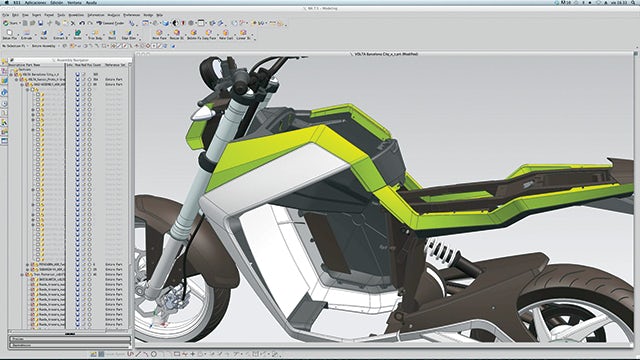
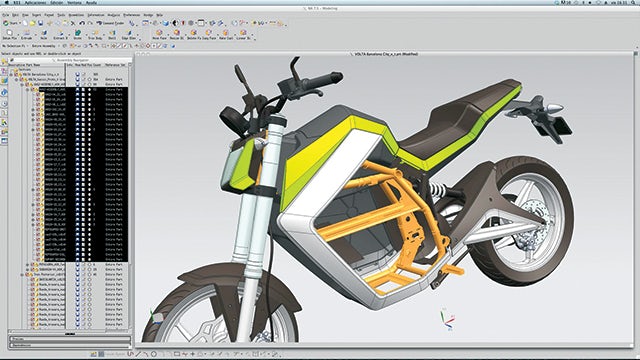
The first project developed entirely with NX was the design of the Volta® BCN electric motorcycle, which was aimed at promoting sustainable mobility in urban environments. ÀNIMA designers used NX for the entire process, from initial sketches to full development.

According to ÀNIMA management, the use of NX resulted in significant improvements in design creativity and design process efficiency. Management notes that the time needed to complete the whole design process – until the manufacture of the first prototype – has decreased by 65 percent.

“Now we know that we can tackle ambitious projects, because NX meets our high level of demand,” says Sabata. She adds, “Having Análisis y Simulación as a technology partner gives us special confidence, because of the organization’s subject-matter expertise and highly professional advice.”

With NX fully implemented, the creative team at ÀNIMA is busy developing projects for both local and international markets. Among projects, ÀNIMA is currently working on new designs for the automotive industry that will soon come to light. In fact, the design team is quite excited about the excellent impression its work will make in this market space, but moreover, the team is eager to demonstrate the value the designs will bring to its customers.NX proves effective from the startNX proves effective from the start

How 3D scanning helped reveal the face of the 3500-year-old Griffin Warrior

Product: Artec Spider
Industry: Medical and Forensic

For thirty-five centuries his body rested in a tomb beneath an olive grove just a short walk from the Palace of Nestor in southern Greece. Surrounding him were more than 2,000 objects dating back to the Bronze Age, including gold cups, rings, and necklaces, hundreds of precious gems, an ornate sword, and the breathtaking, intricately carved Pylos Combat Agate.Griffin Warrior

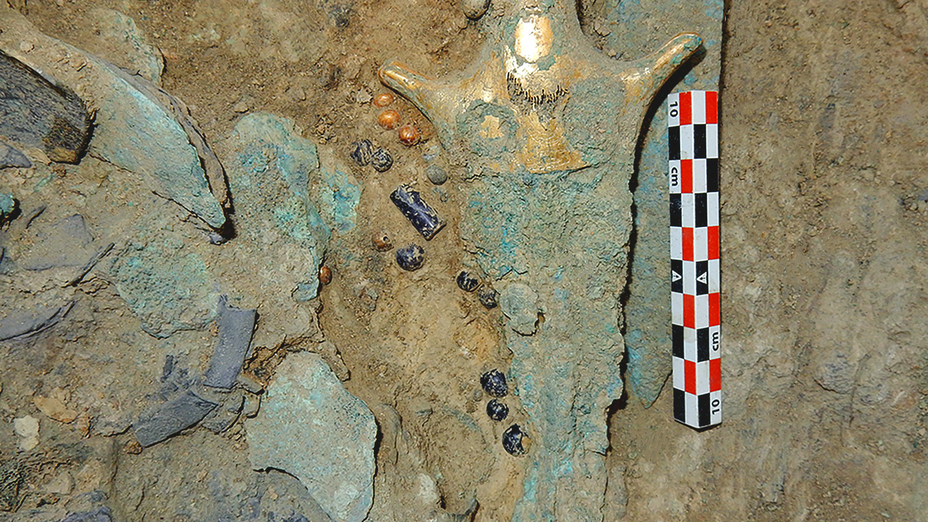
A gold-hilted dagger that had originally been resting upon the chest of the Griffin Warrior. Image courtesy of the Palace of Nestor Excavations, Department of Classics, University of Cincinnati

Given the name “Griffin Warrior” after an ivory plaque bearing the engraving of a griffin was found with him, this ancient Mycenaean nobleman’s true identity is still a mystery.Griffin Warrior

Drs. Sharon Stocker during the excavation of the Griffin Warrior’s tomb. Image courtesy of the Palace of Nestor Excavations, Department of Classics, University of Cincinnati

But while University of Cincinnati archaeologists Jack Davis and Sharon Stocker excavated his tomb over the course of six months, as soon as they discovered the mostly intact skeleton of the Griffin Warrior, they turned to the science of forensic facial approximation to see what he had looked like in real life.Griffin Warrior

Griffin Warrior grave excavation plan. Image courtesy of the Palace of Nestor Excavations, Department of Classics, University of Cincinnati

Biological anthropologist Prof. Lynne Schepartz and facial anthropologist Dr. Tobias Houlton were brought in to assist with this complex, multi-stage process. Schepartz led the excavation of the skull fragments, and Houlton focused on the skull reconstruction and face prediction of the Griffin Warrior.

As course coordinator and lecturer for the MSc in Forensic Art and Facial Imaging program at the University of Dundee, Scotland, as well as a forensic artist and expert in his field, Houlton has worked with Interpol and numerous police agencies in the UK and South Africa on various cases requiring facial approximation for victim identification.

His work has been recognized by National Geographic Magazine, the Smithsonian Channel, BBC Radio 4, and elsewhere.

Taking the right 3D scanner for the task

When it was time to travel to Greece, to begin the excavation and reconstruction of the Griffin Warrior, Houlton brought an Artec Spider along with him.Griffin Warrior

Artec Spider scans of the Griffin Warrior’s skull in-situ. Image courtesy of Dr. Tobias Houlton

A first-choice 3D scanner among forensic specialists and researchers around the world, the Spider is recognized for its abilities to non-destructively capture objects of all shapes and complexities, with submillimeter degrees of accuracy, even those with otherwise-challenging features, such as cranial sutures, wafer-thin bone fragments, etc.

In Houlton’s words, “I knew that the Spider would fit in perfectly with my workflow. Instead of having to adjust everything to meet the needs of the technology, which is what happens with many solutions, Spider was right there with me at every step.”Griffin Warrior

The digitally reconstructed skull of the Griffin Warrior in Artec Studio software, image courtesy of Dr. Tobias Houlton

“Before I lifted a cranial fragment from the sediment, I would scan that layer, in order to preserve each fragment’s exact location and orientation within the sediment.”

He continued, “Then I would scan each piece again, right after excavating it, and would also temporarily glue together groups of fragments and scan these. That way, when it came time to digitally reconstruct the skull, the Spider scans provided precise digital twins of these skull fragments, not to mention the original in-situ scans, which from an archaeological point of view are indispensable.”

CT scanning through ancient soil

But before that could take place, the block of sediment containing the Griffin Warrior’s remains was extracted from the site and brought to the lab. There, a CT scanner was used, to try and distinguish any skeletal elements from the other objects around them.

Unfortunately, the CT wasn’t able to differentiate bone from the other objects in the sediment, yet at least it provided a map of object locations, which later proved useful while extracting the Griffin Warrior’s skeletal remains.

Houlton’s scans were done directly within Artec Studio software, with each scan taking around one minute or less for full capture of individual cranial fragments and sediment layers.

Following this, the scans were processed into 3D models, and what’s more, because Geomagic Freeform wasn’t accessible to Houlton at that moment, he fully reassembled the Griffin Warrior’s skull in Artec Studio.

According to Houlton, “Artec Studio’s alignment tools made it easy for me to select specific fragments, move them around, and align them properly in relation to all the other pieces. It didn’t take long for me to reassemble everything and finally obtain a digitally reconstructed version of the Griffin Warrior’s skull.”

When traditional casting is too risky, 3D “digital casting” is ready to help

Reflecting back on traditional casting methods for documenting skeletal remains, Houlton said, “In the case of the Griffin Warrior, many of the skull fragments were so fragile that there would have been no way for us to safely cast them.”

He elaborated, “Yet Artec Spider ‘digitally cast’ each one in just seconds, and now we have protected 3D copies of them, without ever damaging or posing any danger to the original objects.”

Once back at the office, Houlton exported the digital twin of the Griffin Warrior’s skull from Artec Studio over to Geomagic Freeform, for the actual facial approximation.

Freeform: first choice for digital skull reconstruction and facial approximation

With the software’s ability to put the reconstructionist in direct kinesthetic contact with the 3D object via a haptic pen interface, Freeform is an ideal tool for anyone doing the work, from student to accomplished practitioner.Griffin Warrior

Geomagic Freeform screenshot showing the Griffin Warrior’s skull ready for facial approximation. Image courtesy of Dr. Tobias Houlton

Unlike traditional clay facial approximations, Freeform makes it possible to share the entire approximation with agencies or digital artists near and far, in seconds from the time of completion.

Even more consequential is the guarantee that with digital approximations, in contrast with clay, there’s no danger of the original ever being damaged or lost.

Expanding upon this, Houlton said, “Now, once we’re done with an approximation in Freeform, if the original skull is ever lost or destroyed, and if there’s ever any question about the accuracy of the predicted face, all it takes is referring back to the Spider scans of the skull.”Griffin Warrior

Geomagic Freeform screenshot showing the Griffin Warrior’s facial approximation underway. Image courtesy of Dr. Tobias Houlton

“Within seconds, you’ll be able to verify, without even a glimmer of doubt, the accuracy of the skull reconstruction. Because when you’re looking at the Spider scans, it’s as close to looking at the real skull as anything else,” he said.

Houlton shares with his students at University of Dundee his full spectrum of insider workflow tips and tricks with Freeform.

So, whether they’ll eventually find themselves working as facial approximation practitioners in cooperation with police or intelligence agencies, or as CGI specialists immersed in the world of film, TV, or video games, they’ll have all the foundation they need to transform Artec 3D scans into stunningly lifelike facial approximations.

Rebuilding the face of the Griffin Warrior in Freeform

Since several of the Griffin Warrior’s thinner facial bones were missing, specifically those around the nose, as they’d disintegrated over time due to the acidic soil conditions at the grave site, Houlton relied on his own approach to accurately fill in the gaps.

He created an average face template from the images of 50 faces of modern Greek men of similar age and build, and then brought them together in Abrosoft FantaMorph. Facial averages identify consistent trends in facial patterns, which supported Houlton with the remaining approximation where individual details cannot be ascertained.Griffin Warrior

In Geomagic Freeform – using the tissue depth markers to help build the Griffin Warrior’s face. Image courtesy of Dr. Tobias Houlton

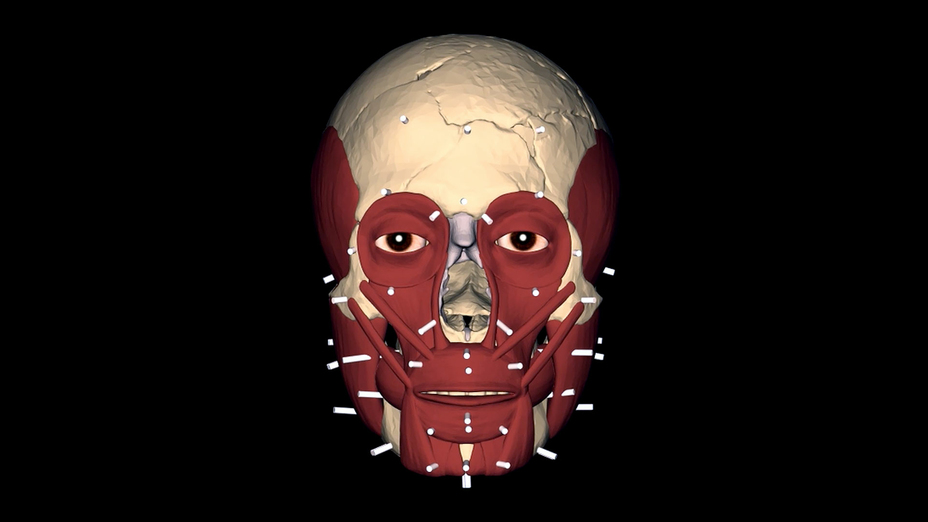
During the approximation, Houlton first inserted the eyes, then all the tissue depth markers (up to 36), followed by the muscles and the skin layer. Freeform’s ability to let users organize and label all these features as independent objects and store them in their own folders is highly useful during facial approximation.

The Griffin Warrior’s face reborn: from digitally reconstructed skull to final facial approximation. Video courtesy of Dr. Tobias Houlton

As well, the software’s ability to “see through” the model and down below the skin, ensuring that soft and hard features relate to each other, saves the digital practitioner from what manual modelers must regularly endure: physically cutting into the clay/modeling wax to check with the underlying skull cast.

Why 2D photography should never be the first choice

When asked to compare working from 2D photographs versus 3D scans for facial approximation, Houlton commented, “2D photos should be a last resort. To give you an example why they’re not desirable, it’s very hard to gauge how deep the fossae are around the canine area, which in part indicates the form of the nasolabial folds.”

He continued, “In general, when it comes to accuracy and vivid realism, 3D scanning lets you achieve fantastic results compared to what you can do with 2D photos.”

In fact, the breadth of precise surface data provided by the Spider scans is more than sufficient for performing reconstructions directly from the scans, without having the original skull present as a reference model.Griffin Warrior

Dr. Tobias Houlton scanning a cranial fragment with Artec Space Spider at the University of Dundee. Image courtesy of Dr. Tobias Houlton

Houlton has done that very thing in multiple international projects over the years. “Having 3D scans of this degree of accuracy makes it possible to take on facial approximation work without ever having to leave our offices.”

Whenever the need arises for a physical model of an approximation, whether for investigative, legal, or other purposes, it’s a simple step to export the digital approximation for 3D printing.

In practice, this can mean finishing a facial approximation, sharing the 3D model with the client, who receives it seconds later, even on the other side of the world. Then they begin reviewing it on-screen while 3D printing a physical model, ready for use just hours later.

3D scanning & 3D printing in human anatomy education

At the University of Dundee’s Digital Making facility, with its collection of 28 various 3D scanners, Houlton and his students have been 3D printing their Spider scans, along with scans from Dundee’s other Artec scanners: Eva and Space Spider.

The successor to Spider, Space Spider features all the power of its predecessor, in addition to powerful temperature stabilization and high-grade electronics.Griffin Warrior

The Artec Space Spider

Dundee’s MSc Forensic Art and Facial Imaging program adopted Artec scanners as part of their curriculum years ago, after being introduced to them by Artec 3D Gold Partner Patrick Thorn.

A highly experienced specialist in 3D scanning for education, cultural heritage, forensics, healthcare, and beyond, Thorn endeavors to understand the needs of his clients, to help them integrate the very best solutions possible. He also conducts workshops for his clients in numerous locations across the U.K., from the tip of Cornwall up to northern Scotland.

Lifelike 3D-printed bone and skull models in the classroom

Houlton commented on how essential 3D printing has been for teaching human anatomy at Dundee, saying, “We regularly work with 3D prints of skulls and other bones, since physically handling these models is immensely conducive to the learning process. And this is another area where our Artec scanners have proven useful.”

He continued, “For example, if you take some 3D-printed cranial anatomy made from Spider scans and set it side-by-side with a 3D print of the same piece of skull, yet made using scans from other 3D scanners we’ve tried, you can see a massive difference in terms of detail, accuracy, and realism.”

As explained in a previous case study, the University of Dundee continues to expand its work with 3D scanning and printing with each passing semester.

For the medical and forensic art students there, by the time they graduate, they will be fully capable of picking up an Artec 3D scanner, capturing any of the human body’s 206 bones in minutes, then transforming those scans into lifelike 3D models ready for AR, VR, 3D printing, or facial approximation in Freeform.

Facial decomposition, documenting mass graves, and beyond

Houlton’s latest project will take him to South Africa with the University of Witwatersrand. There he’ll be working with a PhD student and academic team on a project dedicated to researching the effects of decomposition on human faces, identifying the degree of changes taking place post-mortem, to understand what this means for facial recognition.

Following this, Houlton is hoping to embark upon an archaeology-based project with the Orkney Research Centre for Archaeology, working locally as well as throughout various countries/regions of Africa, engaging with documentation of mass grave sites.

Design and Additive Manufacturing Expertise from 3D Systems to Serve Thales Alenia Space Satellite Sub-System

Product: DMP
Industry: Aerospace and Defense

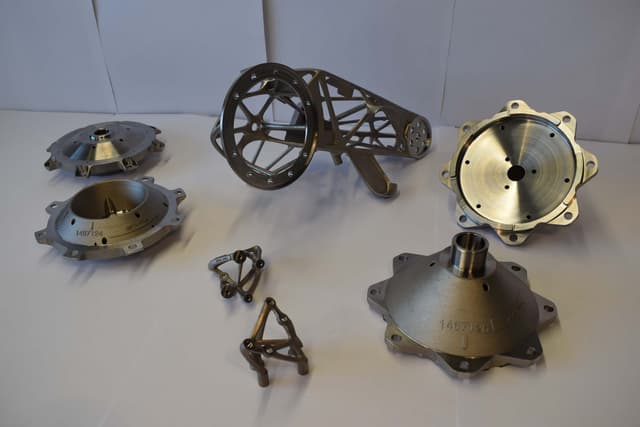
3D Systems collaborates with Thales Alenia Space in the field of design for additive manufacturing (DfAM) to improve performance of a critical sub-system on its Spacebus NEO satellite. The resultant Electrical THruster Mechanism (ETHM) is comprised of seven different additively manufactured brackets. Additive manufacturing (AM) enabled the mechanism to be packaged within a limited volume at the lowest possible mass. Experts within 3D Systems’ Application Innovation Group contributed design and manufacturing know-how to Thales Alenia Space’s ETHM project, packaging their expertise within the final build files that were transferred to Thales’ AM production facility in Morocco. This expert-generated manufacturing plan enabled Thales to seamlessly transition production to its own additive manufacturing facility which is outfitted with several 3D Systems’ direct metal printers. 

“Every feature is more or less conventional, but putting them together in a single compact and competitive mechanism is really a challenge.”

Gilles Lubrano, ETHM Product Manager

OPTIMIZE CRITICAL SATELLITE SUB-SYSTEM FOR ACCURACY AND RELIABILITY

Seven metal printed components of Thales Alenia Space's ETHM

The seven different additively manufactured brackets comprising the ETHM.

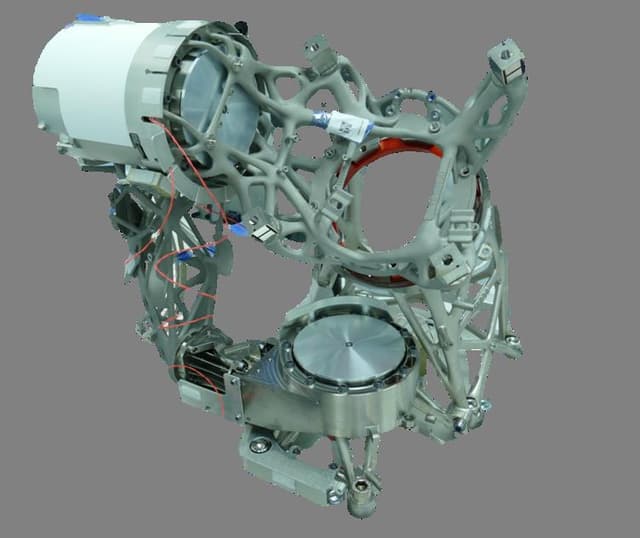
The Electrical THruster mechanism points the satellite propulsion of the Spacebus NEO satellite to correctly position it in space. As such, the reliability of this component is mission-critical. Four ETHMs are required per satellite, forming the chassis around the engines. These parts perform as two axis gimbals holding the electrical propulsion unit, and enabling it to vector with smooth and steady movements.

To meet Thales Alenia Space requirements, the ETHM needed to balance volume and mass constraints while meeting stringent performance specifications, including:

  • High angle pointing accuracy (0.1-degrees);
  • Part count reduction including functional integration of various thruster commodities (harness and piping);
  • Serial production that meets quality requirements for orbital class products.

CONSULTATION AND COLLABORATION FOR SCALABLE PRODUCTION

Render of Thales Alenia Space ETHM

3D Systems experts helped Thales Alenia Space achieve an optimized strength-to-weight ratio while solving for areas of heat concentration to protect functional components from thermal damage.

Design for Additive Manufacturing Consultation

Thales Alenia Space and 3D Systems have an enduring collaborative partnership, and have worked together to put over 1,700 flightworthy parts in orbit as of 2021. In the ETHM project, Thales Alenia Space partnered with 3D Systems’ Application Innovation Group (AIG) to combine several functions within a small design space while guaranteeing accurate dynamics.

The total dynamic volume allotted for the ETHM is 480 mm x 480 mm x 380 mm, and includes rotary actuators, harness, tubing, and a holding mechanism. 3D Systems provided manufacturability and design feedback to help Thales Alenia Space achieve its performance objectives. 3D Systems experts helped Thales Alenia Space achieve an optimized strength-to-weight ratio while solving for areas of heat concentration to protect functional components from thermal damage.

By using AM to design and produce a system, Thales Alenia Space triggered an expansion of positive impacts. Light-weighting improved thrust efficiency beyond what conventional manufacturing would allow, which in turn improved fuel efficiency, resulting in lower costs and new opportunities for technical innovation elsewhere.

Manufacturing Flow Development

3D Systems helped Thales Alenia Space develop a robust manufacturing flow comprising post-processes like CNC-finishing and 100% tomography inspection to guarantee product and process repeatability in an AS9100 controlled environment. 3D Systems application engineers also provided guidance on the level and sequencing of quality controls for risk mitigation to help Thales Alenia Space ensure a thorough, quality-oriented, and cost-efficient manufacturing flow.

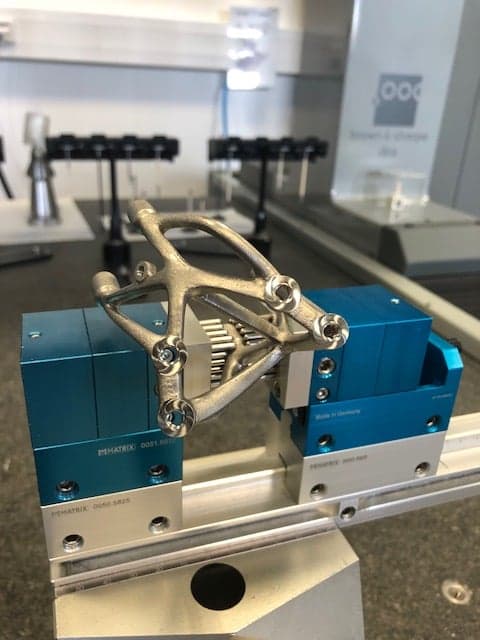
This expertise helped Thales Alenia Space achieve the 0.1-degree pointing accuracy required with an exacting CNC and inspection workflow in which some parts have as many as 249 measurement points taken via coordinate measuring machine that must be in spec. 3D Systems’ collaborative approach included education about the technology along the process of integrated quality controls, as well as root cause analyses of non-conformities against Thales Alenia Space specifications to ensure success. Prior to transitioning production to Thales Alenia Space, 3D Systems helped organize and coordinate a best-in-class supply chain to fulfill series production and produced more than 70 parts at its Customer Innovation Center in Belgium, which is part of 3D Systems’ AIG. The high capacity of this facility and repeatability across 3D Systems’ DMP machines helped ensure a short lead time.

Thales Alenia Space ETHM component in clamp for measurement

Some parts of the ETHM have as many as 249 measurement points taken via coordinated measuring machine that must be in spec.

Print File Preparation and Transfer

To ensure a seamless transition of ETHM production to Thales Alenia Space, 3D Systems application engineers developed each print file in 3DXpert®, incorporating years of AM expertise that saved Thales Alenia Space time and money while guaranteeing quality. Using these expert-generated build files, repeatable production is possible on any 3D Systems direct metal printer. The final brackets are printed in LaserForm Ti6Al4V grade 23 titanium material.

Several aspects of the thruster mechanism design made 3D Systems’ guidance on print strategy of particularly high value, including:

  • Maintaining intended roundness of several open structures with large circular interfaces.
  • Balancing support strength with removability.
  • Accounting for thermal stresses during the printing process that vary based on the geometry and material printed.

3D Systems’ experience working with titanium materials has helped countless critical applications balance complexity and strength to achieve project parameters. Tools like 3D Systems’ 3DXpert simulation module help support these projects by reducing the number of iterations required to achieve a successful outcome.

Technology Transfer

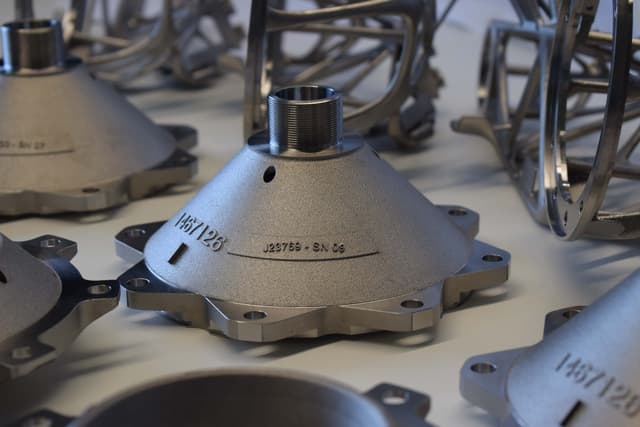
Close up of Thales Alenia Space ETHM components

The final brackets are printed in LaserForm Ti6Al4V grade 23 titanium material.

Thales Alenia Space is now capable of printing these parts at its own facilities following the training and technology transfer 3D Systems has provided over the years. Thales’ group 3D factory in Morocco is outfitted with several 3D Systems’ DMP machines, and took advantage of 3D Systems’ technology transfer offering at the time of installation. Technology transfer is an in-depth, AM-specific training designed to help new printer customers accelerate their transition to AM and safeguard their investment. In combination with the pre-developed build files, 3D Systems has fully supported Thales in its transition to in-house production.

“Using the same machines as the ones in our Customer Innovation Center in Belgium, Thales has simplified its access to a successful print so its team can focus on the industrialization of AM and maximize its return on investments,” said Koen Huybrechts, Manager Application Development, Application Innovation Group, 3D Systems.

BALANCE OF KEY PERFORMANCE CRITERIA FOR OPTIMIZED, SYSTEM-LEVEL DESIGN

ETHM is one of the first full space mechanisms entirely designed with additive manufacturing in mind. The seven different topologically optimized brackets raised the standards of a multi-disciplinary team by their size, the required high precision, and system criticality.

  • Pointing accuracy of 0.1-degrees ensures mechanism will perform as expected in flight
  • Increased thruster efficiency from reduced weight of topologically optimized brackets
  • 249 measurement points validated for quality control of most complex part
  • Integration and protection of thruster commodities for optimal form and function

The Spacebus NEO is part of the European Space Agency’s 15-year Advanced Research in Telecommunications Systems (ARTES) Program.

Enhancing data accuracy to reduce time spent on digital model queries by 50 percent

Product: Teamcenter
Industry: Automotive and Transportation

Overcoming an inefficient system

Based in Liuzhou, China, Dongfeng Liuzhou Motor Co., Ltd. (Dongfeng Liuzhou) is one of Dongfeng Motor Group’s production bases, producing a wide range of commercial vehicles, including tractors, dump trucks, electric logistics vehicles and passenger cars as well as sport utility vehicles (SUVs), sedans and electric vehicles. Dongfeng Liuzhou is also the primary research and development (R&D) center for the group. The company caters to domestic and overseas markets, including the Americas, the Middle East and Africa. Founded in 1954, Dongfeng Liuzhou has more than 5,700 employees.

The company’s existing digital models could only be used to produce 2D computer-aided design (CAD) drawings and were not systematically managed. The Dongfeng Liuzhou design departments needed to collaborate more closely due to the increase in the types of designs required, such as hybrid and electric vehicle technology, but this was not possible with their existing software.

More advanced vehicle models, which required increasing amounts of data, soon exposed problems caused by ineffective data use and management, including the lack of full model configuration management and fully configured bills-of-material (BOM). This resulted in a growing number of single vehicle BOMs, creating a system that was time-consuming and costly.

To meet this challenge, Dongfeng Liuzhou implemented Teamcenter® software, which is part of the Siemens Xcelerator portfolio, the comprehensive and integrated portfolio of software, hardware and services. This helped enable Dongfeng Liuzhou to improve its R&D management and structural process management, resulting in significantly increased efficiency and accuracy.

Outdated data management creates long project cycles

Dongfeng Liuzhou’s production was plagued by inefficiencies and problems with model accuracy. The company’s existing data management tool could not meet their design needs; it was neither fast enough nor able to handle the depth of detail increasingly required for Dongfeng Liuzhou’s vehicle designs.

Dongfeng Liuzhou’s design teams were finding it impossible to use their existing tool design management (TDM) to collaborate in real time across disciplines and design processes. They found that collaboration was only possible on finished designs, a factor which significantly slowed the production process.

With each part of CAD and BOM data management being handled in separate processes, the design requirements had to be dealt with consecutively, which also affected accuracy as they passed from one team to another.

Although Dongfeng Liuzhou’s modeling engineers were able to manage digital models, they could only process partial inspections at any one time on their personal computers, which meant the team could not inspect the entire design as a single entity. Often, the entire vehicle model was too large for the company’s outdated software to handle. The modeling engineers were unable to inspect systems and subsystems simultaneously, resulting in a significant increase in project cycle length and cost issues that only came to light at the production stage.

As departments were not able to collaborate during the design process, colleagues had to rely on spreadsheets to share information and track progress, which increased the risk of human error while hindering attempts to make meaningful improvements to the management system.

Expert partner implements tailored solutions

Dongfeng Liuzhou approached Shanghai Real Information Technology Co., Ltd (Shanghai Real Information Technology) as they had a strong track record in vehicle R&D and product lifecycle management (PLM) for more than 15 years. Shanghai Real Information Technology suggested that Dongfeng Liuzhou use Teamcenter to facilitate the sharing of large amounts of data between departments.

Shanghai Real Information Technology is a Siemens Digital Industries Software Expert Partner in Simcenter® software testing solutions, which, like Teamcenter, is part of the Siemens Xcelerator portfolio, the comprehensive and integrated portfolio of software, hardware and services. Siemens recognizes partners that demonstrate expertise and competency in one of its solutions. These partners are validated by customers and Siemens for demonstrating their superior business and technical acumen.

Shanghai Real Information Technology used the Siemens value delivery methodology (VDM) implementation by standardizing the process. Together with Dongfeng Liuzhou, Shanghai Real Information Technology created a joint project team to transfer the system operation, maintenance and support capabilities during the implementation process and ensure that after the project went live, Dongfeng Liuzhou’s engineers could manage the system, its basic operation and maintenance on their own.

Working closely with Shanghai Real Information Technology, Dongfeng Liuzhou was able to build systems and basic database information. This included the master data of materials, 3D digital models, 2D drawings, BOMs, documents, change data, etc. The basic data was stored in Teamcenter as a structured library to achieve an effective data sharing and permission allocation, while also improving the design re-use rate.

Teamcenter enables real-time management of model data

Shanghai Real Information Technology reorganized Dongfeng Liuzhou’s product data structures to better manage their R&D data. There were two parts to this process: sorting historical product data and building fully configured BOMs.

Implementing Teamcenter enabled Dongfeng Liuzhou to better manage parts, 3D design collaboration, the drawing and document library, standard parts classification and fully configured BOMs as well as process, authority, organization and change management and office integration.

Shanghai Real Information Technology was able to standardize Dongfeng Liuzhou’s existing historical data by using Teamcenter for guided management and applications, as well as to conduct real-time management and verification of their existing R&D vehicle model data.

Accurate digital model data and precise product data structures now provide accurate, real-time data support across all production and manufacturing departments.

Shanghai Real Information Technology and Dongfeng Liuzhou divided the project implementation into system function construction and business application operation and maintenance. The function construction took nine months, and the operation and maintenance is ongoing.

Realizing impressive results with Teamcenter

Dongfeng Liuzhou uses Teamcenter for R&D management and structural process management across their commercial vehicle and passenger vehicle divisions.

Using Teamcenter enabled Dongfeng Liuzhou to cut the labor cost of modeling engineers by 30 percent, 50 percent of which was spent on model queries, and reduce the time spent on report outputs by 90 percent. At the same time, data accuracy increased by 95 percent.

“By using Teamcenter we have removed the existing data inconsistencies and helped us reduce product delivery delays,” said Chen Lai, project lead at Dongfeng Liuzhou.

By using digital prototypes, Dongfeng Liuzhou is able to detect design and manufacturing issues much earlier in these respective processes, which reduces the design and manufacturing rectification tasks, thereby shortening the product development project cycles.

“Using Teamcenter has enabled us to greatly shorten the vehicle development cycles and improve the product development quality,” says Luo Li, PLM division lead at Shanghai Real Information Technology.

As Shanghai Real Information Technology was able to customize the software to the customer’s needs it has built a commercial vehicle-based made-to-order (MTO) design mode based, on the business model of Dongfeng Liuzhou’s Commercial Vehicle Division. The partner also helped Dongfeng Liuzhou to build a fully configured vehicle BOM management system.

Further, Dongfeng Liuzhou also constructed a standard component library and diagram document knowledge base to improve the design re-use rate. It also enhanced sustainability/green initiatives by gradually decreasing offline processes and design data transfers, improving paperless office capabilities and achieving a sustainable environment for enterprise development.

“This project has enabled us to realize the digital R&D business management, laying a good foundation for our manufacturing digitalization in the future,” says Lai. “We have benchmarked with digitally advanced automotive companies in China and achieved rapid implementations, shortening the gap with the industrial benchmark and developing our R&D business.”

Cummins Uses Geomagic Software and Metal 3D Printing to Get 1952 Race Car Running Again 50% Faster

Product: Geomagic Control X
Industry: Automotive and Transportation

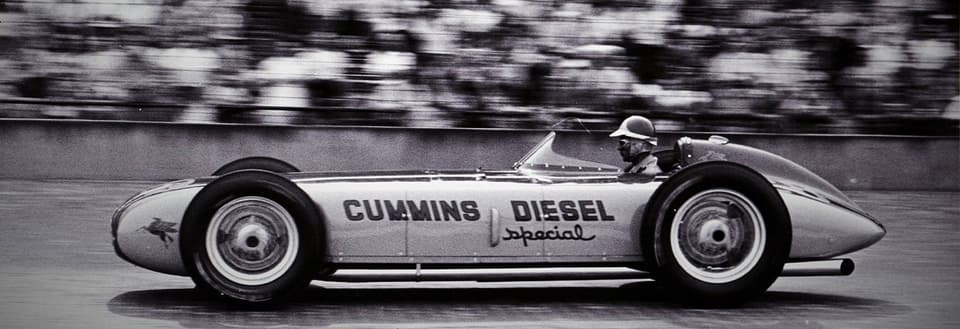
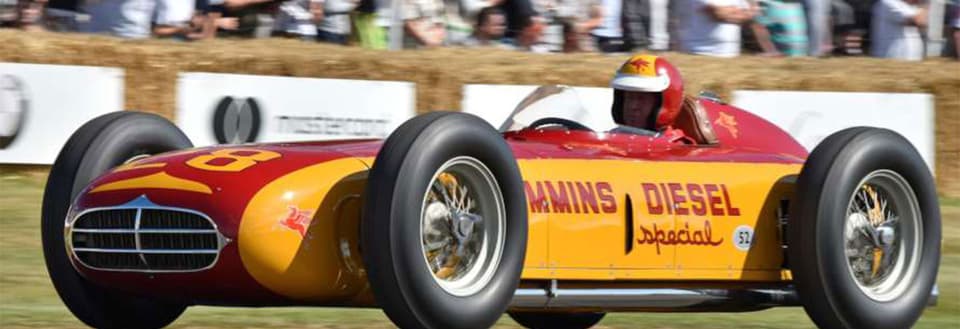
The #28 Cummins Diesel Special shocked the racing world in 1952 when it captured the pole position at the Indianapolis 500 (Indy 500) with the fastest lap time in history. This feat, along with the car’s many other innovations, won it a prominent place in racing history.

Sixty five years later, #28 was invited to the Goodwood Festival of Speed in the United Kingdom to participate in the legendary Goodwood Hillclimb along with hundreds of modern and heritage cars. While preparing #28, the Cummins engineers discovered that the water pump was so corroded it would probably not survive the event. If the #28 car was to make it to Goodwood in working order, it needed a new water pump.

The original water pump was a unique design specific to the #28 car, which meant no spare production parts would fit the bill. To complicate matters further, they had to ship #28 within a matter of weeks, which ruled out traditional sand-casting methods as infeasible for a replacement part given an estimated lead time of 10 weeks. Instead, Cummins engineers turned to reverse engineering and metal additive manufacturing (AM) using a ProX DMP 320 metal 3D printer by 3D Systems with help from 3rd Dimension Industrial 3D Printing, a high-quality production metal manufacturer specializing in 3D direct metal printing (DMP). The new water pump was 3D printed in only three days and the entire process took five weeks instead of 10.

#28 Cummins Diesel Special at the 1952 Indy 500

#28 Cummins Diesel Special at the 1952 Indy 500

A Page Out of Racing History

#28 was the first Indy 500 car equipped with a turbocharger and the first whose aerodynamics were optimized in a wind tunnel. It ran its four qualifying laps at a record-breaking average speed of 138.010 mph.

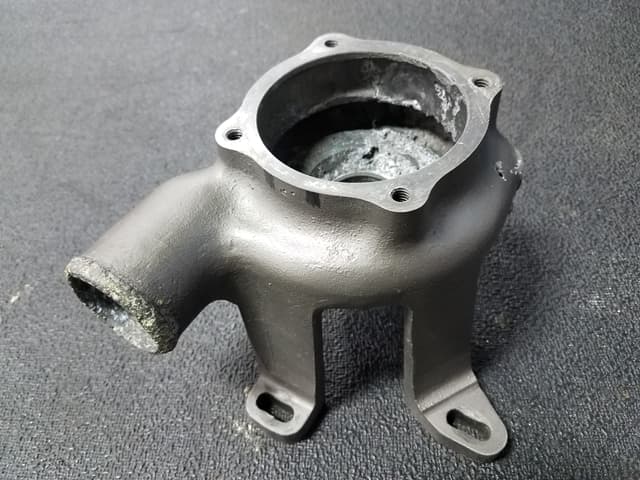
Original water pump showing severe pitting and corrosion

Original water pump showing severe pitting and corrosion

Since its momentous run in 1952, #28 has been displayed at the Indianapolis Motor Speedway Museum and the Cummins corporate office building. In 1969, #28 ran a lap around the Indy track prior to the start of the race to mark the Cummins 50th anniversary celebration. The last time #28 ran was at the Goodwood Festival of Speed in the late 1990s.

“As we prepared the car to run again for the first time in almost 20 years, we noticed severe pitting and corrosion on the water pump,” said Greg Haines, design and development leader for the X15 engine and member of the Cummins history and restoration team. “In a few places, the housing was pitted all the way through and was only kept from leaking by mineral deposits that covered the holes. We needed a new housing quickly if we were to meet our commitment to run the car at Goodwood.”

Racing to Produce a New Water Pump

The baseline method for building a new pump housing is the same method that it used to build the original pump: machining a plastic or wood pattern and using it to form a sand mold for casting. Using this method, it would have taken about 10 weeks to build a single housing, ruling out a run at Goodwood. The lead time for the new water pump housing could have been reduced by 3D printing the new casting pattern or even 3D printing the sand casting mold itself, but the greatest productivity gains available came from bypassing the casting process altogether and using reverse engineering and 3D printing to produce the final part directly in only five weeks—50 percent faster.

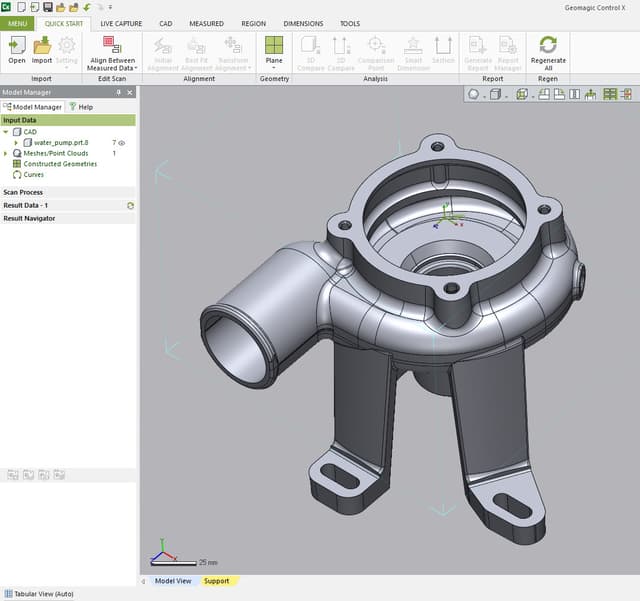
Inspecting water pump in Geomagic Control X

Inspecting water pump in Geomagic Control X

Scanning

Cummins engineers began by scanning the existing water pump housing with a CT scanner. They selected a CT scanner because the pump contained many undercuts and other internal geometries that would have been impossible to capture with a laser scanner or other line-of-sight imaging tool.

Inspecting

To verify that the scan data was accurate before moving forward, the engineers imported the point cloud data generated by the CT scanner into Geomagic Control X inspection and metrology software where they separated and aligned the internal and external geometry of the pump.

“For a project like this, we typically separate out the internal volute geometry from the body so we can model it as a core and do a comparison back to the point cloud data to be sure all our work is accurate,” said Chris George, master CAD model team leader for advanced system design for Cummins.

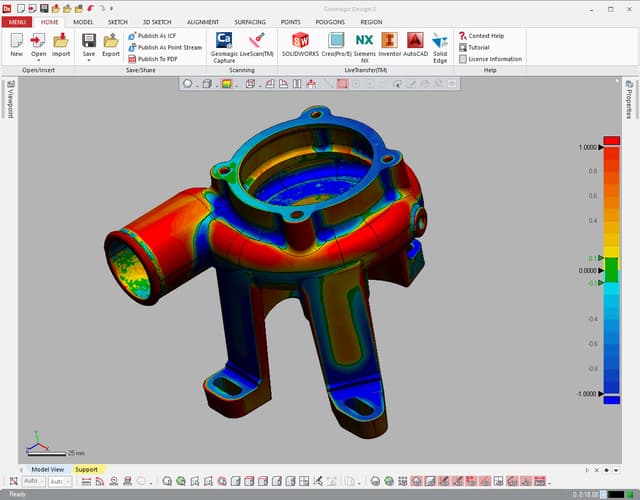
Comparing water pump CAD model to scan data in Geomagic Design X

Comparing water pump CAD model to scan data in Geomagic Design X

Reverse Engineering

With good scan geometry to jump-start its design work, Cummins used Geomagic Design X reverse engineering software to convert the point cloud to a nonparametric solid model to perform CAD fit checks. These checks helped the Cummins team determine the right assembly dimensions for the impeller and shaft and how everything would ultimately fit and seal together.

According to George, Cummins uses Geomagic Control X and Geomagic Design X as its primary software for point cloud manipulation. “The 3D Systems Geomagic software provides a complete solution for processing and inspecting scan data and converting it to a solid model,” he says. “We use them for every reverse engineering project we do, which often requires geometric reconciliations, finite element analyses of structure and flow, and model-to-scan comparisons reported to our engineering customers.”

“The 3D Systems Geomagic software provides a complete solution for processing and inspecting scan data and converting it to a solid model. We use them for every reverse engineering project we do.”

—Chris George, Master CAD Model Team Leader for Advanced System Design, Cummins

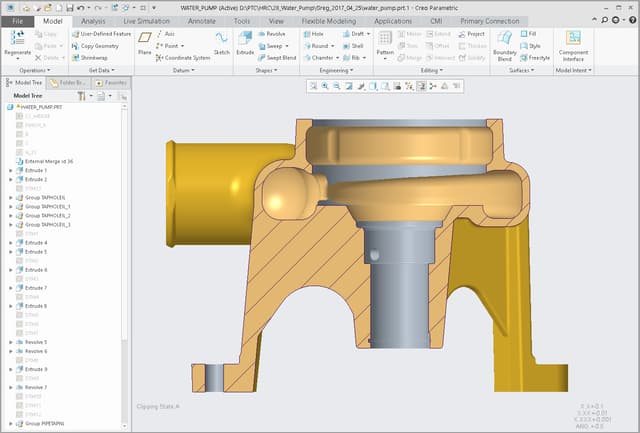
Designing new water pump in Creo

Designing new water pump in Creo

Designing

Due to the significant corrosion of the original part, Cummins could not use the model created from the scanned data as the basis for 3D printing. Instead, Cummins engineers imported the nonparametric model into PTC Creo® 3D CAD software to act as a template for creating a parametric model. In light of the physical damage to the scanned pump, the Cummins team had to make informed decisions as they 3D modeled the replacement to achieve a functional final model.

3D Printing

They then sent this file to the team at 3rd Dimension, who cleaned it up, analyzed it for optimal print orientation, and assigned supports for stable printing. 3rd Dimension engineers further sliced and hatched the part to define the movement of the laser during the build.

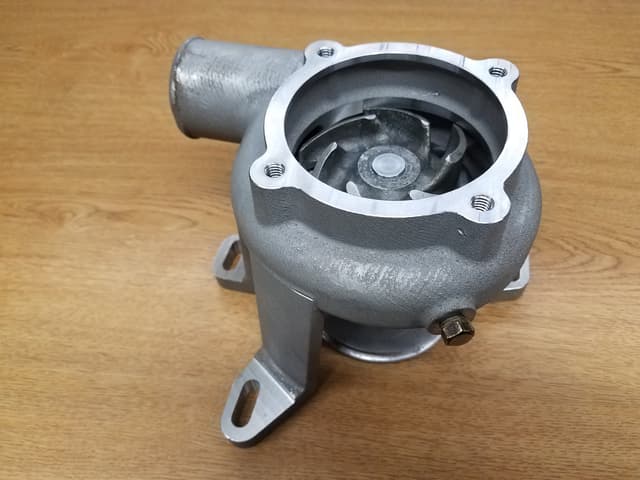
Although the original water pump housing had been made of magnesium to help reduce weight, magnesium’s susceptibility to corrosion following extended water and coolant exposure was a large factor in the problem Cummins was trying to solve. Therefore, 3rd Dimension manufactured the final 3D-printed part using LaserForm 316-L stainless steel material on a ProX DMP 320 metal 3D printer.

New 3D-printed water pump with impeller assembly

New 3D-printed water pump with impeller assembly

“The larger build volume of the ProX DMP 320 enabled us to have some additional options with part orientation, which helped us optimize supports, and the print speed allowed us to get the print done in the time we had,” said Bob Markley, president of 3rd Dimension. “The ProX DMP 320 also does not use a binder to join the material, which means the output is a pure alloy that performs like real metal—because it is real metal. This is a benefit to final part performance given the operational environment.”

Only three days after receiving the 3D file of the water pump geometry, 3rd Dimension sent Cummins the completed pump housing.

Making Racing History Again

The housing mated perfectly with the other pump components and provided like-new performance for over six Goodwood Hillclimb runs. Just as it had at Indy, #28 thrilled the fans at Goodwood and was featured in “The 10 Best Things We Saw at the 2017 Goodwood Festival of Speed” by Car and Driver magazine.

#28 Cummins Diesel Special at the 2017 Goodwood Festival of Speed

In addition, as it did for the Cummins 50th anniversary in 1969, the #28 had a featured role in celebrating the Cummins 100th anniversary by running a parade lap around the track prior to the start of the 2019 Indy 500 race.

Accelerating turnaround of CFD simulations

Product: Simcenter
Industry: Electronics and Semiconductors

Heraeus Noblelight GmbH has been developing specialty light sources since the invention of the quartz glass lamp in 1904. Light, whether ultraviolet (UV), infrared (IR) or middle wave range, is at the heart of everything they do. Located in Germany, the company has harnessed the power of light to solve a wide range of challenges in the manufacturing and process industries. They also design and manufacture consumer products like the Soluva® air purifier, for removing airborne viruses including the Coronavirus disease of 2019 (COVID-19) from healthcare settings, public transport and classrooms.

Engineering simulation is not only used during the product development phase, but also to understand the best way to deploy products in the field. “We use CFD simulation to help our customers understand their processes and where to locate our UV or IR emitters to make them most effective,” explains Dörte Eggers, simulation engineer at Heraeus Noblelight. Eggers continues, “sometimes a customer already has a process in operation that is not working optimally, so we also use simulation to troubleshoot and find ways to improve it.”

Modeling the complexity with CFD

Heraeus Noblelight products cater to a wide range of industrial processes, from curing paints and adhesives using precision IR emitters, to water and air disinfection equipment using ultraviolet C (UV-C). A range of modeling techniques are required to capture the prevalent physics regimes in each case.

“We selected Simcenter STAR-CCM+ for CFD analysis because it delivers a wide range of physics modeling options in a flexible and easy-to-use package,” says Dr. Larisa von Riewel, computer-aided engineering (CAE) group leader. “Our core workload is thermal management simulation. However, we often need to include additional physics like multiphase flow and particle tracking.”

Figure 1. Particle tracking analysis calculating residence time of air in the Soluva air purifier – a device for removing airborne viruses from public spaces.

Seeing the invisible

Since many of their products operate outside of the visible light spectrum, computational fluid dynamics (CFD) simulation is a valuable tool for verifying specific applications, tailored to each customer’s process. Therefore, CFD has become a routine part of the sales process and requires a rapid turnaround of simulation work. This provides confidence that the construction team will deliver a high performing product and add significant value for customers.

As well as making invisible light visible, using CFD analysis makes the unmeasurable measurable. “In some cases, running physical trials is very expensive and sometimes impossible,” states von Riewel. “Taking our IR emitters as an example, simulation is essential as it enables us to estimate parameters we cannot physically measure. Understanding this behavior is critical for achieving the functionality and lifespan we need from the devices.”

Communicating the insights gained from simulation to a range of stakeholders is also an important part of the process. “Every new release of the software has additional post-processing features and we find these very useful to present simulation data to customers in the context of their equipment and processes,” says von Riewel.

Figure 2. The positioning and setup of IR emitters is key to manufacturing high quality products in the automotive industry.

Going faster with Simcenter Cloud HPC

Today, most CFD simulation at Heraeus Noblelight is done in-house using a large on-premise workstation. However, during busy periods, the team needs to tap into additional resources by outsourcing simulation work. The need to scale up and down quickly makes it difficult to manage licensing costs to cover short periods of use and to ensure that resources are used efficiently.

Over the past few months, Heraeus Noblelight has been an early-access user of Simcenter ™ Cloud HPC software, a new hybrid software as a service (SaaS) product, which enables simulation runs to be launched on cloud infrastructure directly from Simcenter STAR-CCM+ ™ software. These are part of the Xcelerator portfolio, the comprehensive and integrated portfolio of software and services from Siemens Digital Industries Software. By purchasing hardware and software in the same transaction and paying only for what is used, Heraeus Noblelight sees potential to gain more efficiency by being able to instantly access high performance computing (HPC) resources from anywhere, at any time.

Figure 3. Heraeus Noblelight Infradry Combi used for drying inks on paper. CFD is used to make sure the IR emitter is kept cool and to enable homogenous heating and drying.

Accessible

“When we are working with remote simulation teams, we often find we do not have HPC resources where we need them to be,” continues von Riewel. “Therefore, Simcenter Cloud HPC would enable us to speed up collaborative projects. We also would not need to worry about license costs going to waste if a project finishes sooner than expected.” Using the cloud means the HPC resources are readily accessible by all team members. “I would say the interface is user friendly and intuitive, with several options for monitoring the runs,” continues von Riewel. “Transferring the simulation files was fast and straightforward.”

For von Riewel and Eggers, simulation is a small part of their working day. Therefore, they are not able to devote as much time as they would like to researching and testing new models and features. Therefore, they rely on the expertise of the Simcenter customer support team and their dedicated support engineer (DSE). “We are always under time pressure. When we face new challenges, we prefer to go to our DSE who explains relevant new features and how they will benefit us. This is a great time saver,” von Riewel explains.

Flexible and scalable

As well as facilitating collaboration with remote teams, Eggers also sees potential to leverage cloud resources to run more ambitious simulations or broaden the scope of projects while still meeting tight deadlines. “In some cases, we need to run bigger models to capture more detail or run more simulations in the same amount of time. Simcenter Cloud HPC gives us that flexibility.”

Secure

Heraeus Noblelight frequently works on projects involving customer proprietary processes and technologies, so data privacy and security are critical for their business. “When we sign agreements with customers, there are usually terms restricting how and where we store and work on their data,” explains von Riewel. “Of course, all stakeholders need to be sure their data is safe. I expect attitudes will gradually change as the world adapts to this new way of working.”

Simcenter Cloud HPC is built on Amazon Web Services (AWS) cloud infrastructure and follows best practices developed by AWS and Siemens for developing and operating multi-tenanted SaaS applications. Users have complete control over data sovereignty and retention and the product will also go through the International Organization for Standardization (ISO) 27001 and System and Organization Controls 2 (SOC2) Type 1 certification.

“I am confident that Siemens is diligent in maintaining the necessary policies and certifications to satisfy us and, importantly, our customers,” von Riewel concludes.

Looking to the future

When asked about how running CFD simulations in the cloud might impact their work in the future, Heraeus Noblelight sees flexibility and accessibility as key benefits. “Since the pandemic, there has been a large shift toward remote work, which means there are not always people available to access workstations in the office when something goes wrong,” says von Riewel. “Being able to work on projects from anywhere in the world is a dream and I feel this is the way humanity should go.”

Von Riewel also sees the ability to scale up and down instantly as a future competitive advantage. “The world continues to develop and everything is increasing in complexity. Models are becoming more accurate and we need to capture more physical realism. You can guarantee we will frequently require more powerful HPC resources in the future. Simcenter Cloud HPC offers that agility, which translates to a more competitive offering for our customers.”

×