
+25 to 35% intralogistics improvement: Eye-opening simulation and analysis of manual vs. automated intralogistics and ASRS integration through Plant Simulation

Product: Tecnomatix
Industry: Autoinjectors
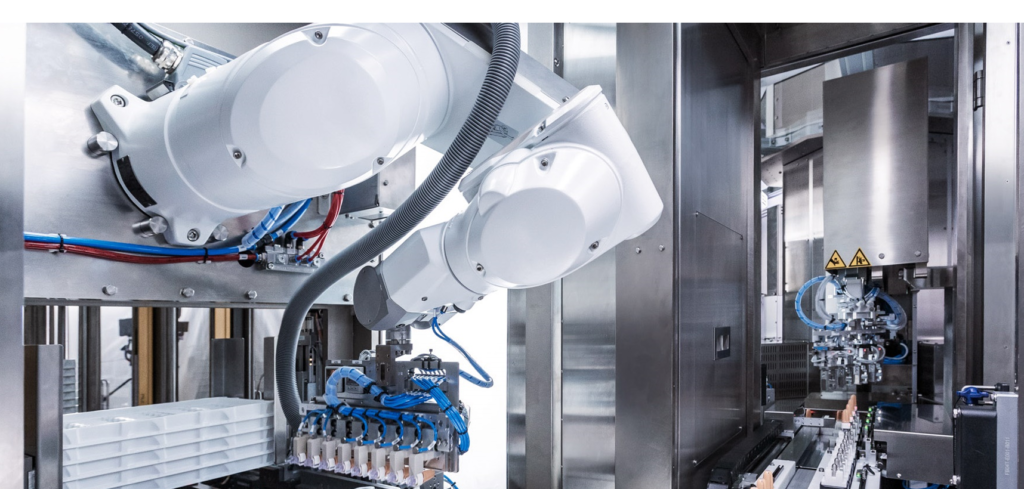
Exploring automation in autoinjector manufacturing: A comparative analysis for medical device production

SHL Medical; Lu Yi-Chi and Luigi Fumagalli

Medical device manufacturing processes have undergone significant transformations, particularly in the realm of automation. At the 2024 Plant Simulation User Conference, we delve into a comparative analysis of manual versus automated intralogistics and automated storage and retrieval system (ASRS) integration through Plant Simulation, shedding light on the transformative journey within autoinjector manufacturing.

Brief introduction to SHL Medical

Medical device production building; SHL Medical
Medical device production building; SHL-Medical

Founded with a noble ambition to improve the lives of patients reliant on self-injection solutions, SHL Medical pioneers advancements that foster patient independence and elevate their healthcare experience. Through partnerships with leading pharmaceutical and biotech companies, we deliver high-quality products and reliable platforms, empowering millions of patients annually and catalyzing positive change within the medical device and healthcare ecosystem.

What we do

At SHL Medical, we specialize in the design, development, and manufacturing of self-injection solutions, offering a comprehensive suite of services from design to build and contract manufacturing. Our portfolio includes autoinjectors, pen injectors, and innovative specialty delivery systems tailored for large-volume and high-viscosity formulations.

Background and objective

The transition from manual processes to automation in medical device autoinjector manufacturing presents a paradigm shift with profound operational implications. Our study, utilizing Tecnomatix Plant Simulation, aims to showcase the enhancements in production efficiency, inventory control, and overall process integration achieved through automation in medical device manufacturing. With a focus on optimized operational strategy, our objective is to provide a comparative analysis and actionable insights into integrating automation to enhance operational performance across key areas in medical device production.
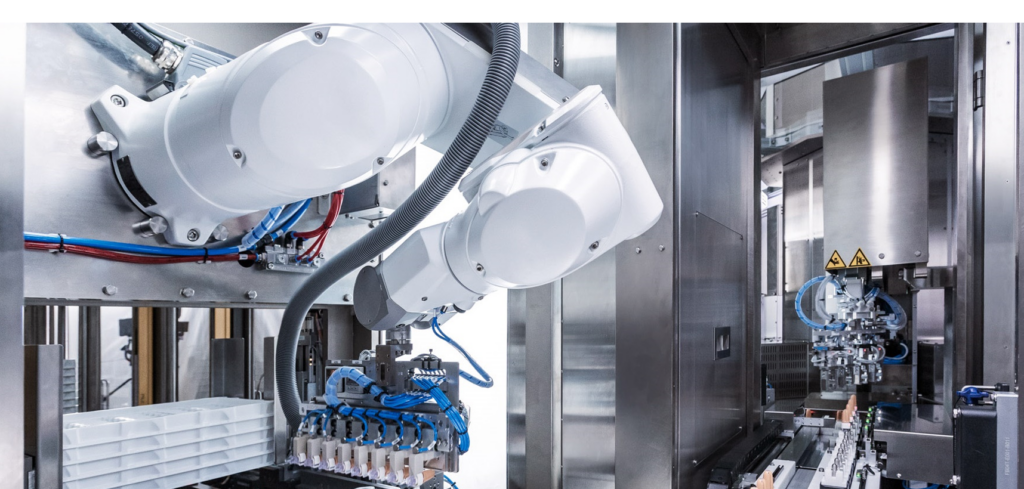
Medical device manufacturing of self-injection solutions

Addressing complexity challenges with Plant Simulation

Navigating the complexities of automation implementation necessitates overcoming several challenges. From data dependency and supplier collaboration to integration trials, each hurdle poses unique obstacles. However, Tecnomatix Plant Simulation emerges as a potent solution, enabling data adaptation, guiding suppliers with precise requirements, and minimizing costly trial-and-error processes.

Simulation model development

Central to our analysis is the development of a robust simulation model that encapsulates production data, layout design, operation flow, and intralogistics strategy. By meticulously crafting a virtual representation of manufacturing operations, we gain invaluable insights into the dynamics of manual and automated production stages.

Analysis of results

Our analysis delves into two key aspects: operation evaluation and performance comparison. By meticulously evaluating requirements, testing solutions, and implementing optimization adjustments, we unveil the tangible benefits of automation. From significant headcount savings to enhanced operation efficiency and intralogistics improvements, the data underscores the transformative impact of automation in autoinjector manufacturing.
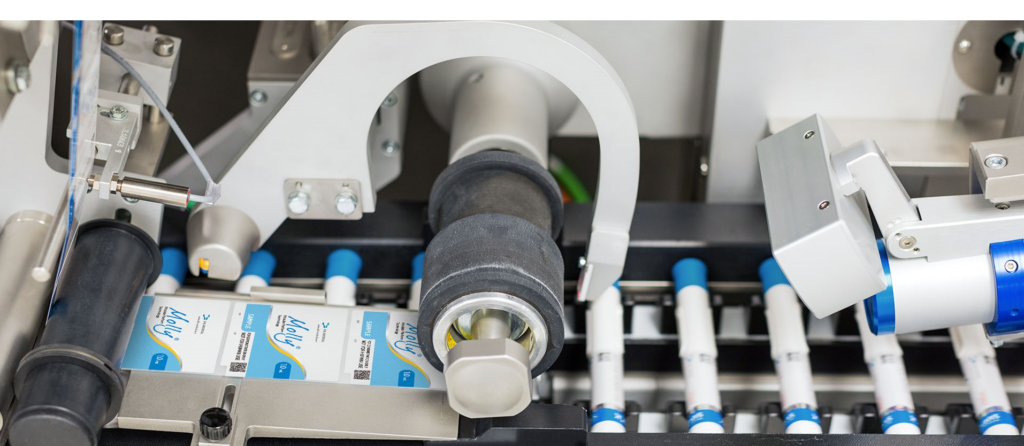
Medical device labeling of self-injection solutions

Analysis of results: Performance comparison

This segment delves into a comparative analysis between the manual and automated production stages, emphasizing the transformative changes achieved through automation and subsequent optimization adjustments. Utilizing plant simulation software as a powerful tool, the data presented below holds significance for the transition to automated systems, aiding in strategic decision-making and investment.

Benefits

  • -60% headcount saving: Automation drastically reduces the need for manual handling and supervision, resulting in a substantial decrease in labor costs.
  • 15 to -25% inventory level decrease: Automated systems facilitate more precise inventory control, leading to a notable reduction in excess stock and storage space requirements.
  • +25% operation efficiency: Enhanced automation fosters swift material movements and efficient management, thereby enhancing overall stability and throughput.
  • +25 to 35% intralogistics improvement: Optimized automated workflows streamline material handling processes, mitigating delays and boosting productivity. Furthermore, the automated storage and retrieval system (ASRS) effectively utilizes limited space, maximizing storage efficiency.

Conclusion

As we navigate the ever-evolving landscape of medical technology, automation emerges as a catalyst for innovation and efficiency. Through meticulous analysis and strategic insights, SHL Medical continues to spearhead transformative initiatives that redefine the boundaries of possibility within autoinjector manufacturing. Join us in shaping the future of healthcare delivery, one innovation at a time.

Innovation by nature thanks to IT/OT convergence

Product: Opcenter
Industry: Agriculture

Reshaping the potato starch industry

As a leading global player in the potato starch market, Royal Avebe has been reshaping the industry for over a century. Avebe was founded by local farmers in the Netherlands back in 1919. Since then, the small group of farmers has grown to more than 2000 members in the Netherlands and Germany.

Today, Avebe produces potato starch and potato protein, used in food and industrial applications. To get the most out of the potato, they are always looking for innovative solutions and products. Like any other company operating in a dynamic marketplace, Avebe faces its fair share of challenges, including keeping up with changing customer needs and market trends.

As consumer preferences shift towards healthier, natural, and clean-label products, Avebe continuously works to stay ahead of the curve. By investing in research and development, Avebe strives to create starch-based solutions that not only cater to evolving dietary requirements but also enhance the quality and taste of food products.

Avebe’s digitalization journey with Siemens and ATS Global

In their relentless pursuit of innovation and sustainability, Avebe recognized the need to embrace digital transformation to address the challenges in their industry. To achieve this, they teamed up with Siemens, a global technology leader, and ATS Global, a trusted solution partner specializing in IT and OT integration.

Through this strategic collaboration, Avebe embarked on a digitalization journey that revolutionized their production processes. By leveraging Siemens’ cutting-edge IT/OT integrated solutions, Avebe could, on one hand, reduce the workload for the operators, and on the other gained unprecedented insights into their operations, enabling them to optimize efficiency, increase productivity, and ensure consistent quality throughout their production lines.

The implementation of Siemens’ advanced technologies, such as Industrial Internet of Things (IIoT) platforms and data analytics tools, empowered Avebe to capture real-time data from their production facilities. With this data, Avebe can monitor key performance indicators, identify bottlenecks, and make data-driven decisions to drive continuous improvement.

ATS Global played a pivotal role in integrating Avebe’s IT and OT systems seamlessly. They delivered an MES/MOM system that included integration into ERP and shop floor.

The benefit of having one partner both on the IT and the OT is that they can see solutions for problems you don’t have yetJan Hessel Veurink, Manufacturing IT Engineer at Avebe

“We are utilizing our knowledge with our customers because we realized a long time ago that the IT and OT is so complex that it’s very difficult for the customers to follow. If you have to discuss this with single points, it gets very complicated very quickly”, says Rob Valent, Global Partner Manager at ATS Global “and our customers want a partner to help them basically reducing the complexity and not add complexity.”

By embracing digitalization, Avebe is able to tackle the growing demand for sustainable solutions head-on. Through optimized production processes and precise control over resources, Avebe significantly reduced waste, minimized environmental impact, and paved the way for a more sustainable future.

“The benefit of working with a company like Siemens is that it offers such a broad portfolio of IT / OT solutions, that we can select the solutions that best suit the customer needs.” says Rob

OKQ8 Creates Future-proof Digital Depot Management

Sweden’s leading fuel company uses Siemens Digital Enterprise portfolio and partner PlantVision for digital transformation in the Oil and Gas Industry

OKQ8, one of Sweden’s largest fuel companies, has increased operational reliability with a fully automatic depot management solution. Using Siemens Digital Industries Software solution partner, PlantVision AB, and the Siemens Digital Enterprise portfolio, OKQ8 has fully automated the fuel loading and unloading process, with full control and traceability in a modern, future-proof system.

OKQ8 was struggling to streamline their depot management. They needed better traceability, reliability, and user assistance to meet their customer follow-up needs. They wanted to create a more stable and efficient solution using trusted products and implementation resources.

OKQ8 chose the Siemens Xcelerator portfolio and PlantVision as their partners for digital transformation. Using Siemens SIMATIC PCS 7, COMOS, SMIT and Opcenter Execution Process software, OKQ8 knew that they had trusted solutions that had been vetted in the industry. PlantVision’s expertise with this full portfolio of products ensured the success of the project.

“It is great to have integration between all systems,” said Johan Bergstrand, automation engineer at PlantVision. “Having a standardized and integrated platform with COMOS, SIMIT, Opcenter Execution Process and SIMATIC PCS 7 connects everything in one database. Recipe management, I/Os and all the information are in the same place and synced between the systems. It is smart engineering.”

OKQ8 says the handling, which consists of loading, unloading, inventory levels, administration and invoicing, is now fully automated. The result is a reliable, modern, future-proof and significantly more efficient and traceable solution for depot management that can also be used for follow up and documentation.

Read the entire case study to learn how OKQ8 leveraged Siemens’ solutions and partner PlantVision to transform their depot management, the details of their implementation, and key learnings for your own operations.

BASF reduces batch production time by 5 – 10%


Using Siemens Opcenter, leading chemicals company streamlines production with digital manufacturing

BASF, one of the world’s largest chemical companies, has achieved the highest levels of operational excellence by streamlining the production of their crop protection solutions for soil management, plant health, pest control and digital farming. Their Xemium® product is an active and environmentally safe fungicide that enables highly reliable crop protection for greater yields, helping growers combine profitability with environment protection.

Xemium production runs 24 hours a day, 365 days per year and involves both continuous and batch processes as well as laboratory analyses for quality control and end-of-line packaging. BASF sought a digital solution that would help them reliably produce and package their fungicides, improve production transparency, and maximize productivity. They chose Siemens Opcenter as their foundation for digital manufacturing.

Opcenter allowed BASF to create vertical process integration, closing the digital gap between ERP and SCADA systems. Quality control was integrated throughout their digitalized production processes, with handheld scanners improving their data acquisition from operations.

The result was a complete digital thread that streamlined their manufacturing operations, reducing their batch production time by 5 to 10 percent. They were able to eliminate 5 days of manual paperwork per month by digitalizing their processes and capturing production data automatically. Their fungicide supply was delivered on a more timely schedule for their customers, promoting sustainable, high-yield farming.

W.A. Pfeiffer grows the business with digital manufacturing

Product: NX Manufacturing
Industry: Components

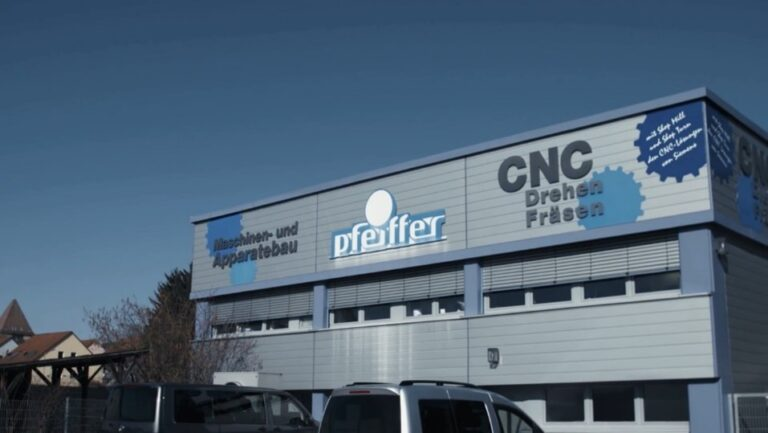
W. Andreas Pfeiffer – Maschinen- und Apparatebau manufactures precision components for a wide variety of applications such as optical devices, machinery, and medical technology. This relatively small but highly-successful company competes globally with only 25 employees and 16 CNC machines in their production facility in the picturesque town of Zirndorf, Germany.

By using the digital manufacturing capabilities of Siemens Xcelerator, W.A. Pfeiffer transformed their operation, manufacturing high-quality products and continuously growing the business, despite the highly competitive global market. 

Building a seamless digital manufacturing process

Operating as a small company, W.A. Pfeiffer faced difficulties in growing and increasing new capabilities at their location, as the facility cannot be physically expanded further. Andreas Pfeiffer, CEO, recognizes  the challenging circumstances but knows embracing digitalization would provide its operations with a competitive edge. “The goal is to achieve higher production automation and end-to-end connectivity so that we can reduce set-up times and minimize throughput times,” said Andreas Pfeiffer, CEO.

To eliminate these challenges, W.A. Pfeiffer now operates as an all-encompassing digital CAD/CAM/CNC chain to transform the business into a digital machine shop.

For W.A. Pfeiffer the Teamcenter PLM software helps with the management of all the data for the part manufacturing process, which begins with the incoming customer order. 3D data is seamlessly transferred from Teamcenter to NX CAD/CAM to generate programs for the CNC machines. Using Mcenter, formerly SINUMERIK Integrate, the CNC programs and tool lists are seamlessly transferred to production.

By integrating order planning into the digital manufacturing process, W.A. Pfeiffer witnessed immediate improvements with setup and throughput times. Opcenter APS helps them to access detailed information about production orders and monitor resource utilization.

W.A. Pfeiffer’s customer and supplier relations have significantly advanced, and internal collaboration is better streamlined by using Siemens’ range of software solutions.

High-performance machining with NX CAM    

NX CAM software helped W.A. Pfeiffer to improve productivity both during the planning and in the production phase. The company leverages NX’s advanced capabilities to create innovative high-speed machining strategies and generate machine-specific NC programs using cloud-based postprocessing.  

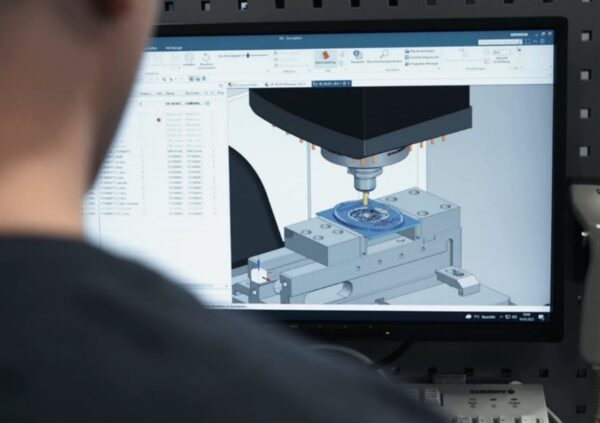
Thanks to the G-code-driven simulation in NX, engineers can digitally verify the generated operations. The advanced capability allows them to evaluate and optimize the processes before transferring them to production, saving setup time and increasing machine uptime. Siemens’ NX CAM helps the company run error-free and highly efficient part production on the shop floor.

The digital machine shop advantages

This highly successful yet lean company relies on the Siemens’ digital solutions to continuously grow and scale their manufacturing business. With the introduction of NX CAM, Teamcenter, Opcenter APS, and Mcenter, W.A. Pfeiffer achieved higher automation, seamless end-to-end connectivity, and shorter lead times.  

Using advanced toolpath technologies helped W. Andreas Pfeiffer reduce the machining cycle by 25% while extending tool life. I expect that we will be able to reduce setup times by up to 50% overall.

Andreas Pfeiffer, CEO

Teamcenter Easy Plan does what it says

Product: Teamcenter
Industry: Home appliances

Teamcenter Easy Plan at BSH Home Appliances

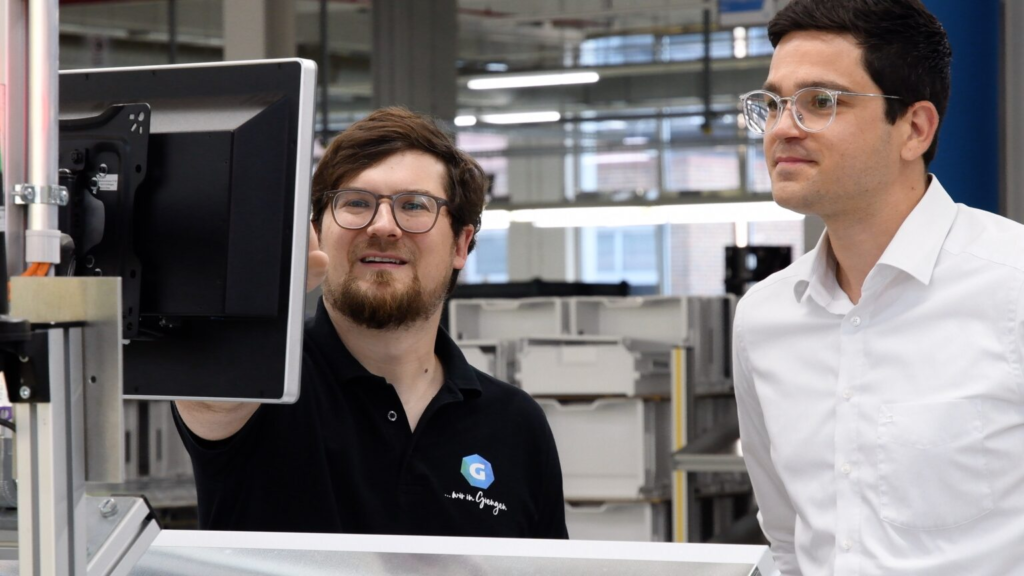
We love to hear how Teamcenter and Siemens Xcelerator tools help our customers succeed. This story looks at the global roll-out of Teamcenter Easy Plan at BSH Home Appliances. We were lucky enough to go straight to the heart of Germany to the BSH plant in Giengen to see the results firsthand.

I don’t know how many of you have been shopping for a new refrigerator lately, but the selection seems mind-bogglingly endless compared to what I remember from my first fridge purchase in the 1990s. It used to be that you just measured your space, tallied up your budget, and, presto, out you went to your local (Siemens) dealer to buy a classic white stand-up model with a little freezer unit on top.

Today, all this has changed. Or at least most of it. You’ll probably hit the Internet for reviews and ideas, maybe google for the best price and performance, and then the tough decisions start: which fridge do you choose?

Brands, model variations and more

First, do you want a freestanding or a built-in? Then what size exactly? What about finishings: inox, black glass, a color, or plain old white? Glossy, matte or in-between? Fridge on top and freezer on the bottom? Or vice-versa? American side-by-side doors? French doors? Mid-storage drawers? Door-in-door technology? Craft icemaker? And water dispensers of all shapes and sizes…Not only how do you select one? How do you manufacture all this choice? Earlier this year, we were lucky enough to visit BSH Home Appliances in Giengen, Germany to hear how Teamcenter Easy Plan helps.

BSH Home Appliances is one of the largest manufacturers of its kind in the world and is number one in Europe. BSH manufactures refrigerators, washing machines, dishwashers, induction cooktops, cordless vacuum cleaners, espresso machines and much more for well-known and respected brands like Bosch, Siemens, NEFF and Gaggenau.

With 62,000 employees and 41 plants worldwide (at time of publishing this blog), BSH manages a huge portfolio with hundreds of product variants on a global scale. Production can vary from plants that make only washing machines to plants like the one in Giengen, which makes only built-in refrigerators and freezers. Other BSH sites focus on small innovative appliances like espresso machines and cordless vacuum cleaners. In most cases, each of the 41 BSH sites manufacture product variants for more than one brand.

“Imagine a production line with over several hundred products,” says Philipp Winter, an IT business consultant in the Global Digital Services Department of BSH Digital Factory. “Our production lines have to adapt constantly, as well as line operators and the planners.”.

Manufacturing planning complexity

Depending on the plant, operators might build twenty-five Siemens built-in refrigerator models followed by 25 Bosch models with different tray designs and then still other different models for other brands – all on the same line. Other plants might have robotic lines that makes slightly different home appliance models for every type of consumer in the portfolio.

It is hard to imagine how one starts to organize such a complex production process on a global scale. But Philipp Winter, an IT business consultant in the Global Digital Services Department of BSH Digital Factory, and his colleague, Sacha Weckend, an industrial engineer responsible for the Teamcenter Easy Plan implementation at the Giengen, Germany plant were happy to explain how they count on Siemens tools for manufacturing planning.

As you see, BSH uses Teamcenter® software to runs its entire product development database. In 2015, BSH extended this to all manufacturing and planning data, integrating Teamcenter and the Tecnomatix® portfolio, which are part of the Siemens Xcelerator portfolio, the comprehensive and integrated portfolio of software, hardware and services, into its digital factory ecosystem.

At most of the BSH locations, local industrial engineers and planners have access to tools including Easy Plan, which is built on top of Teamcenter, Process Simulate in the Tecnomatix portfolio and Line Designer. These tools allow BSH to organize and optimize production lines for maximum performance for globally distributed plants, complex product variation schemes, line balancing, productivity and production efficiency, human health and safety issues, robotics and even collaborative robots (cobotics).

Teamcenter Easy Plan is just very easy to use

“You reach a limit at some point where you need special software to face and challenge this complexity in manufacturing,” says Winter. “We have leveraged digital manufacturing solutions from the Siemens Xcelerator portfolio for many years. This has resulted in an accurate digital twin of our factory ecosystem. Now we have added Easy Plan, which is our latest planning software, to do our line balancing and all our time management on the production lines.”

“We have specific cycle times for our assembly lines,” says Sasha Weckend. “For each workstation we try to find the perfect amount of work content. You can learn Easy Plan quite fast. It is easy for me to train new colleagues, trainees and students. The user interface is quite intuitive. If you have worked with an internet browser then you know where you have to click with Easy Plan. Easy Plan is just very easy to use. I think this is why the implementation is quite seamless.”

So, thanks to some pretty special Siemens software, an accurate digital twin of the BSH factory ecosystem, and the ease-of-use of Teamcenter Easy Plan, it looks like BSH Home Appliances is well on its way to successfully tackling modern-day process and product complexity to make the fridges (and home appliances) we will want to buy in the future.

Siemens’ expansion of its production capacity in Ciudad Juarez will significantly boost its foreign sales.

Siemens Mexico, Central America, and the Caribbean have inaugurated ITESA 4, a new manufacturing facility spanning 16,000 m², focused on producing devices for energy measurement and distribution.

With a presence of 130 years in Mexico and nearly four decades in Ciudad Juarez, Chihuahua, the company highlights that the investment of over 300 million pesos is aimed at meeting the demand of the North American market, particularly in the residential sector. Alejandro Preinfalk, President and CEO of Siemens in Mexico, Central America, and the Caribbean, stated, “Through initiatives like the one we are presenting today, we will continue to collaborate as a strategic partner of Mexico to strengthen its position as a leader in digital, secure, and sustainable electrification.”

Over four implementation phases, scheduled to conclude by the end of next year, four product assembly lines will be installed and six will be relocated, specializing in manufacturing processes (CNC stamping, metal bending, welding, and painting) for metallic components and aluminum bars. As a result, a double-digit increase in export operations is anticipated. “We have estimated that this productive expansion will boost our exports by 16%, allowing us to meet the demand of our primary market,” emphasized Rolando Calderón, Manufacturing Director in the region.

María Angélica Granados, Secretary of Innovation and Economic Development of the State, emphasized the economic impact of the project and the over 260 associated direct job opportunities: “Siemens’ expansion will create employment, benefiting hundreds of families […] The development of labor skills in the manufacturing industry adds value; it’s about skilled labor […]”.

During the opening ceremony, Mayor Cruz Pérez highlighted the pivotal role played by the human factor in the area’s economic and industrial processes: “Juárez is an industrial powerhouse thanks to its people; it’s the talent and capacity of its population that place the city in a prominent position nationally and internationally”.

Marco Cosío, Vice President of Siemens’ Smart Infrastructure business, stated: “We are committed to redefining our boundaries and transforming our processes to lead the electrification of homes, industries, and communities”.

According to the company, this investment supplements other recent announcements, bringing the total investment to approximately 2.2 billion pesos and creating more than 1,000 direct jobs.

Streamlining planning and scheduling processes to achieve on-time delivery on average 96 to 98 percent of the time

Product: Opcenter
Industry: Aerospace & defense

Applied Composites, founded in 1982, is a global leader in the composites industry, providing composite solutions for air-frames, engines, defense and mission systems, launch vehicles and satellite structures. Overall, the company aims to strategically offer engineering services, programmatic support and vertically integrated manufacturing capabilities to customers in the aerospace and defense industries. Applied Composites has a long customer satisfaction history thanks to their focus on improving their processes to reduce time and costs.

However, as Applied Composites grew, they noticed issues regarding planning, scheduling and their overall processes. As a solution, the company consulted with Lean Scheduling International (LSI), part of ATS Global (ATS), a Siemens Digital Industries Software partner. This led to the company leveraging Opcenter™ software as a solution, which is part of the Siemens Xcelerator business platform of software, hardware and services.null

Keeping up with business growth challenges

Although business growth sounds like an overall win-win situation, there are challenges that come with it. Applied Composites realized that it was becoming more difficult to manage planning, scheduling and overall processes, especially when the company’s growth was affecting all areas. As the customer base grew, the amount of work grew, causing the need for more employees. With these compounding issues, the plant’s work environment also suffered, creating stress for workers to understand where products were and causing orders to go missing. Additionally, not knowing what materials they would need for certain jobs or not being able to schedule enough employees to run available machines was causing the company to fall behind.

During this period, Applied Composites was using spreadsheets and enterprise resource planning (ERP) software to create a detailed production report listing all customer jobs and ship-by dates. The ERP software would set the material dates using its built-in materials requirement planning (MRP) function; however, this system had flaws. It did not consider tooling as a constraint, which is crucial for accurately scheduling downstream operations in the manufacturing process. Due to this, Michael Moses, the master scheduler at Applied Composites, would have to schedule 6 to 8 weeks out after receiving the MRP process report.

Additionally, John Pettit, the operations manager at Applied Composites, describes the challenges of the supervisor’s role in the first operational step (laminating). First, they would have to look at the daily report. Then piece together how to manage the shop floor for the day. This includes figuring out what the delivery dates were, knowing that they had to have everything in their department at least four weeks before the due date and giving other departments a week to finish. Overall, the process was not optimal and left room for error.

Applied Composites knew they needed to find a way to overcome these issues, especially when it came to scheduling and planning. “Overall, we wanted to have a clear indication of what we could be delivering on,” says Moses.

Teaming up to find a solution

To find a solution, Applied Composites solicited help from LSI. At first, the company struggled with adapting to a solution that had an alternative approach to scheduling versus their original ERP software, leading the first implementation to not be successful. However, once the company was confident in LSI’s suggestion of using Opcenter Advanced Planning and Scheduling (APS), they were able to successfully implement it.

Using mini-proofs of concept, LSI worked with Applied Composites to suggest and gather data for driving their schedule. Additionally, by having a hands-on approach for configuring models and validating data requirements, the companies can test various validation scenarios.

Overall, Applied Composites chose Opcenter APS as their scheduling and planning solution because of its capability to manage complex scheduling requirements with multiple constraints active throughout the manufacturing process. This was something the company’s previous ERP software could not do.null

Overcoming planning and scheduling limitations

Before integrating Opcenter APS, Applied Composites experienced numerous limitations using their old solution. This included a lack of visibility for material availability, a reliance on the scheduler’s and shop floor supervisor’s tribal knowledge, a stressful and chaotic environment, exponential amounts of time spent on production scheduling and no solution to aid the scheduler in making decisions. However, thanks to Opcenter APS, they were able to overcome most of them.

To overcome these limitations, using Opcenter APS, Applied Composites was able to configure models to consider all constraints, from materials to tooling or molds to operator capabilities. From there, they could efficiently create a schedule according to the plant’s true capacity and not an estimate. With these configurations, the company could also improve their scheduling processes since the software could automatically make many of the scheduling decisions. Previously, the scheduler took hours to create a high-level report and then use it to create a schedule in a spreadsheet, leveraging knowledge and data from multiple sources.

As for visibility, using Opcenter APS, workers could see where the orders were in the plant, inform customers of actual lead times versus standard lead times and see if there were any potential issues downstream. Further, the ability to set accurate material demand dates and schedules was groundbreaking for the company. Now they could schedule over 30,000 operations quickly and easily, saving time and manual effort.null

Previously, department supervisors handled scheduling and processed downstream operations simultaneously, causing them to miss opportunities to maximize throughput and reduce changeover times. Additionally, Applied Composites considered assigning three schedulers to manage the plant’s activities; however, with Opcenter APS, they required one master scheduler, lowering the need for more workers for a specific task.

Overall, by using this solution, Applied Composites can generate an easy-to-follow schedule, helping them limit the decision-making happening on the shop floor and reducing stress and disorganization.null

Benefiting from Opcenter

Once Applied Composites fully integrated Opcenter APS, they pushed the software’s capabilities to the max, using nearly every out-of-the-box (OOTB) feature without customizations, reducing scheduling time from hours to minutes. Using this solution provided the company with an accurate schedule that respects tooling and machine constraints, labor and materials while maximizing set up time, prioritizing delivery dates and allowing them to flag priority customers. They can also stay on top of any issues or delays that may arise, allowing the company to immediately notify the customer and inform them of the recovery date.

“Using Opcenter APS ties it all together, giving us an opportunity to be upfront with our customers and to help identify what’s going to contribute the most success to the program,” says Moses.

Thanks to the constraint capabilities, Applied Composites can now streamline their tooling and labor processes. For tooling constraints, the company had unique challenges concerning molds, which multiple operations used. Once a mold was in use for one operation, it was used for multiple stages until the system released it later during a downstream process. This means that technicians cannot schedule that mold again until it is released. To overcome this challenge, the solution needed to commit those molds to each consecutive operation that required them, track their use and not allow another operation to schedule them until they were available.

As for labor constraints, the company used these at the department level; however, only certain operators had the specific resource skills or capabilities to use them. Using Opcenter APS, Applied Composites can now see the plant’s capacity, how many additional people they need to hire or if there is a tool constraint issue.null

“How many plants have full scheduling software that can do almost everything?” says Moses. “With Opcenter APS, we can accomplish everything from capacity planning to giving the shop floor technicians a visual board of what they need to work on in order that also allows them to see their monthly on-time delivery stats.”

Another major benefit of this solution was achieving on-time delivery on average 96 to 98 percent of the time. “By leveraging Opcenter APS, we can react to changes quicker,” says Moses. Since the company could react quicker, technicians could solve issues as soon as they received notification.

“Using Opcenter, we haven’t dipped below 96 percent for on-time delivery except maybe one or two times during the COVID supply shortage,” says Moses.

By implementing a data-driven solution like Opcenter APS, Applied Composites needs to keep its data accurate. This not only ensures that the solution continues to work but also helps the company standardize its processes and prioritize correcting data inaccuracies, keeping the company streamlined.

Overall, by implementing Opcenter APS, Applied Composites has a solution that is flexible enough to grow with its business and has almost doubled the number of scheduled operations.nullnull

Hyundai Motor Group uses AI to reduce the parameter optimization process from 1 week to 15 minutes

Product: Simcenter
Industry: Automotive

AI-powered shift left

In the vehicle development process, it is advantageous for companies to shift left in the V-cycle as much as possible. By avoiding late-stage design changes, engineering teams can achieve significant time and cost savings and help drive products to market faster.

Artificial intelligence (AI) is an increasingly popular tool to enable engineering teams to shift left. For example, engineers can train neural networks to search through enormous amounts of simulation models and data and help identify the ideal vehicle or component configuration.

Powered by AI, the effort to shift left is more urgent than ever as the world transitions to a more sustainable future with electrification. Many original equipment manufacturers (OEMs) are in the process of transitioning from producing internal combustion engines (ICEs) to battery-powered vehicles. Each of these vehicles has years of development data and simulation models that now need to be adapted for electrification.

Neural networks for vehicle target setting

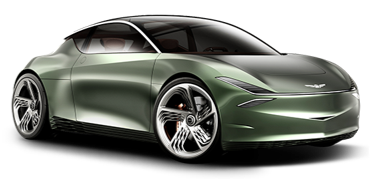
Simcenter Engineering Services and Hyundai Motor Group partnered to use AI to reduce the parameter optimization process for the Genesis GV 80.

At the start of their electrification journey, Hyundai Motor Group (HMG) recognized the need to implement AI to enable a seamless shift left in the electric vehicle development process. In 2023, they partnered with Simcenter Engineering and Consulting services to build the neural networks that will enable them to define architecture-driven requirements at the concept stage of vehicle development.

Early in the design process (at the left of the V-cycle), engineering teams typically have an estimate of what they would like to see from their next generation of vehicle, including mass, size, suspension technology, etc. These early ideas need to be explored and analyzed in the most efficient way possible to define the ideal design and configuration. Target setting for attributes such as optimal mass, kinematics, drivability, ride and handling gives engineering teams subjective key performance indicators (KPIs) to meet. The earlier these targets can be met, the more time and cost savings a company can reap.

Ilsoo Jeong, comfort engineer, is part of the driving comfort virtual development team at Hyundai Motor Group. His team was tasked with target setting for chassis development of the Genesis GV 80, which will be released in a future generation as an electric vehicle (EV).

“Our goal was to achieve the best possible comfort and handling performance, so we had to consider hundreds of chassis parameters, such as mass distribution, suspension kinematics, the mounting system,” says Jeong.  “We also needed to consider how these designs and configurations would need to be changed considering the ICE will be replaced with a battery.

“Additionally, we wanted the ability to perform sensitivity analyses to quickly understand how changes to the design of one component may impact the performance of others. We realized that taking advantage of AI could help us accomplish this quickly and efficiently. We partnered with Simcenter Engineering and Consulting Services to build these neural networks because they had the most expertise in Simcenter Amesim, our preferred tool, and because of their vast expertise in the vehicle development process.”

EV architecture optimization

In a separate project, the Simcenter Engineering Services team had collaborated with HMG engineers to develop an architecture in Simcenter Amesim software that could be used to evaluate a variety of vehicle maneuvers and provide automatic postprocessing.

This architecture allowed criteria to be weighed separately – including 52 individual KPIs for each requirement – to achieve an overall score, and it could handle over 350 parameters as input.

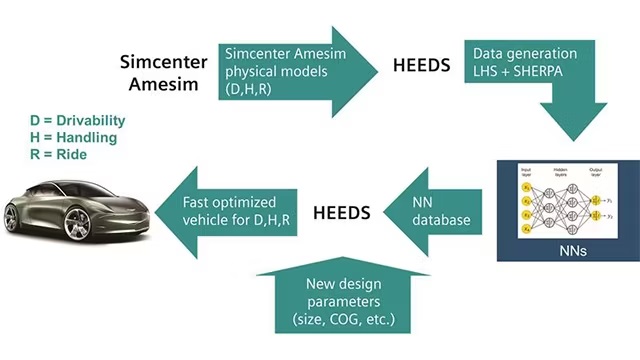
In this project, Simcenter Engineering Services expanded on this work to apply it to the chassis. Using the targets provided by HMG, Simcenter engineers generated over 200,000 simulation models in Simcenter Amesim and validated them against real vehicles. They saved the simulation results in a high-performance computing (HPC) to make them run faster in the future.

“Simcenter Amesim was the driving force behind our decision to select Siemens for this project,” explains Jeong. “Only Simcenter Amesim had the capabilities to perform the number of simulations we needed, as well as the flexibility for attributes such as NVH frequency. Simcenter Amesim was also advantageous because it enabled us to work with our own templates rather than a prepackaged one. When it came to flexibility and simulation time, Simcenter Amesim was the best choice.”

Using Simcenter Reduced Order Modeling software, Simcenter Engineering Services created and trained a neural network to deliver simulation results that enables direct optimization of models later in the process. This neural network integrates with HEEDS software to assist HMG engineers in identifying the ideal vehicle configuration.

Using AI to reduce the parameter optimization process from weeks to minutes

“If our targets or parameters change, we will no longer need to start the entire process from scratch,” says Jeong. “We can now find the optimal parameter set very quickly by searching through the neural network built by Simcenter Engineering Services. The ability to easily retrieve these simulation results means we can give very quick feedback to each subsystem team on the ideal configuration. Later in development, we will also be able to efficiently compare the vehicle’s driving performance to our targets by using the benchmarking data retrieved by the neural network.”

AI-enabled time savings

The collaboration with Simcenter Engineering Services and use of Simcenter software has led to significant engineering process benefits for Jeong’s team.

“Before this project, one requirement evaluation took two minutes to run in simulation,” says Jeong. “Using the neural network developed by Simcenter Engineering Services, this was reduced to one-tenth of a second. Similarly, our subsystem parameter optimization process used to take a week. With the help of Simcenter Engineering Services, this has been reduced to 15 minutes.”

Together, Jeong and the Simcenter Engineering Services team are working to reap even more efficiency benefits from this neural network. They will soon integrate with Teamcenter software to fully link to and provide traceability for parameters and requirements. This will enable a program manager with no knowledge of simulation to directly input their requirements and use parameters from a previous project to run simulations directly on the web. They can then predict system performance or optimize parameter sets for subsystems, bringing the power of system simulation to nonexperts.

“Siemens’ Simcenter portfolio and Simcenter Engineering Services will continue to be a special development partner for HMG,” says Jeong. “Our companies have a strong relationship and I look forward to collaborating on future projects.”

×