
Solid Edge Startup Spotlight: 120km range, up to 6kg payload and a partnership with UPS – Tom Plümmer from Wingcopter

Product: Solid Edge
Industry: SMEs

Tom Plümmer is the co-founder of Wingcopter, an aviation startup from Darmstadt that has dedicated itself to the subject of drones. Tom’s background is actually in the media sector, but via detours and an earlier startup he came across his current co-founder Jonathan, who heads the entire development department at Wingcopter. Together they have one goal: to use their technology to make the world good. This interview was recorded back May 2020, as part of the podcast series Startup Hacks from Bernhard Kalhammer.

Bernhard Kalhammer: Welcome to a new episode of Startup Hacks, today with a super exciting interview guest, Tom Plümmer from Wingcopter. He will explain to us what Wingcopter is and who Tom Plümmer is.

Tom Plümmer: Thank you for the invitation. I’m Tom, one of the founders of Wingcopter. To describe myself, I would say I’m not really an engineer. We have good people, who have taken over the whole engineering part, including my co-founder who works in this field. My background is in media – I studied Media Management with a focus on communication design and product design and filming.
I would say my time in Africa has probably shaped me the most.  I spent almost two years working with kids for an NGO in Ghana, which was very cool. During my studies, I went abroad again for one semester with the German Academic Exchange Service. Through the DAAD I was able to study for a year at the University of Accra, where I focused on film. I met many people there and had a very intense and good time. I love the continent, the positive energy of the people, the willingness to participate with great ideas.

Of course, the problems I experienced in Africa also shaped me. For example, if a health care system is not well built, supply and cooling chains are quite bad for medical goods. Those two factors resulted in chaos. I took my knowledge with me to Germany. Through my studies, I worked with technology. Unfortunately, I have never really developed any kind of technology or invented things myself.

Two things led the way to what we are doing today: Wingcopter. Starting in Africa and other countries, seeing a lot of development potential, especially in the areas of supply chain and healthcare. I needed drone technology to take aerial photos.

I started focusing more on drones and founded a small startup that offered drone services, while I was still in school. I worked with two partners who knew how to fly drones. My responsibilities included recording from the drones.

Filming can have a positive impact, but I wanted to use the drone technology for more than just filming, but it was underdeveloped at the time. The drones were not able to fly for a long time or far distance, but the visionary in me dreamed about using them for logistics. Having dinner with co-workers, we discussed the possibility of building new drones. This was not in any of our capabilities, the missing element was engineering abilities.

A co-worker recommended a smart talented engineer in Darmstadt, name of Jonathan Hesselbarth . He had built drones himself,  and has an engineering background, so thought maybe this would be an excellent contact.

I met Jonathan in 2015, and by that time Jonathan had been developing drones for five years. Jonathan studied engineering with a focus on aeronautics, lightweight construction and aerodynamics, and he was able to do exactly what I absolutely couldn’t. He wanted to create something big and been building prototypes since 2010. Basically, they were already the Wingcopter.

Bernhard Kalhammer: Crazy. What a stay in Africa. From the NGO to your first startup, which was already underway in the field of drones. You have to tell us what drones you used. And how you ended up with Wingcopter.

Tom Plümmer: The special thing about Wingcopter is the swivel rotor mechanism, which Jonathan invented to combine two drone types.

You have a multicopter that can take off and float in the smallest space, which simply flies upwards and does not need a runway. It creates the problem that you must generate buoyancy like a helicopter continuously to keep it in the air. Accordingly, the battery is empty quickly, which is the frustration that always comes with the drones.

Now people know more about this technology, because drones are gaining more and more popularity. At that time, it was so impressive. The drone takes off vertically, moves a little bit forward, and then out of the forest, out of a hole in the trees. It swings its rotors, and the thing shoots across the field and goes up in the air in big rounds, it flies like an airplane.

Drones always look more spider-like. What’s special is that our Wingcopter has a wing on the rotors that can swing 90 degrees. There are four rotors on the drone, the rear ones are going up, the other ones are going down. This technique gives very good stability during wind and makes the whole system extremely controlled. That means you have the same speed, flight time and range like a plane. There are also drones that are started with a catapult and captured again with nets.

All this is not necessary here, because the Wingcopter brakes in the air. It can fold the rotors back and just land and take off vertically. What’s special is that we have a platform that is simply efficient, that starts in the smallest of spaces, that can fly long and far and can carry a lot very quickly. The platform can be equipped with all possible sensors, for example with a delivery box.

We have a delivery box that can be dropped on a rope. After that the drone turns around and flies back to the landing point. The drone doesn’t even need to land in order to deliver.

A two-way delivery would be very valuable, if you deliver medicine and transport laboratory samples back. We also have multispectral cameras, which are good for agricultural smart farming, so you can create great mappings and measurements. We have installed lasers for laser scanners, as well as cameras with zoom and infrared. A huge range of solutions that are possible, thanks to Wingcopter. This allows us to serve a whole range of industries and customers, up to a maximum of 6 kilos. With the next version, it might be a lot more, so you will be able to put all kinds of stuff on it.

You would suddenly have a platform for 20 different solutions on 20 different markets. You can calculate what this would mean for the future of Wingcopter, it is important that we don’t lose focus.

Bernhard Kalhammer: I was just about to say that. Testing is always a good way to get a sense of what you’re focusing on. But you are absolutely right, if it is so multifunctional, it is difficult to keep an overview and not lose focus.

Tom Plümmer: Overall, we tested a lot. We tried a lot of different things, with many different customers on different markets, and then we figured out what worked the best. We are already part of this market and are already flying tests in several countries. In those countries, we also have permission to fly long distances. Those are delivery drones that deliver parcels.

We decided we were getting into logistics, and that was mainly my dream. I described earlier that it is my desire to improve the supply chains in developing countries and build health systems. With drones, we can skip the expansion of the highways, which would take a long time and would costs a lot. I see the possibilities.
We decided to focus on making deliveries by drone and perfect that. We have already gained experience in this area and delivered vaccines for children for UNICEF. With one flight we delivered 50 pieces, so a very large load.

Bernhard Kalhammer: You guys use a Siemens software, right? Solid Edge has also played an important part in prototype development in general, how did you use the Solid Edge software?

Tom Plümmer:We are very happy with the product. It’s our basic tool for development and adjustments. We can make optimizations, designs and adjustments according to customer requirements. All our engineers use Solid Edge.

I can’t say anything bad about it, it really helped us. How to start a startup is a good question. You must have certain licenses for programs, you have better conditions as a student, when you have a company, you have to pay for them. There are great programs out there. We’ve been sponsored for a while and the critical part is to create the final transformation. But we are well positioned in engineering now.

Bernhard Kalhammer: Like you said, Solid Edge has a start-up funding program.

In the beginning the cash is low and the motivation is high. We all want to start our own thing. If you are working with hardware like you, the investment is a completely different story. If you can save the costs for a great software for the first year, which contributes a significant part for the development of the product, that is amazing.

Tom Plümmer: Yeah, I put it a little fuzzy. Without this good offer for startup companies, it’s really hard to make the jump from student to company. If help is offered, please take it, that’s what helped us. Unfortunately, I cannot recall all the details of how long the grace period was. We had the chance to try the software and to decide that we wanted to work with this tool. Meanwhile, it helped us through the production and marketing process. I think that it could help many more startups.

Bernhard Kalhammer: Hey, it was a really cool interview. Thank you so much for your time. I truly enjoyed it. I wish you all the best for the future.

Young engineer in Zimbabwe exploring generative design

Product: Solid Edge
Industry: Academic

Wisdom James Murombo has a passion for engineering and has been exploring the use of new techniques to optimize his designs for strength and weight. Wisdom is in his third year of study of Industrial and Manufacturing Engineering at the National University of Science and Technology (NUST) in Bulawayo, Zimbabwe.

Optimizing designs using generative design

For design projects that are assigned to NUST students, Wisdom was motivated to think beyond conventional solutions and is exploring the use of generative design techniques in Solid Edge. “I’ve always been interested in engineering and design,” Wisdom says. “My father runs a workshop for diesel engine maintenance and I have learned many practical engineering techniques by helping him in his workshop. But I always wondered if the design of the engine components I worked on can be improved.”

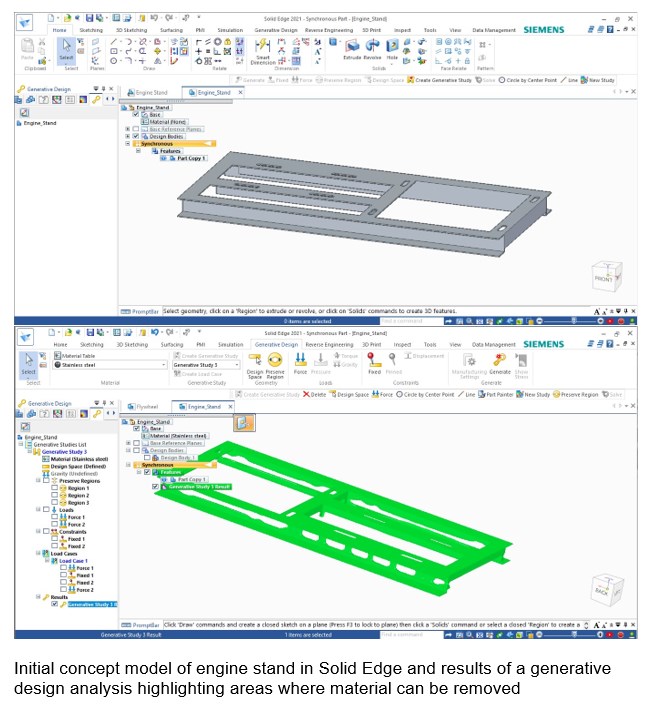
Wisdom continues: “I’m using Solid Edge with its generative design capabilities to investigate whether I can make components as light and efficient as possible while maintaining the required strength.” One of his recent projects was to design an engine mount to use in his father’s workshop: “I came up with an initial conceptual design and added the loads that the support will need to support. The generative design capability in Solid Edge shows me where the material can be reduced without compromising the strength of the stand.”

Design a system to help COVID19 diagnosis

Wisdom does not limit his talent to mechanical design projects. He also has skills in writing software and artificial intelligence. He recently joined forces with another student to design a system that processes x-ray images to support rapid diagnosis of COVID19 patients. Wisdom says: “Using AI techniques, the system has the potential to partially automate the initial diagnosis of patients. This can help our healthcare professionals work more efficiently with an increasing number of patients.” This project took second place in the 9th ICAT Tech-a-thon of the International Network of Appropriate Technology (INAT).

Future plans

When he graduates, Wisdom plans to apply his design and automation skills to work for a company in the areas of manufacturing, mining or automotive in Zimbabwe or abroad. Another possibility is for Wisdom to start its own business and be in addition to the Solid Edge for Startups program. We want Wisdom success in the future and hope you will continue to explore next-generation design technologies on Solid Edge.

Interview: Dan Swartz from Ventrac speaks Synchronous and SEU

Product: Solid Edge
Industry: Automotive abd Transportation

“We looked at other products, but the Solid Edge guys were able to show us what we wanted to see, that it was turning a 2d sheet metal part and put it in 3D. They were the only ones to do that, so we went with their product.”

Dan, how did you get involved in Solid Edge First?

I have a bit of a different background from a lot of Solid Edge users. I never went to engineering school or anything like that. I started in the paint line and worked until I entered the engineering office running autoCAD. Eventually I was doing CAD Admin, and it helped make the decision about moving to Solid Edge. We also looked at other products, but the Solid Edge guys were able to show us what we wanted to see, that it was turning a 2d sheet metal part and put it in 3D. They were the only ones to do that, so we went with their product.

We started using Solid Edge with V19 (approx. 2004, two versions before ST1), coming from AutoCAD. Our lead engineer still starts product designs in AutoCAD, but one of the great things about Solid Edge is that bringing autoCAD data is so easy, and we can keep working on design.

I’ve Heard You’ve Been to Solid Edge University A Couple of Times…

Shortly after we started using the software, we also started attending annual conferences. They weren’t called Solid Edge University back then. We attend meetings in Huntsville, Nashville, Cincinnati, Atlanta.

ventrac5.jpg

These conferences are like family reunions. We were Solid Edge SharePoint beta testers, so we can talk to other beta testers and see how they come with the new versions, other Solid Edge users, and we can always see the demos of the new software. Every year there are always new things, never the same, even though we come to these conferences year after year.

There are so many different classes, you really need to take a look at the agenda and choose and choose your interests. There are so many things you can’t do everything. Ventrac usually sends between 2 and 5 people. That way we can separate and each of us sees the sessions we’re interested in. On the way home we compare notes and then back in the office we update the rest of the Solid Edge users on the things that are most important to us.

I know that for a small business like Ventrac, an event like Solid Edge University was very difficult for us to justify the cost. But we went, and what we discovered is access to information and the people we know, it’s a great way to networking, learn some tips and tricks either from other users, or Siemens professionals themselves! If you are struggling in any area on Solid Edge, this is a place to figure out how to do that! You have classes where users like me are sharing what they do and how they use SE. so it’s very easy to relate to someone there. Like Synchronous, if you don’t know how, it’s scary. But go to SEU, attend a synchronous class, and ask questions about those who are using it.

There are some things that confuse me when I’m at one of these conventions. One is when I see companies that don’t keep up with the software. And also when people don’t even try some of the best new features like Synchronous. I’ll talk to someone and they’ll ask me how I do something, and I’ll tell them, and they could say, “I’ve never seen that before” “What version are you in?” “Oh, we’re in like ST2 or something.” Of course you’re going to miss a lot of great new tools when you never upgrade to the latest version.

ventrac2.jpg

Already using ST9?

ST9 has been available for a couple of weeks, and we’re installing it on our Share Point test server. We used to install the new version when we were using only Solid Edge, but since we now use Solid Edge SharePoint, we performed a trial installation to make sure everything works with Share Point.

Shy or Tidy?

We are a sheet metal shop and we work all our straight brakes. Kids in the store like to see drawings coming from Solid Edge. Most of our things are done in Synchronous, although sometimes we come across things that have to be done neatly. It baffles me why more people don’t use Synchronous. It makes a lot more sense. It’s easy to use, and you don’t have to worry about exploiting features or long rebuild times.

Do you have Any Tips for New Solid Edge Users?

The best advice I can give anyone who asks me what to do? Attend the next SEU, stay up-to-date on maintenance versions and packages, and learn synchronously. As I said before, Synchronous has changed CAD Forever. If you’ve never attended a Solid Edge University, start today! It’s worth the money!

ADIRA introduces a new additive manufacturing process for large-scale parts

Product: Solid Edge
Industry: Industrial Machinery

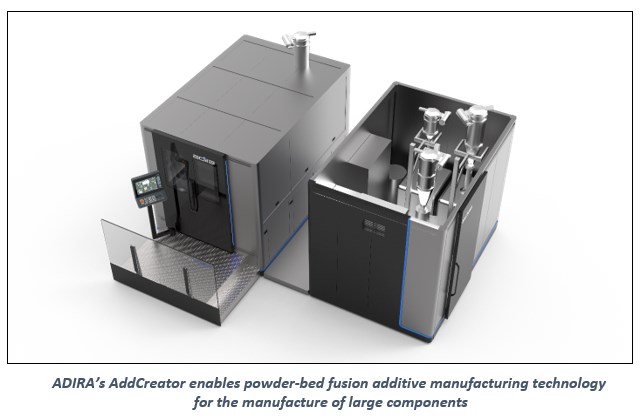
ADIRA, based in the Porto area of Portugal, has a long history of success in the design and manufacture of sheet metal machinery. Its products include press breaks, shears, laser cutting systems and custom solutions. ADIRA sells its machinery in 60 different countries where it is used by manufacturers in many different industrial sectors. ADIRA’s most recent approach focuses on additive manufacturing with the development of a radical new powder bed fusion system, the AddCreator.

Additive Manufacturing with Powder and Bed Fusion

Bed-powder fusion is a relatively recent technology that was first proposed in 1995. Use a laser or electron beam to melt and fuse metal dust. Other than sintering, the fusion of powder and bed completely melts the metal powder to produce a solid and homogeneous mass. This process can quickly and accurately create high-strength and geometrically complex components. ADIRA’s unique implementation of additive powder bed fusion manufacturing is called “laser shingle fusion”.

Unique Scaling Capacity For Large Component Manufacturing

According to Tiago Oliveira, Chief Marketing Officer of ADIRA, “A unique feature of the AddCreator is the ability to apply mosaic laser fusion to large-scale component manufacturing. We have developed a modular, mobile construction chamber that moves around the dust bed area. From a manufacturing planning perspective, larger components are divided into smaller segments. By using our patented scanning strategies, the scanning fields overlap ensuring the correct “dot” of the tiles. This results in highly accurate and homogeneous parts.”

The combination of the manufacture of large components and the accuracy of 100 microns of the laser system is giving rise to interest in AddCreator from manufacturers in different segments of the industry. An example is from the aerospace industry for the manufacture of turbine rotors. These components feature curved geometries and complex internal chambers and are very expensive to manufacture using traditional machining methods.

Using Solid Edge to Design the AddCreator

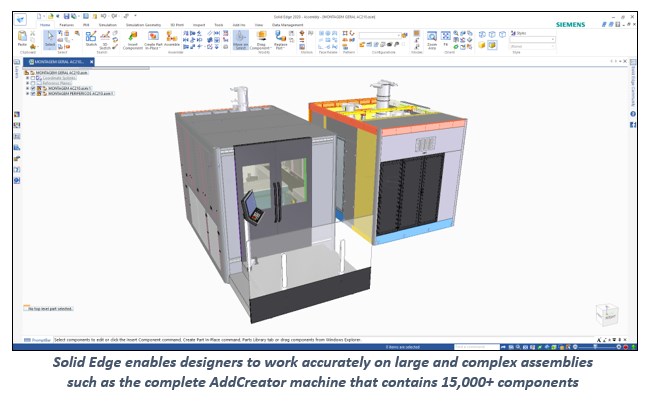
ADIRA has been using Solid Edge successfully for several years for the design of its sheet metal manufacturing machinery. They are now applying this knowledge to the development of AddCreator. The complete AddCreator machine includes structural elements, sheet metal housings, a grated system for positioning the construction chamber, and high-precision electromechanical subassemblies. According to AddCreator project manager Joao Paulo Santos, “we have created an accurate 3D CAD model of the complete machine with more than 15,000 components. Solid Edge allows us to work accurately in this very large assembly. For example, our designers can specify that certain areas of the assembly become “inactive” when they focus on other areas. This improves system interactivity for our designers.”

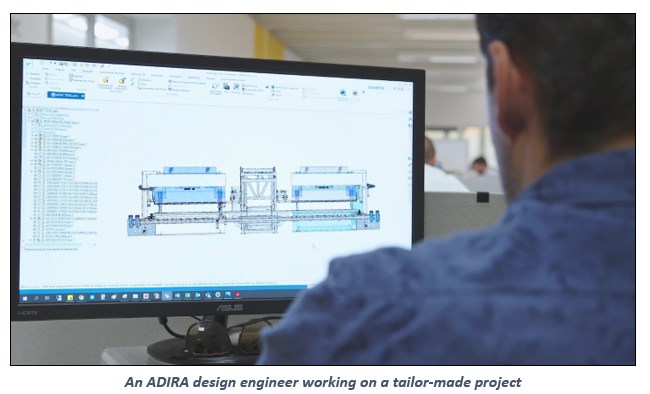
It also describes some of the benefits ADIRA is achieving using unique synchronous technology within Solid Edge: “Synchronous technology allows us to design faster and make changes more easily. An example of the power of synchronous technology is its ability to work with 3rd-part CAD data. One of our partners provides us with STEP files of the components they develop and manufacture for us. Using synchronous technology, we access the complete 3D design, use it in our assemblies, and directly edit smart features like holes.”

Partnering with Cadflow and Siemens

It continues, “We also receive high-quality technical support from our local channel partner Cadflow. We work with Cadflow to train in specific Areas of Solid Edge for our designers. We also participate in your solid edge-specific capabilities webinars, for example, in the design of steel structure structural elements.”

In the future, ADIRA plans to investigate additional Solid Edge capabilities. These include generative design, technical publications, electrical circuit design, and enhanced data management capabilities. ADIRA uses Siemens SIMATIC Controllers for its machines. Closer integration of the mechanical, electrical and software aspects of its designs is another area in which ADIRA sees interesting possibilities for future collaboration with Siemens.

×