
Streamlining planning and scheduling processes to achieve on-time delivery on average 96 to 98 percent of the time

Product: Opcenter
Industry: Aerospace & defense
Applied Composites, founded in 1982, is a global leader in the composites industry, providing composite solutions for air-frames, engines, defense and mission systems, launch vehicles and satellite structures. Overall, the company aims to strategically offer engineering services, programmatic support and vertically integrated manufacturing capabilities to customers in the aerospace and defense industries. Applied Composites has a long customer satisfaction history thanks to their focus on improving their processes to reduce time and costs.

However, as Applied Composites grew, they noticed issues regarding planning, scheduling and their overall processes. As a solution, the company consulted with Lean Scheduling International (LSI), part of ATS Global (ATS), a Siemens Digital Industries Software partner. This led to the company leveraging Opcenter™ software as a solution, which is part of the Siemens Xcelerator business platform of software, hardware and services.null

Keeping up with business growth challenges

Although business growth sounds like an overall win-win situation, there are challenges that come with it. Applied Composites realized that it was becoming more difficult to manage planning, scheduling and overall processes, especially when the company’s growth was affecting all areas. As the customer base grew, the amount of work grew, causing the need for more employees. With these compounding issues, the plant’s work environment also suffered, creating stress for workers to understand where products were and causing orders to go missing. Additionally, not knowing what materials they would need for certain jobs or not being able to schedule enough employees to run available machines was causing the company to fall behind.

During this period, Applied Composites was using spreadsheets and enterprise resource planning (ERP) software to create a detailed production report listing all customer jobs and ship-by dates. The ERP software would set the material dates using its built-in materials requirement planning (MRP) function; however, this system had flaws. It did not consider tooling as a constraint, which is crucial for accurately scheduling downstream operations in the manufacturing process. Due to this, Michael Moses, the master scheduler at Applied Composites, would have to schedule 6 to 8 weeks out after receiving the MRP process report.

Additionally, John Pettit, the operations manager at Applied Composites, describes the challenges of the supervisor’s role in the first operational step (laminating). First, they would have to look at the daily report. Then piece together how to manage the shop floor for the day. This includes figuring out what the delivery dates were, knowing that they had to have everything in their department at least four weeks before the due date and giving other departments a week to finish. Overall, the process was not optimal and left room for error.

Applied Composites knew they needed to find a way to overcome these issues, especially when it came to scheduling and planning. “Overall, we wanted to have a clear indication of what we could be delivering on,” says Moses.

Teaming up to find a solution

To find a solution, Applied Composites solicited help from LSI. At first, the company struggled with adapting to a solution that had an alternative approach to scheduling versus their original ERP software, leading the first implementation to not be successful. However, once the company was confident in LSI’s suggestion of using Opcenter Advanced Planning and Scheduling (APS), they were able to successfully implement it.

Using mini-proofs of concept, LSI worked with Applied Composites to suggest and gather data for driving their schedule. Additionally, by having a hands-on approach for configuring models and validating data requirements, the companies can test various validation scenarios.

Overall, Applied Composites chose Opcenter APS as their scheduling and planning solution because of its capability to manage complex scheduling requirements with multiple constraints active throughout the manufacturing process. This was something the company’s previous ERP software could not do.null

Overcoming planning and scheduling limitations

Before integrating Opcenter APS, Applied Composites experienced numerous limitations using their old solution. This included a lack of visibility for material availability, a reliance on the scheduler’s and shop floor supervisor’s tribal knowledge, a stressful and chaotic environment, exponential amounts of time spent on production scheduling and no solution to aid the scheduler in making decisions. However, thanks to Opcenter APS, they were able to overcome most of them.

To overcome these limitations, using Opcenter APS, Applied Composites was able to configure models to consider all constraints, from materials to tooling or molds to operator capabilities. From there, they could efficiently create a schedule according to the plant’s true capacity and not an estimate. With these configurations, the company could also improve their scheduling processes since the software could automatically make many of the scheduling decisions. Previously, the scheduler took hours to create a high-level report and then use it to create a schedule in a spreadsheet, leveraging knowledge and data from multiple sources.

As for visibility, using Opcenter APS, workers could see where the orders were in the plant, inform customers of actual lead times versus standard lead times and see if there were any potential issues downstream. Further, the ability to set accurate material demand dates and schedules was groundbreaking for the company. Now they could schedule over 30,000 operations quickly and easily, saving time and manual effort.null

Previously, department supervisors handled scheduling and processed downstream operations simultaneously, causing them to miss opportunities to maximize throughput and reduce changeover times. Additionally, Applied Composites considered assigning three schedulers to manage the plant’s activities; however, with Opcenter APS, they required one master scheduler, lowering the need for more workers for a specific task.

Overall, by using this solution, Applied Composites can generate an easy-to-follow schedule, helping them limit the decision-making happening on the shop floor and reducing stress and disorganization.null

Benefiting from Opcenter

Once Applied Composites fully integrated Opcenter APS, they pushed the software’s capabilities to the max, using nearly every out-of-the-box (OOTB) feature without customizations, reducing scheduling time from hours to minutes. Using this solution provided the company with an accurate schedule that respects tooling and machine constraints, labor and materials while maximizing set up time, prioritizing delivery dates and allowing them to flag priority customers. They can also stay on top of any issues or delays that may arise, allowing the company to immediately notify the customer and inform them of the recovery date.

“Using Opcenter APS ties it all together, giving us an opportunity to be upfront with our customers and to help identify what’s going to contribute the most success to the program,” says Moses.

Thanks to the constraint capabilities, Applied Composites can now streamline their tooling and labor processes. For tooling constraints, the company had unique challenges concerning molds, which multiple operations used. Once a mold was in use for one operation, it was used for multiple stages until the system released it later during a downstream process. This means that technicians cannot schedule that mold again until it is released. To overcome this challenge, the solution needed to commit those molds to each consecutive operation that required them, track their use and not allow another operation to schedule them until they were available.

As for labor constraints, the company used these at the department level; however, only certain operators had the specific resource skills or capabilities to use them. Using Opcenter APS, Applied Composites can now see the plant’s capacity, how many additional people they need to hire or if there is a tool constraint issue.null

“How many plants have full scheduling software that can do almost everything?” says Moses. “With Opcenter APS, we can accomplish everything from capacity planning to giving the shop floor technicians a visual board of what they need to work on in order that also allows them to see their monthly on-time delivery stats.”

Another major benefit of this solution was achieving on-time delivery on average 96 to 98 percent of the time. “By leveraging Opcenter APS, we can react to changes quicker,” says Moses. Since the company could react quicker, technicians could solve issues as soon as they received notification.

“Using Opcenter, we haven’t dipped below 96 percent for on-time delivery except maybe one or two times during the COVID supply shortage,” says Moses.

By implementing a data-driven solution like Opcenter APS, Applied Composites needs to keep its data accurate. This not only ensures that the solution continues to work but also helps the company standardize its processes and prioritize correcting data inaccuracies, keeping the company streamlined.

Overall, by implementing Opcenter APS, Applied Composites has a solution that is flexible enough to grow with its business and has almost doubled the number of scheduled operations.nullnull

Hyundai Motor Group uses AI to reduce the parameter optimization process from 1 week to 15 minutes

Product: Simcenter
Industry: Automotive

AI-powered shift left

In the vehicle development process, it is advantageous for companies to shift left in the V-cycle as much as possible. By avoiding late-stage design changes, engineering teams can achieve significant time and cost savings and help drive products to market faster.

Artificial intelligence (AI) is an increasingly popular tool to enable engineering teams to shift left. For example, engineers can train neural networks to search through enormous amounts of simulation models and data and help identify the ideal vehicle or component configuration.

Powered by AI, the effort to shift left is more urgent than ever as the world transitions to a more sustainable future with electrification. Many original equipment manufacturers (OEMs) are in the process of transitioning from producing internal combustion engines (ICEs) to battery-powered vehicles. Each of these vehicles has years of development data and simulation models that now need to be adapted for electrification.

Neural networks for vehicle target setting

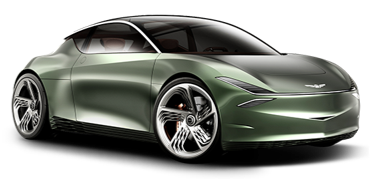
Simcenter Engineering Services and Hyundai Motor Group partnered to use AI to reduce the parameter optimization process for the Genesis GV 80.

At the start of their electrification journey, Hyundai Motor Group (HMG) recognized the need to implement AI to enable a seamless shift left in the electric vehicle development process. In 2023, they partnered with Simcenter Engineering and Consulting services to build the neural networks that will enable them to define architecture-driven requirements at the concept stage of vehicle development.

Early in the design process (at the left of the V-cycle), engineering teams typically have an estimate of what they would like to see from their next generation of vehicle, including mass, size, suspension technology, etc. These early ideas need to be explored and analyzed in the most efficient way possible to define the ideal design and configuration. Target setting for attributes such as optimal mass, kinematics, drivability, ride and handling gives engineering teams subjective key performance indicators (KPIs) to meet. The earlier these targets can be met, the more time and cost savings a company can reap.

Ilsoo Jeong, comfort engineer, is part of the driving comfort virtual development team at Hyundai Motor Group. His team was tasked with target setting for chassis development of the Genesis GV 80, which will be released in a future generation as an electric vehicle (EV).

“Our goal was to achieve the best possible comfort and handling performance, so we had to consider hundreds of chassis parameters, such as mass distribution, suspension kinematics, the mounting system,” says Jeong.  “We also needed to consider how these designs and configurations would need to be changed considering the ICE will be replaced with a battery.

“Additionally, we wanted the ability to perform sensitivity analyses to quickly understand how changes to the design of one component may impact the performance of others. We realized that taking advantage of AI could help us accomplish this quickly and efficiently. We partnered with Simcenter Engineering and Consulting Services to build these neural networks because they had the most expertise in Simcenter Amesim, our preferred tool, and because of their vast expertise in the vehicle development process.”

EV architecture optimization

In a separate project, the Simcenter Engineering Services team had collaborated with HMG engineers to develop an architecture in Simcenter Amesim software that could be used to evaluate a variety of vehicle maneuvers and provide automatic postprocessing.

This architecture allowed criteria to be weighed separately – including 52 individual KPIs for each requirement – to achieve an overall score, and it could handle over 350 parameters as input.

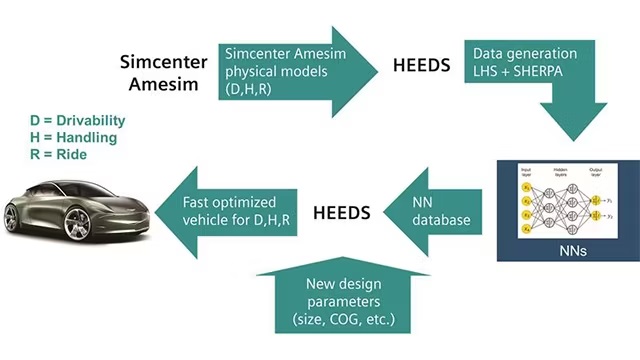
In this project, Simcenter Engineering Services expanded on this work to apply it to the chassis. Using the targets provided by HMG, Simcenter engineers generated over 200,000 simulation models in Simcenter Amesim and validated them against real vehicles. They saved the simulation results in a high-performance computing (HPC) to make them run faster in the future.

“Simcenter Amesim was the driving force behind our decision to select Siemens for this project,” explains Jeong. “Only Simcenter Amesim had the capabilities to perform the number of simulations we needed, as well as the flexibility for attributes such as NVH frequency. Simcenter Amesim was also advantageous because it enabled us to work with our own templates rather than a prepackaged one. When it came to flexibility and simulation time, Simcenter Amesim was the best choice.”

Using Simcenter Reduced Order Modeling software, Simcenter Engineering Services created and trained a neural network to deliver simulation results that enables direct optimization of models later in the process. This neural network integrates with HEEDS software to assist HMG engineers in identifying the ideal vehicle configuration.

Using AI to reduce the parameter optimization process from weeks to minutes

“If our targets or parameters change, we will no longer need to start the entire process from scratch,” says Jeong. “We can now find the optimal parameter set very quickly by searching through the neural network built by Simcenter Engineering Services. The ability to easily retrieve these simulation results means we can give very quick feedback to each subsystem team on the ideal configuration. Later in development, we will also be able to efficiently compare the vehicle’s driving performance to our targets by using the benchmarking data retrieved by the neural network.”

AI-enabled time savings

The collaboration with Simcenter Engineering Services and use of Simcenter software has led to significant engineering process benefits for Jeong’s team.

“Before this project, one requirement evaluation took two minutes to run in simulation,” says Jeong. “Using the neural network developed by Simcenter Engineering Services, this was reduced to one-tenth of a second. Similarly, our subsystem parameter optimization process used to take a week. With the help of Simcenter Engineering Services, this has been reduced to 15 minutes.”

Together, Jeong and the Simcenter Engineering Services team are working to reap even more efficiency benefits from this neural network. They will soon integrate with Teamcenter software to fully link to and provide traceability for parameters and requirements. This will enable a program manager with no knowledge of simulation to directly input their requirements and use parameters from a previous project to run simulations directly on the web. They can then predict system performance or optimize parameter sets for subsystems, bringing the power of system simulation to nonexperts.

“Siemens’ Simcenter portfolio and Simcenter Engineering Services will continue to be a special development partner for HMG,” says Jeong. “Our companies have a strong relationship and I look forward to collaborating on future projects.”

Robopac moves toward 50% production capacity increase with Siemens Opcenter

Product: Opcenter
Industry: Machinery solutions

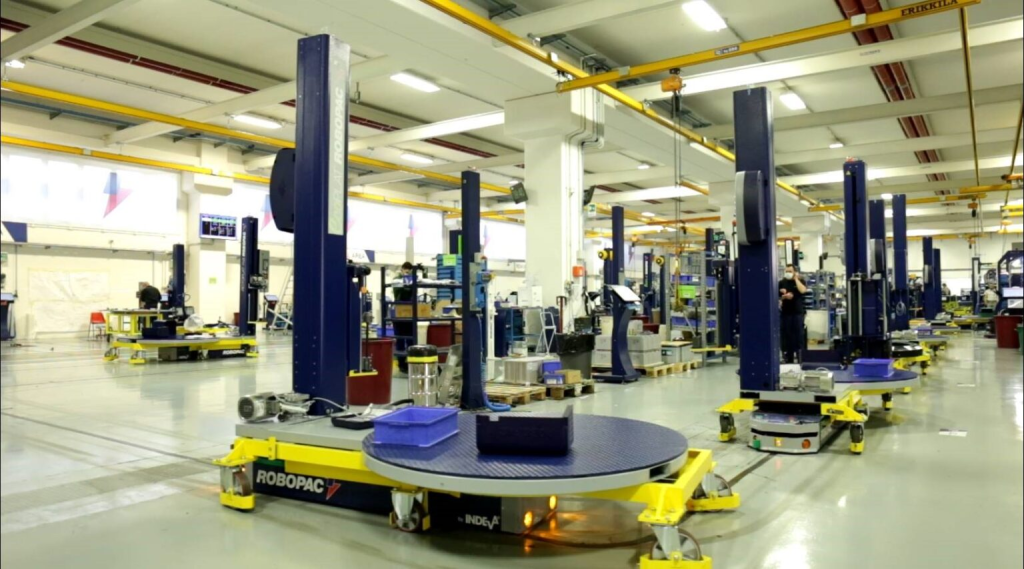
Global manufacturer of packaging machine solutions launches the Robopac Smart Factory

Since 1982, Robopac has been manufacturing end-of-line solutions, including semi-automatic wrapping machines with smart technology, industrial shrink wrappers, shrink wrapping machines, case packers, and tailor-made packaging solutions. The company has grown into a global leader in the packaging sector, with seven manufacturing facilities (five in Italy, one in the US, and one in Brazil) along with nine subsidiaries across the world. Robopac has the capacity to manufacture 50,000 machines each year. It emphasizes high-performance packaging solutions with extreme attention to the circular economy.

Robopac has experienced growing demand both in the volume of machines it manufactures and in the variety of products it offers.  “Our customers are requesting customized products more and more,” explains Alessandro Manduchi, Robopac operations manager. “Robopac offers a very high number of configurations for each of our packaging machines, and this is one of our key differentiators.”

To keep up with demand for customized products without compromising manufacturing cycle time or quality, Robopac is making its production process more flexible and capable. The company recently initiated the “Robopac Smart Factory” project, which includes (1) a reorganization of the production system and industrial layout and (2) digitalization of core processes and operations.

For its digitalization efforts, Robopac selected Siemens Opcenter manufacturing operations management (MOM) platform. The Robopac technology team determined that Opcenter is ideally suited to support the company’s expected volume growth while ensuring greater process efficiency, flexibility and quality, as well as service reliability for Robopac customers. “Siemens offered a complete end-to-end solution for our scheduling, manufacturing, reporting and quality control processes in the production area,” Manduchi summarizes.

Opcenter has been integrated with Robopac’s enterprise resource planning (ERP) system and warehouse management system (WMS). The MOM platform has also helped Robopac fully implement automated guided vehicles (AGVs) along the production line. Opcenter is supporting the Robopac Smart Factory in several ways:

  • Optimizing advanced scheduling of production orders
  • Reducing manual and paper activities on the shop floor
  • Orchestrating and monitoring the entire production flow, including AGV movement
  • Guaranteeing real-time monitoring and full traceability through line dashboards
  • Creating a digital thread that links production and quality management

Robopac has worked for years on lean production techniques and continuous process improvement. “Even in this context of good performances,” Manduchi reports, “the Smart Factory project has shown that technology, driven by human skills and abilities, can contribute to further upgrades leading towards excellence. We were absolutely impressed by the flexibility and ease of use of the Opcenter solution that quickly enabled us to achieve the targets of our Robopac Smart Factory initiative.”

CETIM – using AI and Simulation to gain the advantage

Product: Simcenter
Industry: Aerospace, automotive

CETIM is a research and study center that supports many industries (aerospace, automotive, agriculture, construction, energy, oil & gas, process) in their current and future technological challenges.

  • Collective studies (link between academia and industry)
    • Study common problems for a large set of industry players to share/capitalize on knowledge/know-how
  • Commercial studies (service offering)
    • Specific engineering services for companies who do not necessarily have the tools or expertise in-house

CETIM aims at improving the competitiveness of the companies that benefit from its services/studies thanks to mechanical engineering, innovation transfer and advanced manufacturing solutions.

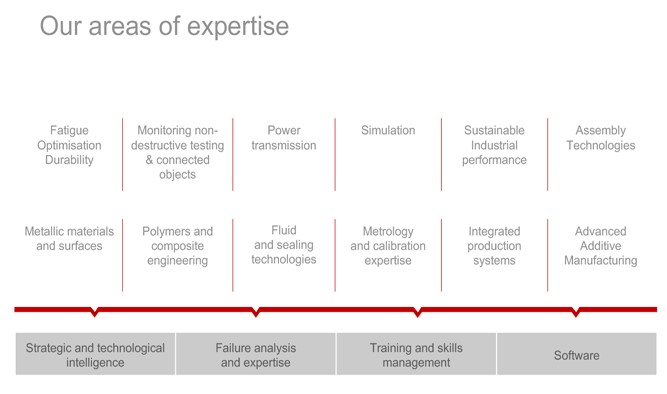
The range of skills and expertise offered by CETIM is very wide (see image below + “metallic and composite materials, surface treatments, manufacturing processes, assembly, sealing, fluid and flows, NDT, …”).

A simulation poll bringing together about thirty simulation engineers was created in 2017 under the direction of Thierry Raphenne to meet the needs of analysis in the product development phase, which are more and more prevalent in the industry.

CETIM areas of expertise

Part 1 – Simulation team: Experts to support industry engineering challenges

Thierry Raphenne and his team ran a simulation poll on a community of experts. Thierry supervises that team of 30 people who work full time on simulation analysis projects (mechanics, finite element, CFD, DEM…). He has worked in this field since his engineering study. At CEA, his thesis established a material behavior model with finite element method.
Expectations from the industry on requesting expert support from CETIM:

  • Validate product sizing
  • Understand the source of a failure. (Failure analysis, simulation helps to understand and explain the phenomena)

“What simulation brings is a better understanding of what’s going on and an acceleration of the implementation / release of products. For example, the design of a car today is done in less than 18 months versus 5 years ago. The use of simulation accelerates the process of validation and design of industrial products. Without simulation > more recurrent breakage because many fatigue situations are not considered, which are at the origin of part breakage.” – Thierry Raphenne

Simulation allows us to analyze more use-case and consequently, therefore can reduce development costs.

Without simulation, the work was done more on simplified hypotheses. This led to the oversizing of certain parts of the machine to ensure that they fitted and did not break.


Part 2: A strong link between academia and industry to meet common needs – with a particular focus on co-simulation

Collaboration among academia and industry worlds

CETIM offers the opportunity to bridge the gap between the industry players and academics, based on real-world cases coming from the industry. Those work groups allow the development of strong skill sets for the company benefiting from CETIM simulation expertise. Those transversal projects assemble up to 80 industry representatives who are then split into subgroups to work on given topics. One of the projects co-led among CETIM, the industry and the academic world is to focus on simulation and coupling.


Focus on co-simulation

For industrial players involved in that collaborative working group, it’s key to focus simulation and coupling among various types of simulation (from 1D to 3D, to couple Multiphysics with multibody type of simulation..). The aim is to verify and validate the design of a complete (and complex) system using simulation.

After this working group, the idea is to establish what are the know-how that can be easily transferred to the industrial players, based on a real demonstrator built by the team.


Part 3: The strength of Simcenter simulation solutions

The CETIM simulation team opted for Simcenter

The team chose simulation software from the Simcenter portfolio because these solutions “provide a wide range of physics, mechanical, fluidic, thermal, which allows multi-physics simulations to be performed with a single environment. Simcenter solutions are open to input/output from/to other simulation solutions.” – Thierry Raphenne


The development of a methodology to spread the use of software

“we have developed templates on the way to use Simcenter software to save time for post-processing of results, for combining constraint values. Available to all users of the software.”
“There is still a lot of work to do to internally to create a strong/solid simulation community. We still need to convince non-users of the simulation of the usefulness and create a dynamic team.”

“People are more eager to trust simulation analysis when it cannot be visualized by tests (in the case of CFD for example). Highlighting of very complex, very coupled phenomena, which cannot be done in tests / allows us to popularize more the utility of simulation tools” – Thierry Raphenne


Part 4: Application cases – simulation to answer very complex engineering challenges application cases – almost impossible to test.

The industry needs is to get things done right the first time, to reduce time to market delivery with a reliable and durable product.


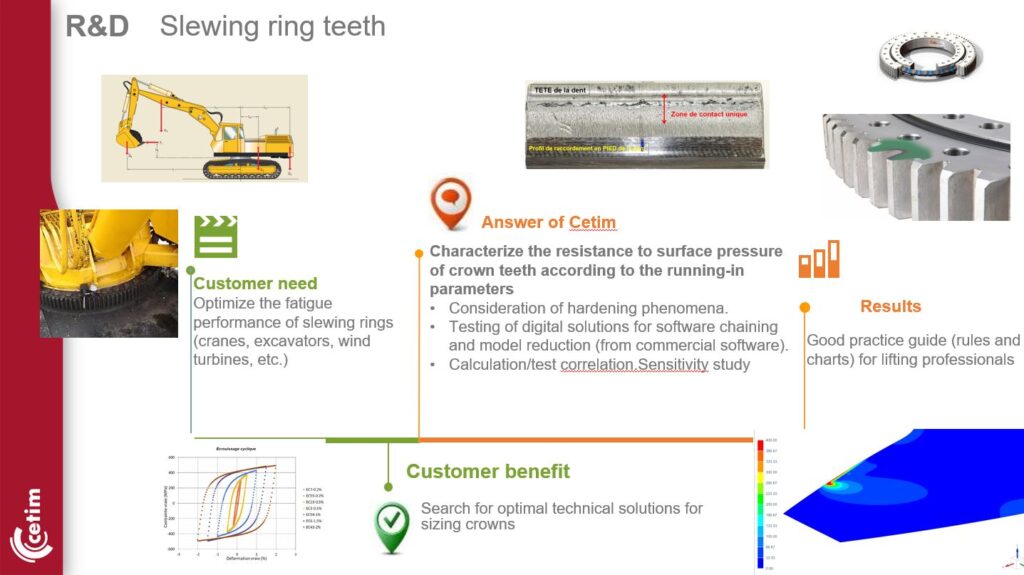
Application case 1 :

Increase the lifespan of machine parts. In the context of energy transition, being able to predict lifespan of machine parts and increase the durability of equipment.

CETIM - Heavy Machinery
Application case – Heavy construction machine


Application case – Heavy construction machine


Application case 2:

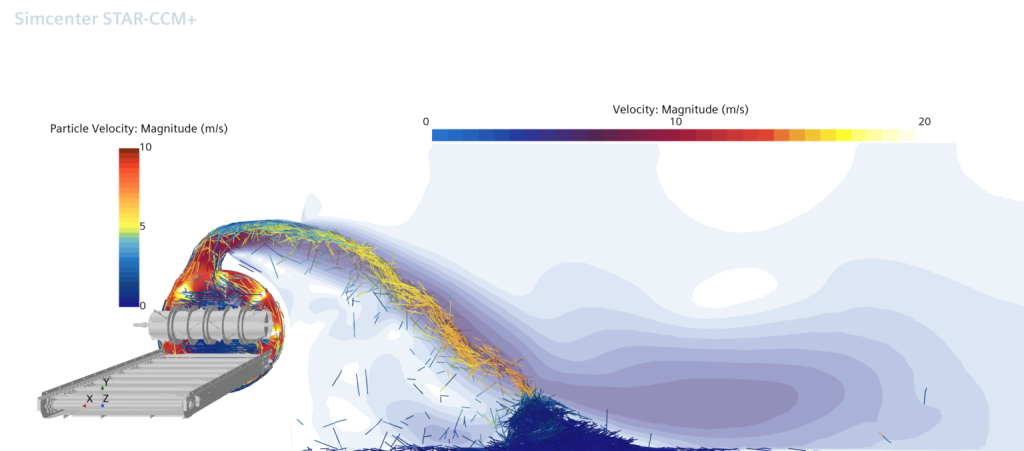
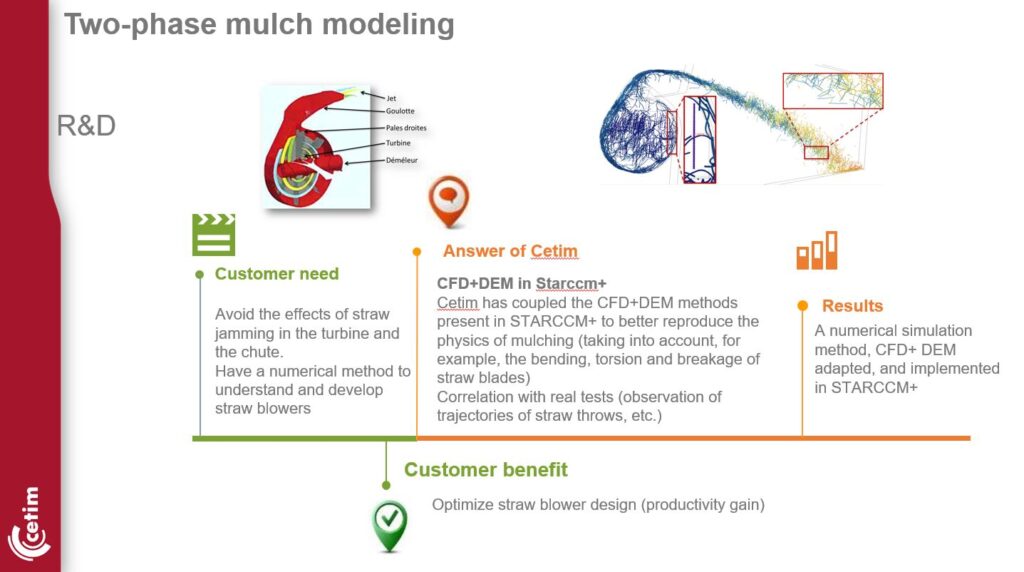
“Thanks to Simcenter STAR-CCM+ technical feature, especially on DEM application we could win new projects to support the agricultural industry”

2-Phase Mulch Modelling

Part 5 : Machine learning and artificial intelligence – future of simulation

  • The future of simulation involves the use of AI with the implementation of machine learning methods.  This will be increasingly used by industry and will boost the use of simulation. Simulation will help refine and develop models in complex contexts. Benefits from studies and related results achieved on previous projects will be used to nurture new projects (part of the transverse project simulation and coupling.)
  • Coupling data from testing and simulations campaign will naturally follow thanks to an increasingly important use of machine learning > integration of data coming from the test bench.

Ingemat: a virtual commissioning success story

Product: Tecnomatix
Industry: Automotive

Automotive engineering company uses Tecnomatix virtual commissioning software to better meet customer requirements while driving operational efficiency.

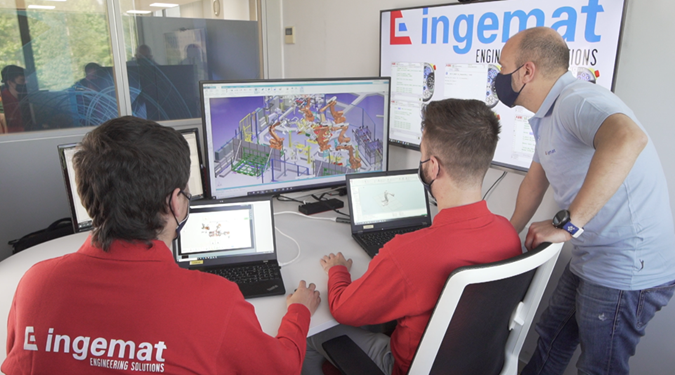
Ingemat employees using Process Simulate software for virtual commissioning solutions
Ingemat employees using Process Simulate software for virtual commissioning.

Ingemat is a Spanish engineering company offering robotic automation services for different industrial sectors, specializing in turnkey, tailor-made projects for the automotive industry. Their services cover installation design, erection, assembly, and commissioning to achieve the customer’s requirements for cycle time and quality. The primary technologies used in their projects include welding, hemming, bonding, clinching, and riveting.

Why Ingemat adopted virtual commissioning technology

Designing, deploying, and constructing a production line has always been based on a sequential process— The fixture installation is followed by robot installation and ensuring smooth operation with the equipment. Then, equipment and robots are integrated with programmable logic controller (PLC) automation until a qualified prototype can be produced. 

But this waterfall process is time-consuming and costly, involving massive robot and control code debugging and dealing with physical installation and cabling and wiring issues. It also requires using several expensive prototype assets that are not always available on time. This makes engineers perform under restrictive time constraints and high-stress levels, especially in the automotive space, where high-quality standards are imposed. 

The high standards of the automotive industry require Ingemat to work efficiently with as few errors as possible to meet timing and cost milestones. Because of this, they adopted Process Simulate in the Tecnomatix® portfolio of digital manufacturing software for robotics simulation and virtual commissioning.

“I would say, based on experience acquired in recent years, the selection of Process Simulate as a tool for virtual commissioning has been the right choice.

Oscar Vázquez, Electrical Engineering Deputy Manager at Ingemat

Watch this video to learn why Siemens was the right choice, or continue reading below.

Process Simulate helps Ingemat drive operational efficiency

Projects at Ingemat start with mechanical design and simulation, while electrical design progresses in parallel. After completing or advancing the mechanical design and simulation to a mature stage, offline robot programming (OLP) and PLC programming will kick off, followed by virtual commissioning. 

Using Process Simulate, Ingemat has realized virtual commissioning projects with different robot brands such as ABB, KUKA, Fanuc, Yaskawa, and Kawasaki – all this in connection with PLCs issued from Siemens and Allen‑Bradley, as well as custom-defined hardware.

Process Simulate software screenshot showing a virtual commissioning project by Ingemat
Ingemat uses Process Simulate and virtual PLC software together for virtual commissioning projects.

This methodology using Process Simulate allows Ingemat to parallelize work and shift most of the engineering tasks to the left in the project timeline, performing them in the back office.

Enabling mechanical, robotics, and controls departments to collaborate in the same platform allows the robot programs and the automation control code for PLCs and human-machine interfaces (HMIs) to be validated in the virtual environment before their delivery to the shop floor. 

As a result, the physical commissioning phase is much shorter and more efficient, requiring less debugging effort and fewer prototype assets, allowing the virtual commissioning personnel to focus on the quality of the produced assembly rather than the debugging of program code.

Why Process Simulate was the right choice for Ingemat

In a typical project, Ingemat implements virtual commissioning on a robotic zone, including up to 10 robots performing various tasks.

Once the virtual commissioning technician sets the engineering environment, it takes 2 to 3 weeks to test the production scenario and finish the virtual commissioning phase via the collaboration between the PLC and robot programmers. 

Consequently, robot programs and PLC codes are validated in the virtual environment and are already in a mature state when reaching the shop floor for the first time, leading to the following: 

  • 90% line readiness before physical implementation
  • 40% reduction in on-site debugging time
  • 10% savings in overall cost

The city of the future is here, and Dubai’s Micropolis Robotics is at the forefront

Product: Simcenter
Industry: Robotics

Imagine a world where communities are safer, cleaner, more efficient, and more convenient for residents.

In this world, a crime in progress can be immediately identified and reported. Groceries and food are delivered to homes without extra service fees or wait times. Trash is collected and roads are frequently cleaned with zero emissions.

All powered by robots.

It’s not the future, nor is it science fiction.

It’s happening now, and Dubai-based tech startup Micropolis Robotics is making it real.

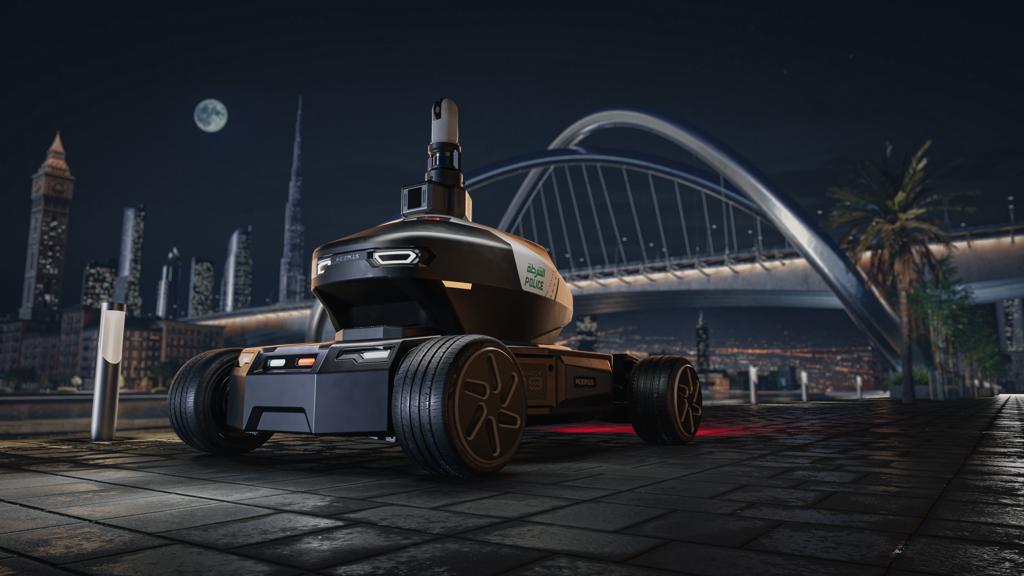
Autonomous robots Dubai

I sat down with CEO and founder, Fareed Aljawhari, to learn more about his company and how they’ve partnered with Siemens to bring this vision to life.

Tell me about your company. What inspired you to start it?

Since I was a small child, I’ve always been fascinated with technology. You could say it’s in my blood. Funny enough, what got me interested in robotics was my discovery of a plotter back in 1996.

I remember watching a storekeeper set up a small sign and complimenting him on the artwork, expressing my admiration of the artist’s precision and quality. His response? “A person didn’t draw this, it was a robot.”

I was shocked. I asked him if he would show me the plotter and he gave me the address, so I went to see it for myself.

When I arrived, I was in awe. I must have watched that plotter run for at least 30 minutes. I asked the machine operator if he would show me how to use it. This turned into my first “job,” but because I just wanted to learn, I didn’t ask to be paid.  

A few months later, I used this knowledge to get a job at a trade center operating the plotters. I wanted the job so badly that I didn’t tell them during my interview that I was underage. Of course, they eventually found out, but I had gotten so good at operating this machine that they agreed to pay my high school and college tuition fees in exchange for my work.

In school, I studied architecture, which gave me a solid foundation in design. Then I learned about product development, and eventually jumped to marketing and brand development. This led to a career as a creative director. All this experience was vital to the founding of Micropolis Robotics, as it gave me a comprehensive understanding of what a product is.

In 2012, I started my own agency with a similar idea as what is now known as the Metaverse. This was the inspiration for the name Micropolis – think “metropolis,” but it’s micro because we want to mimic a virtual city.

In 2014, I was introduced to my first investor, who also founded the Sustainable City in Dubai. He loved the idea of a virtual city, and I began developing a graphic engine to build a virtual city for Dubai.

Fast forward to 2018 and I presented a project called Microspot to Dubai Police. Microspot is a crime deterrence/prevention software we developed based on our graphic engine that we created for the virtual city. It identifies a crime in progress and uses facial recognition software to identify the person committing the crime.

The Commander in Chief loved it and asked, “What if you added embedded this technology into an autonomous patrol robot?”

I knew we could fail, but I also knew that if I didn’t say yes, I would regret it the rest of my life. So, I said yes.

What happened next?

Next, we started to research and learn how to build robots. My background is in design, so I designed a mockup of an autonomous police robot. It was good, but the Commander in Chief told us, “Great, but it won’t work for police. You need to make it bigger.” So we went back to the drawing board.

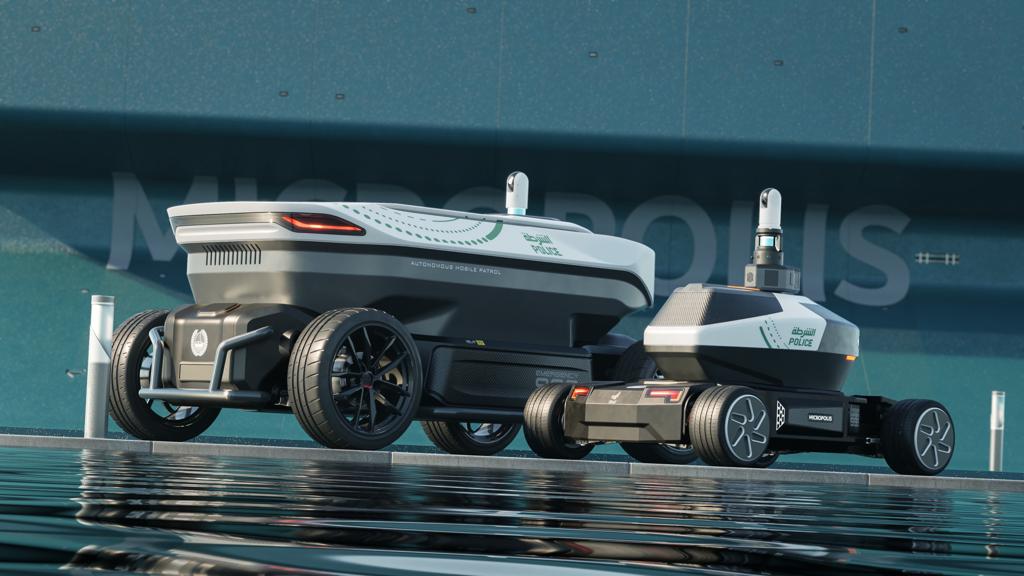
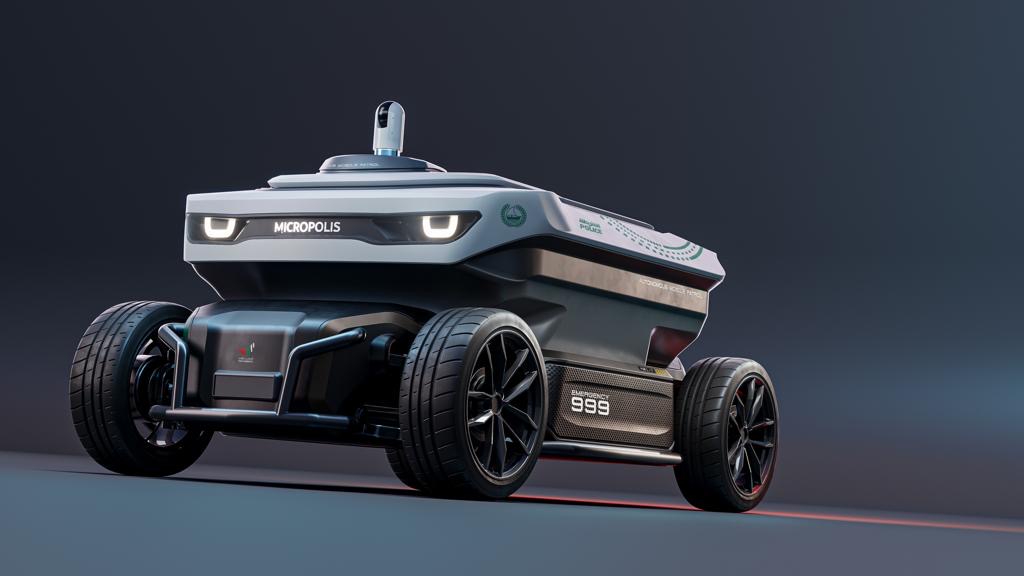
In 2021, we finalized the visual design for the M01 and M02, our first patrol robots. After that, I started looking for investors to bring this design to life.

Autonomous robots in Dubai

This is where things got even more difficult. Dubai is very advanced – we have excellent infrastructure with an Internet City, Media Production City, and lots of industrial cities. And the government is very supportive of technologies like this, but the problem is we don’t have a lot of investors who are interested in tech and we don’t have a large pool of engineering talent here. You either need to attract talent from Europe and the United States, which is where engineering talent tends to be concentrated, or you have to make your own.

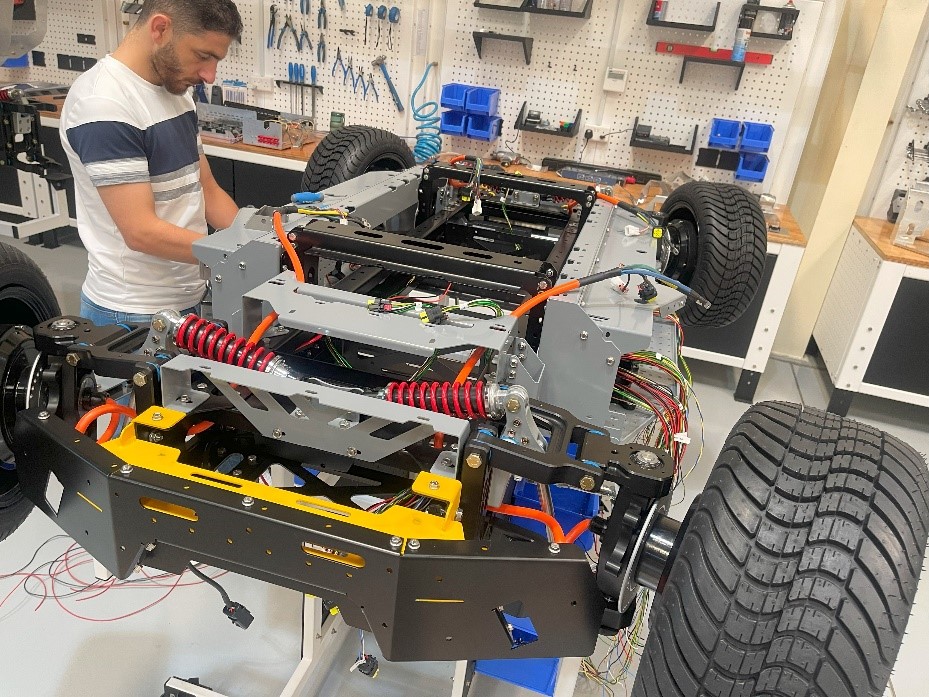
Engineer building an autonomous robot

We hired local engineers and adopted a framework inside of our company where we allowed them to experiment and make as many mistakes as possible. We learned from each other’s triumphs and errors and eventually got organized. We now have a very professional, extremely talented team and presented the first successful models of the M01 and M02 robots in 2022.

In 2023, we received an investment from Dubai Police to build the final stage of these patrol robots, and we succeeded. It’s now a production-level robot.

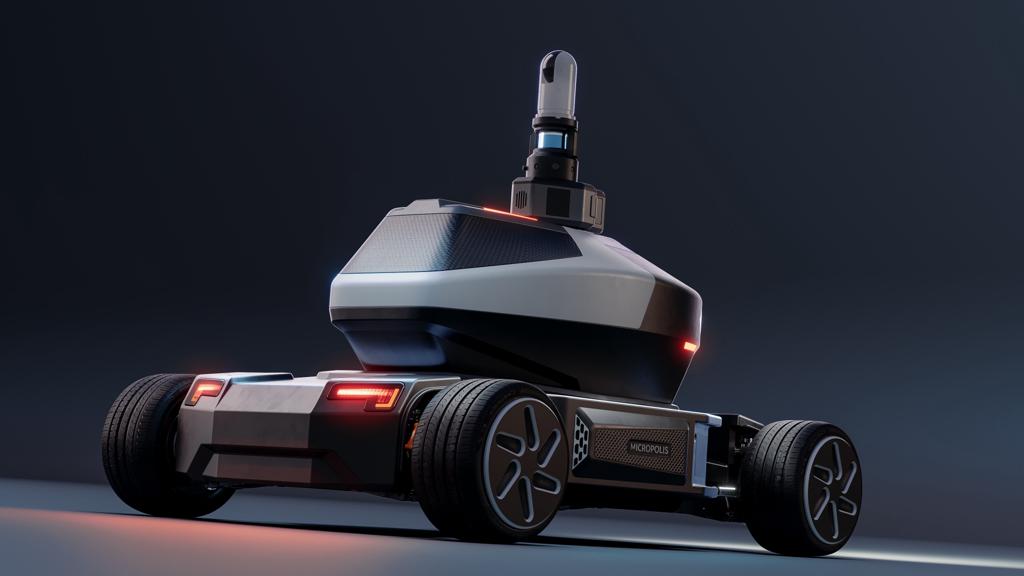
Autonomous robot Siemens Micropolis Robotics

The learning curve is getting shorter and shorter, our team is bigger, and everyone just got very good at what they do. I’m proud of my team. Suddenly they are all like masters of their craft.

Where does Siemens come into all of this?

We got everything right with our robots except autonomous driving. This was the biggest challenge facing our company and we needed a company like Siemens with expertise and know-how in autonomy.

We partnered with the Simcenter Engineering and Consulting Services team to develop algorithms to help us reach Level 4 in autonomous driving. For both the M01 and M02, our plan is to develop a perception layer, including internal sensors with audiometry wheels, encoders, IMU, and steering angles, as well as external sensors such as LIDAR, cameras, ultrasonics, imaging radars, and obstacle detection.

Why did you choose Simcenter Engineering and Consulting Services for this project?

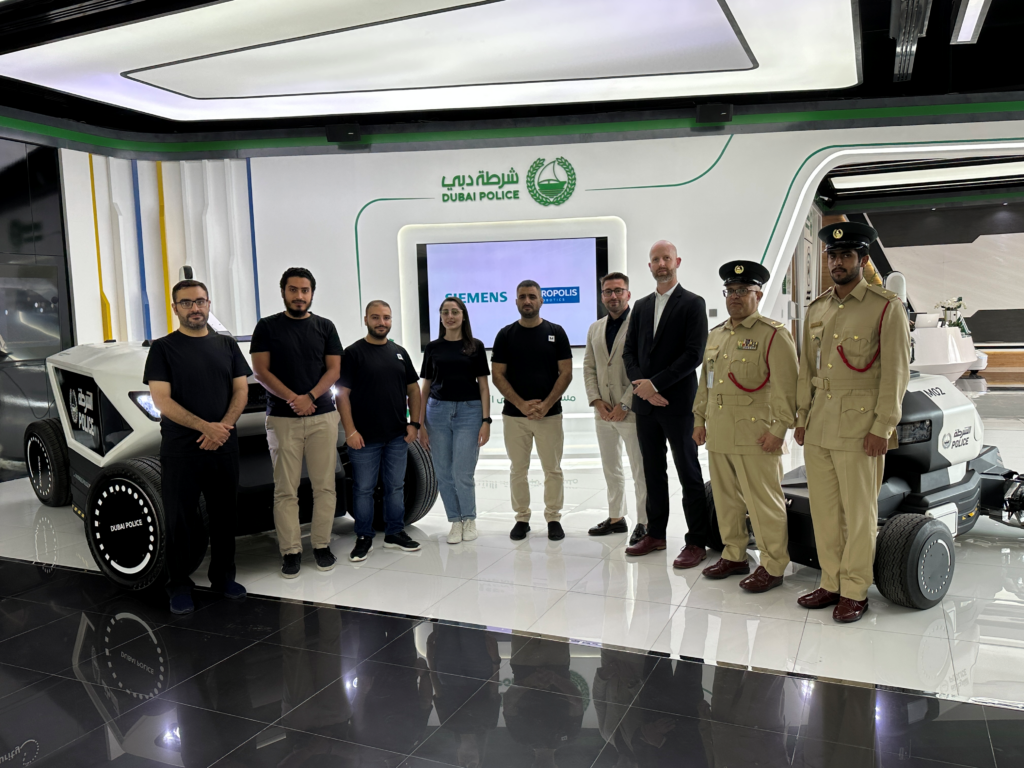
Siemens and Micropolis Robotics partner

Siemens is one of those brands who, when you hear the name, you know you’re going to succeed. We selected Simcenter Engineering and Consulting Services because we needed their expertise, knowledge, and ability to get the job done right. We thought we just needed help developing some algorithms, but they’re taking our autonomous technology to a different level and have really partnered with us to develop a proper autonomous driving program.

Simcenter Engineering Services has been an incredible partner to our company. When we first contracted with them, I thought we would maybe get four or five of their engineers to work with. Instead, we get access to 26 of their engineers. It’s beyond anything I could have hoped for.

We have been delighted by the amount of expertise Simcenter Engineering Services is providing for this project. Their professionalism, organization, and level of knowledge is just extraordinary. My team and I are constantly learning from them and we are getting better every day because of them.

When will these robots be deployed?

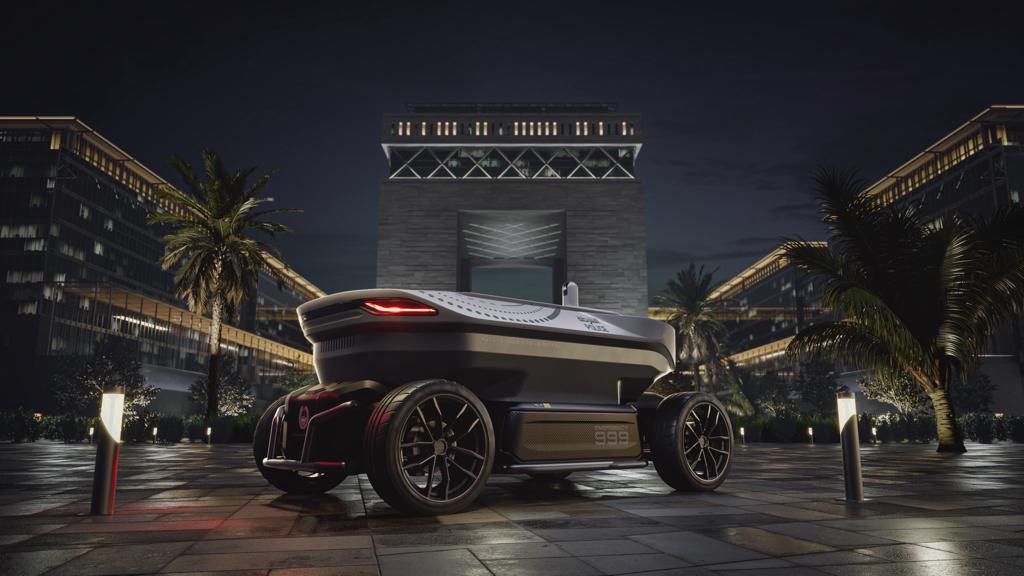
Autonomous robot in Dubai

The Dubai Police have been excellent partners and have been very flexible in their timing with us. We are hoping to launch the patrol robots in summer 2024. We would start with residential and commercial areas first with the M02 because it is smaller. We hope to launch the M01, which is the size of an SUV, in 2025.

The delivery and cleaning robots are a bit further out. We don’t have the capacity to develop all three robots at the same time, so we will take what we have developed and learned from the patrol robots and apply similar technologies to the other robot types.

Are you expanding this beyond Dubai?

Absolutely. Abu Dhabi is also interested. The Emirati Ministry of the Interior is interested. We will first focus on the UAE and Saudi Arabia, but will eventually expand to an international scale. We won’t be regional forever.

What would you say to someone who questions the ethics of using robots to do police work? Or to those who would accuse robots of stealing jobs?

Autonomous robot for police

My response would be that this is simply a reporting robot. It sends a picture of the person committing a crime to the police along with an identification. If it has misidentified the person, the human analyzing the picture can tell the system it is wrong. However, facial recognition software has made some incredible advancements in recent years and is almost always right. But even if the facial recognition software did make a mistake, the AI embedded into the robots will learn from that mistake and use it to get better with time.

As to whether robots are stealing jobs, it is true that some jobs will vanish as new technologies emerge. But we’re also adding new jobs that didn’t exist before and augmenting others. We’re enhancing security for residents of Dubai and improving safety for Dubai Police officers by removing the need for them to go into dangerous situations.

Robots also have the potential to enhance human lives and creativity. If I can send a robot to get my groceries, that is 20 minutes of my day that I have to focus on something else or create something new. We are not only making society safer, we are also giving people time back to think and create.  

You mentioned earlier that it is challenging to hire engineers due to your location in the Middle East. Given this challenge, can you explain why you launched Micropolis Robotics in Dubai rather than somewhere else?

Autonomous robot on street in Dubai

As an entrepreneur, I believe I have a responsibility to my region. Dubai and the broader Gulf Cooperation Council (GCC) region have been actively working to transform the technology consumers in our area into technology innovators. The government of the UAE is taking proactive steps to encourage entrepreneurs from the region to take the initiative and establish their tech firms. They’ve invested heavily in developing advanced infrastructure to foster innovation in technology and attract the best talent from around the world.

Their commitment to innovation aligns perfectly with our vision at Micropolis Robotics. We are excited to be part of this transformative journey, leveraging the promising local market demand. With GCC countries increasingly focusing on developing smart cities and enhancing the well-being of our residents, the opportunities for innovative tech products and solutions are very promising here.

Succeeding here feels like a victory.

What is the future of your company and partnership with Siemens?

Our goal is to be a tech powerhouse that develops technology to automate large operations. We think Siemens will play a huge role in all our future software development – this autonomous robot project is just the beginning. We don’t live alone in this world and recognize that we need big partners like Siemens and NVIDIA in order to be successful. 

But what we’ve talked about today is just one example. Robots are just one piece of technology that is useful for humanity, and our goal is really to develop any technology that is useful for humanity.

For example, one project that is currently in the development stage is an alarm system for forests. I consider myself an environmentalist, so seeing all the recent forest fires in every corner of the earth saddens me. We are developing an idea for a sensor grid that could alert the authorities at the very start of a fire. The sensors would detect whether there is a change in the atmosphere that would indicate a fire has started. Forest authorities could then go to that location and confirm whether a fire has started and stop it before it spreads.

Our overarching goal is to develop technologies that better humanity and the planet.

Sending it with Siemens NX

Product: NX Design
Industry: Bikes

How a mountain bike enthusiast designed and manufactured his custom carbon fiber bike from scratch with Siemens NX

Siemens is not only offering products to big companies, but also small and medium businesses and even private persons can subscribe and benefit from the Siemens Xcelerator portfolio of software and services. This is what this case demonstrates:

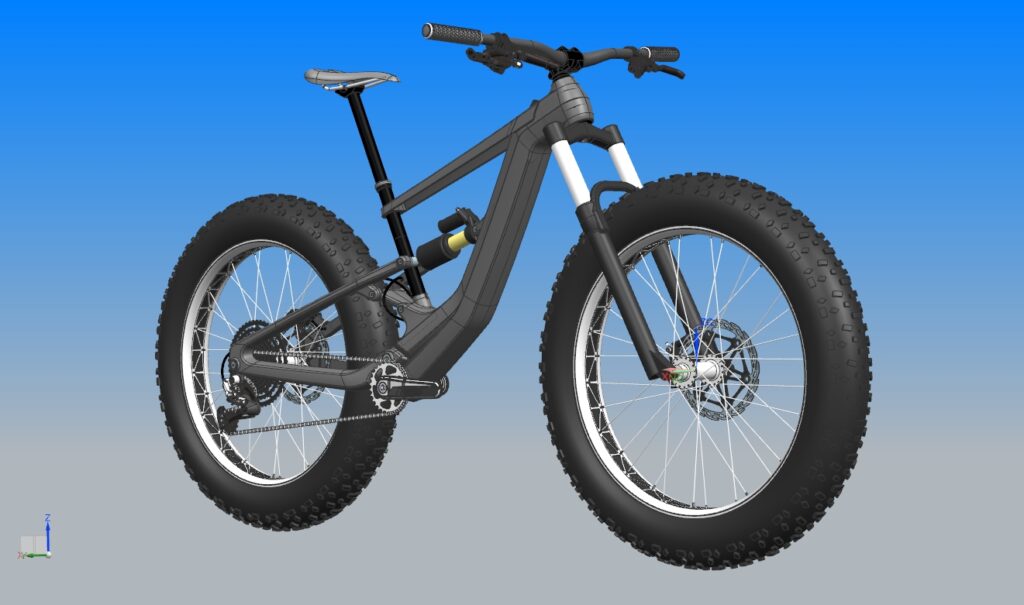
We recently found out about the project completed by a German mountain bike enthusiast, who calls himself Uncle Bob, and his journey that started with an empty screen and ended with custom self-built carbon fiber mountain bike.

Uncle Bob’s journey

Due to an injury from biking, Uncle Bob needed a new project to keep himself entertained. He is the founder of an engineering consultancy, which is why he owned the Siemens NX CAD software and has experience with it. So, in his free time he just started directly scribbling in Siemens NX with a try and error approach and with the following weeks, his ideas became a solid concept. 

Bob was especially delighted with the plentiful and individual 3D visualization options NX had to offer, they enabled him to work creatively and to see the realistic result of his design before building. 

Considering the design, Uncle Bob has gone for a form follows function approach: “If something already looks like something that will not last, it surely will not last during tests.” 

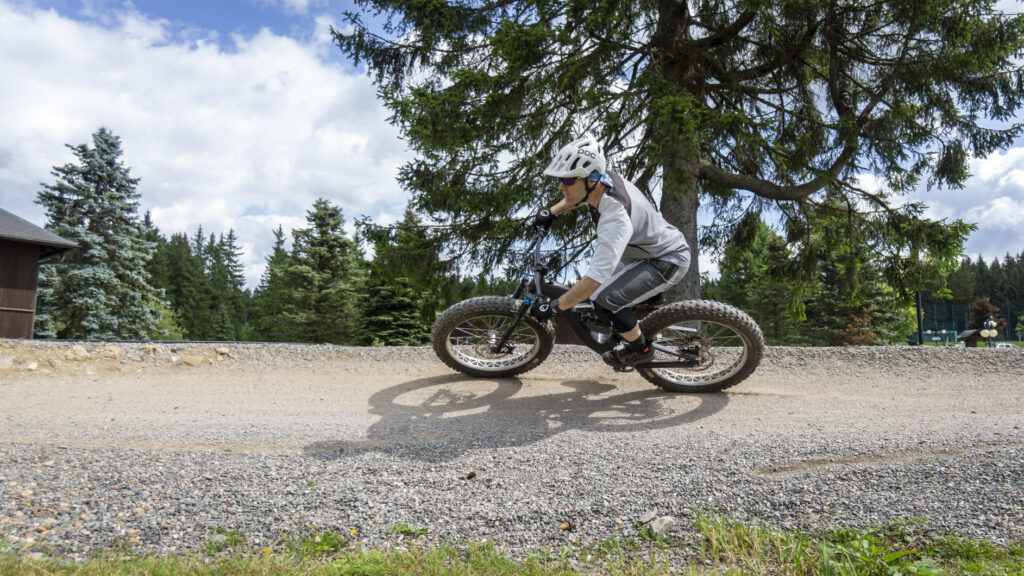
mountain bike in forest

Why NX?

Apart from the design aspect, he really appreciates NX for the ability to test and verify his CAD design data into finite element analysis (FEA) simulation tools, which he uses in his daily professional life as well as with this bike. “I have not regretted the investment for Siemens NX, it was worth it and definitely helped me to ease up processes. Before NX, I had to copy data manually from program to program. The implementation of NX at Daimler got me starting to look out for better solutions.” 

bike model inside of nx

So, an FEA study was done to stress test the frame and structure. After all, mountain bikes like these need to withstand high physical forces due to big jumps, loose ground and high speeds. And his bike did!

For example, his calculations resulted that the frame around the bottom bracket can withstand jumps or falls with more than 6,000N. For the areas that failed his tests, the layup of the composite material was modified in Siemens NX and additional plies were added to strengthen these areas.

Getting started and getting building with NX

bike model mold

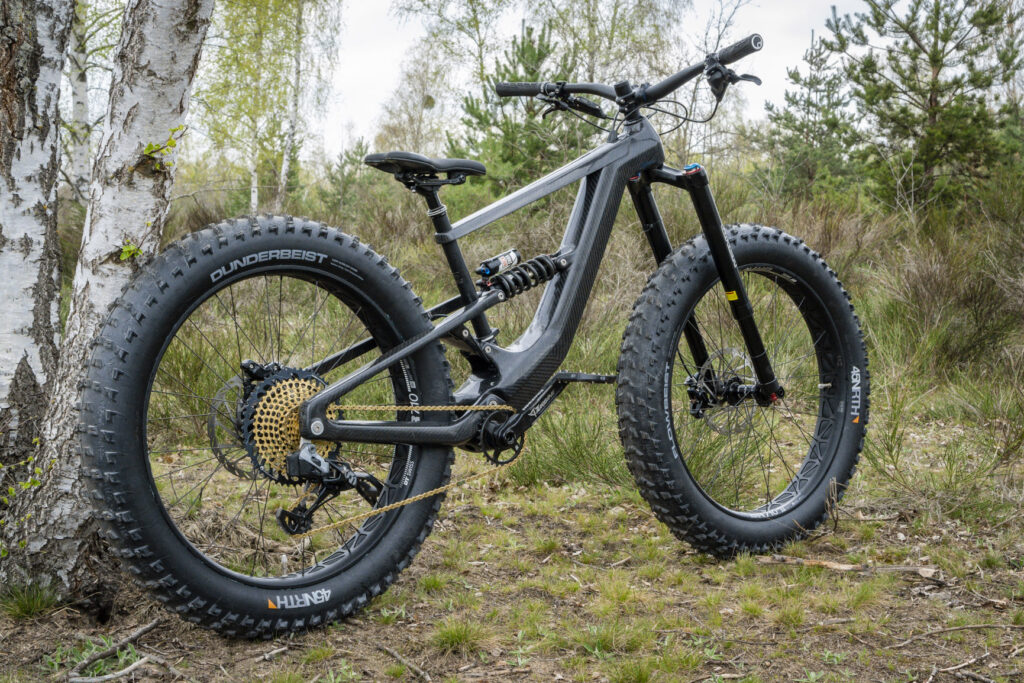
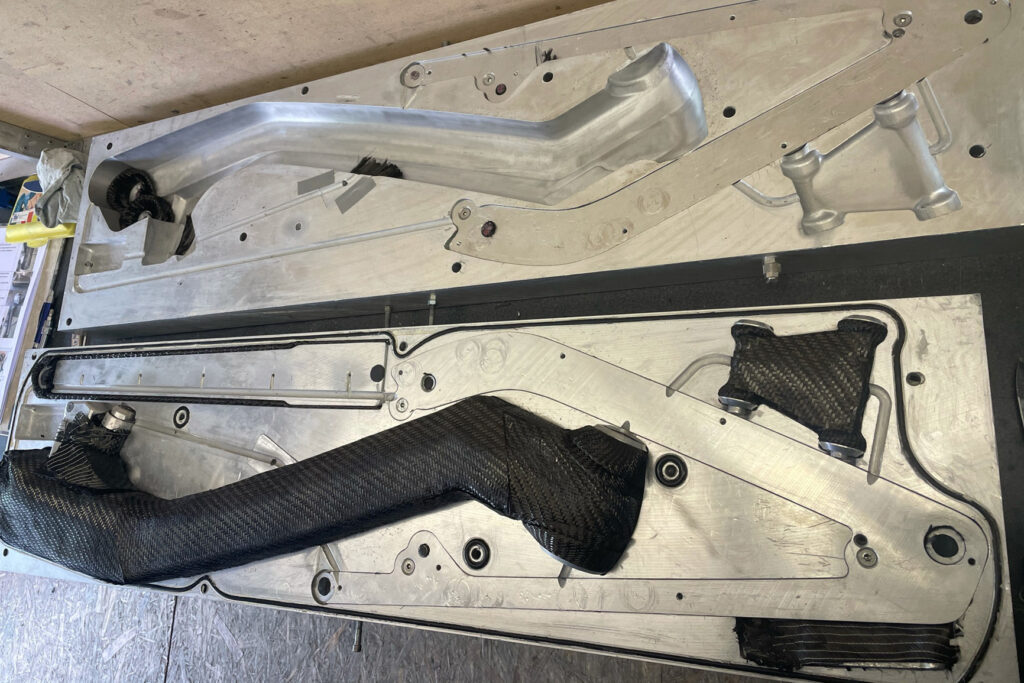
With a flaw free concept ready, he designed an injection mold in Siemens NX that he could use for producing the carbon-fiber parts. Due to the extensive 3D features in Siemens NX, he could make the mold as material efficient and small as possible.  Then he started working in his garage: A wax core was casted that represents the inner geometry of the carbon frame. Then, he wrapped the carbon fiber around it and closed the mold airtight. Using vacuum and high pressure a hardening resign was injected into the mold. After a few hours of tempering the resign was hardened and with higher temperature the wax core melted and flowed out. Now the frame was made. He didn’t clearcoat the frame because Uncle Joe was confident enough that his construction and his materials used were sufficiently durable anyway.

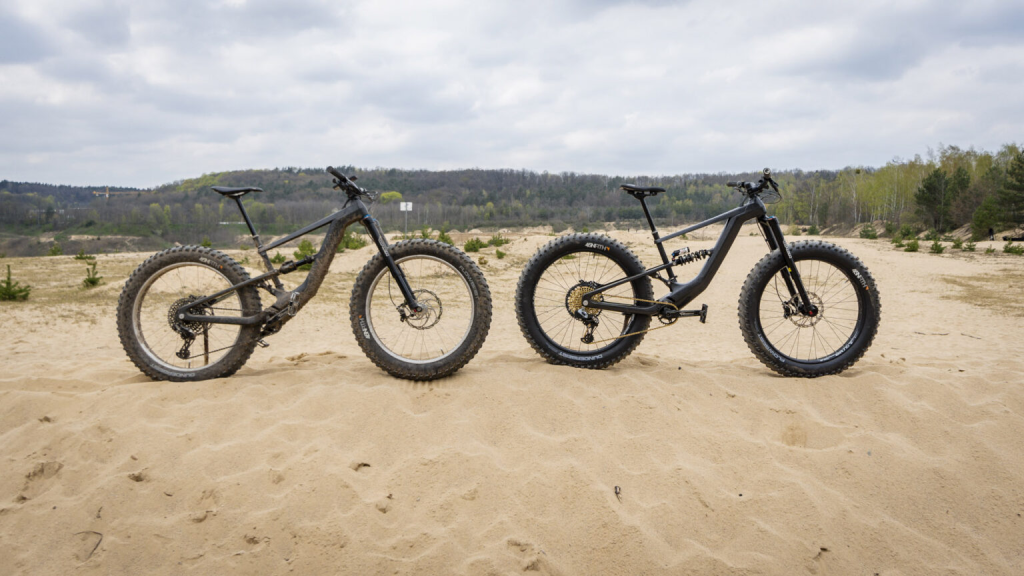
After that, the frame was made and he started to assemble all the custom frame parts and bought standard parts together. A few weeks later it was all done, a extreme mountain fat bike, that all-in-all only weighted 17kg, with the NX constructed custom carbon forged frame only taking 3kg part of that. After his first test ride, Bob was beyond impressed:

“Insane! Sore muscles in the face because of the permanent grin. I can only say: Dreamy. The bike fits me like a glove.”

The strength of Siemens NX

This business case shows the accessibility, exactness and prediction powers of Siemens NX. Building something from carbon-fiber was a task that only large manufacturers would consider just ten years ago. With Siemens’ NX, now even talented designers can plan and design flaw free carbon structures from scratch at home. 

Revolutionizing Space Engineering: The OX Origin Story with Siemens

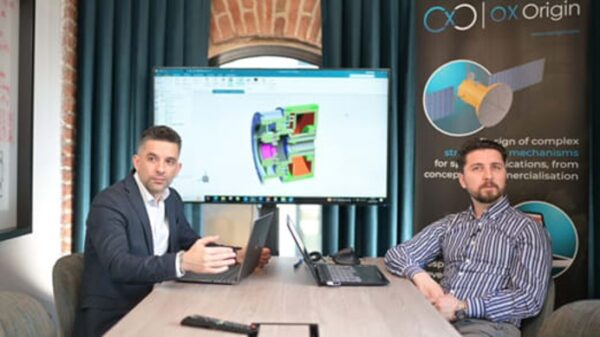
In the vast expanse of space, there are pioneers on a relentless quest to unlock the mysteries of the cosmos and push the boundaries of human exploration. One such pioneer is OX Origin, a Romanian startup with a singular mission: to propel humankind towards the stars. Founded by visionaries Alex Bugnar and Ilie Ciobanu, OX Origin is not just another player in the aerospace industry; it’s a revolutionary force redefining how we approach space systems and software engineering.

Breaking Boundaries in Space Technology

OX Origin’s founders are on a mission to bridge the gap between conventional space technology and cutting-edge design and engineering practices. Co-founder Ilie Ciobanu notes, “The tools being used in the space industry are falling behind when it comes to design and engineering technology. Not in the technology they produce, but the technology that’s being used, especially the software tools that tend to be older than the latest state-of-the-art software.”

Ciobanu keenly observes that the challenge lies not in the quality of the technology created but in the tools used to manage these projects. He believes that the industry’s reluctance to embrace the latest technology is holding back progress, and this is precisely what OX Origin aims to change.

The Visionaries Behind OX Origin

The journey of OX Origin began when Bugnar and Ciobanu crossed paths during their early professional careers in Oxford, United Kingdom, inspiring the name “OX Origin.” Their qualifications and areas of expertise make them a dynamic duo:

  • Alex Bugnar holds a master’s degree (MSc) in Ultra Precision Technologies and a Bachelor of Science (BSc) in Telecommunications Engineering. He specializes in software engineering at OX Origin.
  • Ilie Ciobanu possesses a BSc in Astronautics Engineering and an MSc in Space Technology, focusing on the design and consulting aspects of their business.

Their collaboration and complementary skills were the catalysts for founding OX Origin in 2020. Beyond personal chemistry, they saw an opportunity to help and educate fellow space industry professionals.

In Pursuit of the Stars: StarLeap and MARS

While OX Origin’s overarching mission is ambitious, they are actively developing solutions to realize it. One such solution is StarLeap, an enterprise web-based platform designed to manage the end-to-end design process of complex space systems. Additionally, they offer MARS, a solution designed to assist mechanical engineers in verifying bolted joints and ensuring associated safety margins through bolt static analysis.

In addition to their proprietary solutions, OX Origin harnesses the power of Siemens software solutions in their projects:

  • NX for design
  • Simcenter for simulation
  • Nastran for computations
  • Teamcenter Share for collaboration

Ilie Ciobanu, the primary software user, shares his perspective, stating, “Compared to other solutions on the market, I feel Siemens’ is the most connected.”

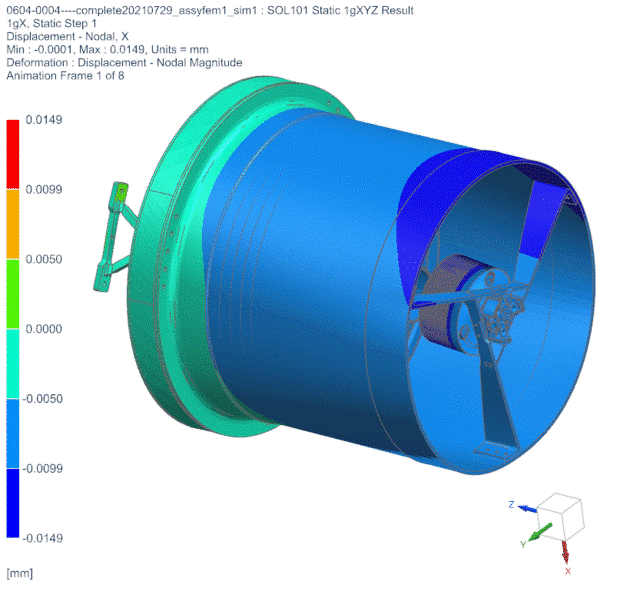
He highlights the seamless integration between NX and Simcenter, allowing for extensive design analysis. This compatibility enables OX Origin to explore various configurations, assess mechanical, thermal, and static performance, and select the best design to meet client requirements.

Collaboration Made Effortless with Teamcenter Share

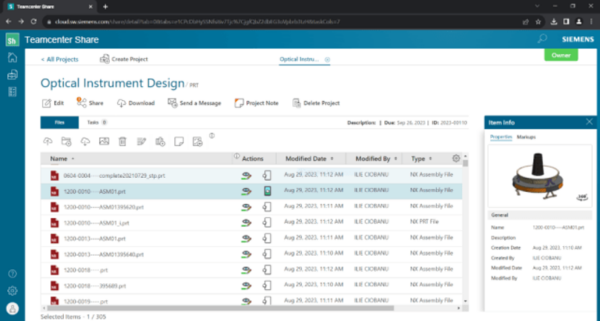
With Teamcenter Share, OX Origin effortlessly collaborates with clients across the globe. This cloud-based platform facilitates the secure sharing of files, models, and simulation results. Permissions can be assigned to ensure data security. Clients can then actively participate in processing, modeling, and simulating the data while providing feedback and desired adjustments.

Beyond collaboration, Teamcenter Share serves as a central hub for storing and managing data and streamlining client tasks and activities. According to Ciobanu, “It makes life easier and helps us manage the tasks and activities of the clients we work with.”

Leveraging product variability to streamline wind turbine development

Product: Teamcenter
Industry: Wind

The Teamcenter Product Configurator is an important part of our global PLM strategy. By leveraging a single source of truth for multi-disciplinary product configuration data across the entire product lifecycle, ENERCON is positioned to remain at the forefront of technological advancements in the wind energy industry.

Sebastian Heinzel , Product Owner, Senior Consultant PLM
ENERCON

Adapting to the dynamic changes in the wind industry

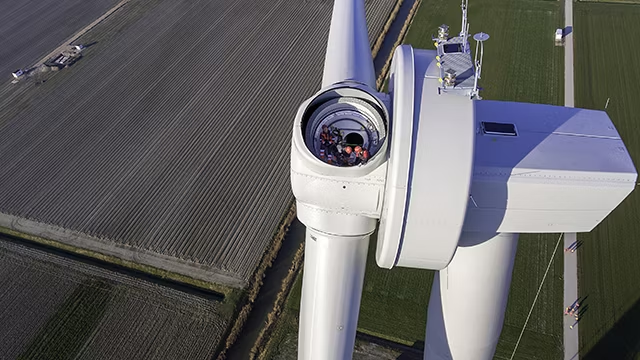
The wind industry is characterized by its unique challenges including dynamic market conditions, technological advancements and increasing customer demands for customization. ENERCON has been in the wind industry for over 35 years developing, producing, installing and maintaining wind turbines. To further streamline its operations and enhance variability management, ENERCON partnered with Siemens Digital Industries Software to adopt Teamcenter® software and specifically Teamcenter Product Configurator. Teamcenter is part of the Siemens Xcelerator business platform of software, hardware, and services.

ENERCON was looking to streamline manufacturing operations and enhance wind turbine development. The company faced numerous challenges in a highly complex and ever-changing industry, including needing customization, shortening lead times, ensuring up-to-date product configurations, and integrating computer-aided design (CAD) systems. By implementing Siemens’ solutions, the company achieves significant improvements in process efficiency, collaboration, and time-to-market, while also aligning its bill-of-materials (BOM) management and expanding its capabilities for future growth.

A new approach for managing product complexity

ENERCON faced several business challenges over the years including managing a highly complex product line, meeting customer demands for customization, reducing lead times from order to quotation, ensuring stakeholders work with valid and up-to-date product configurations and addressing limitations with their current SAP systems that don’t allow them to validate the digital twin.

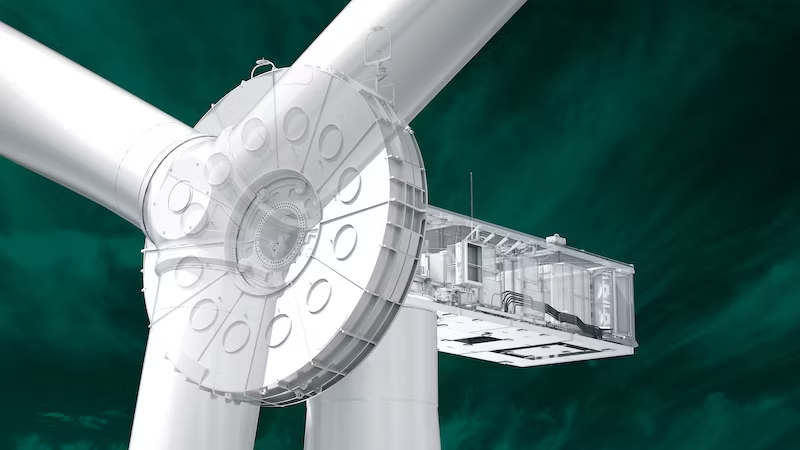
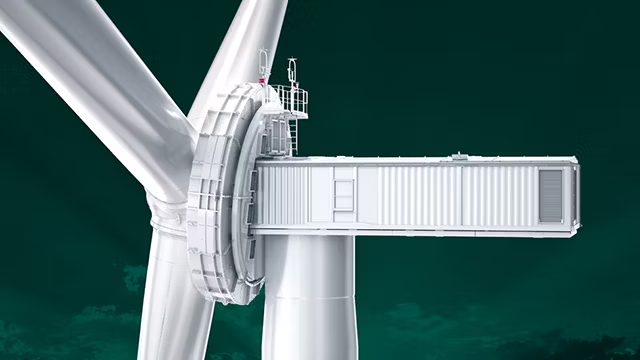
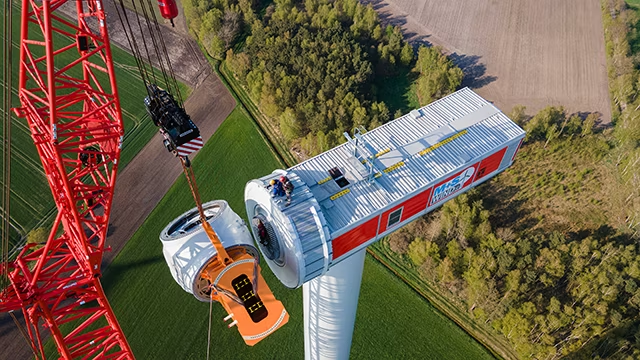
ENERCON realized it needed to modernize its approach to product variability management. In 2018, it embarked on a search for a solution that would integrate a common product configuration definition across its design BOM (DBOM), engineering BOM (EBOM) and manufacturing BOM (MBOM), serving as a reliable source of truth for its entire value chain. Implementing Teamcenter Product Configurator allowed ENERCON to bring together variability data from their BOMs and consider the holistic value chain perspective. This effort coincides with ENERCON’s latest project, which is developing the E-175 EP5 wind turbine. This turbine has one of the largest rotor diameters for onshore turbines right now. ENERCON plans to continue applying this variability management approach in the development of the new evolution of their turbine, the E-175 EP5 E2.

Leveraging Teamcenter Product Configurator provided ENERCON with valid and buildable product configurations. ENERCON leveraged these capabilities to configure its products early in the development process, eliminating the need for downstream configuration changes in its enterprise resource planning (ERP) system. With access to valuable data within Teamcenter, ENERCON’s engineers can easily validate the feasibility of different configurations, ensuring that all combinations were valid and buildable.

Configuration management will be integral to improving the company’s engineering change management processes. ENERCON plans to convert their operating model from a made-to-stock and engineer-to-order approach to a CTO+E approach. This model incorporates more repeatability and reuse into the business model while still supporting client customization. This will allow ENERCON to better control fast-track changes such as health and safety execution (HSE) topics, supplier discontinuity, part obsolescence and missing part topics. By implementing a CTO+E approach, changes would be able to be applied to any product variant at any time between revision packages. Using this engineering change management process with a common variability backbone, ENERCON will have the ability to adapt their BOMs and manufacturing processes quickly without jeopardizing the supply chain management processes in their plants.

“Using Teamcenter Product Configurator will help us implement a CTO+E approach, advancing ENERCON’s transformation to a project-driven company,” says Martin Gorges, head of PLM governance for ENERCON.

Using Teamcenter to improve collaboration and communication

ENERCON used Teamcenter Product Configurator as a digital configurator, enabling improved communication and collaboration among stakeholders across the development lifecycle. By working off a common source of variability information, everyone involved had access to the latest and most accurate data, eliminating confusion and discrepancies. This streamlined collaboration, enhanced efficiency, and reduced the risk of errors caused by out- dated or incorrect configuration data.

Implementing Teamcenter Product Configurator yielded significant results for ENERCON, enabling them to streamline internal processes. ENERCON successfully used a common configurator across disciplines, eliminating silos and improving process efficiency.

ENERCON is using Teamcenter Product Configurator to provide a digital configurator that serves as a common source of variability information. This facilitates seamless communication and collaboration among stakeholders.

“By understanding the product parameters that need to be accommodated, ENERCON will be able to respond to customer orders more quickly, shortening lead times and enhancing customer satisfaction,” says Sebastian Heinzel, senior consultant PLM for ENERCON.

Using the predefined rules and constraints within Teamcenter Product Configurator allowed ENERCON to deploy new features and implement changes in a more efficient and timely manner. Although ENERCON is still working to develop the E-175 EP5 wind turbine, the company has already experienced a significant reduction in development time. Additionally, consolidating variability management has simplified the value chain and ensured consistency in the product data.

Continuing to improve the manufacturing process

Looking ahead, ENERCON plans to further leverage Siemens solutions for MBOM, SBOM and digital manufacturing. By expanding its use of Siemens solutions, ENERCON is aiming to enhance its manufacturing processes, improve serviceability, and stay at the forefront of technological advancements in the wind energy industry. “We are training very hard to get to know everything about Teamcenter Product Configurator so we can utilize all of its capabilities,” says Sebastian Heinzel, senior consultant PLM for ENERCON.

ENERCON is in the concept phase of a PLM program that will bring both Engineering BOM and Manufacturing BOM configuration management into Teamcenter. This will enable them to deploy highly sophisticated discrete manufacturing processes best known within the automotive and aerospace industries. With the help of Teamcenter, ENERCON’s goal is to perform pre-planning up to 36 months in advance of manufacturing and work with schedul- ing agreements showing early demands to the suppliers. This will allow them to make changes to product variants holistically across all platforms, plants, systems and processes, including pre-planning. An integrated PLM configuration management solution also helps ensure stable high-volume production without line stops while avoiding the use of obsolete materials or high numbers of part stocks.

Implementing Teamcenter Product Configurator will be transformative for ENERCON’s wind turbine development processes and manufacturing operations. They have consolidated a diversified portfolio into a single platform, which allows them to handle more complex variability. Using Teamcenter Product Configurator has helped ENERCON get one step closer to going from a design-centric approach to a part-centric approach.

These results have positioned ENERCON for continued success in a rapidly evolving industry while continuing to take on new projects. ENERCON is looking forward to continuing to leverage Teamcenter to develop the E-175 EP5 E2 wind turbine that will be available in 2026 as well as other future next generation products.

Using Teamcenter Product Configurator will help us implement a CTO+E approach, advancing ENERCON’s transformation to a project-driven company.

Martin Gorges , Head of PLM Governance
ENERCON
×