
Powering sustainable pharmaceutical manufacturing with factory simulation software

Product: Tecnomatix
Industry: Pharmaceuticals

Explore how Siemens Tecnomatix Plant Simulation and Opcenter solutions help to digitalize pharmaceutical manufacturing for sustainable efficiency.

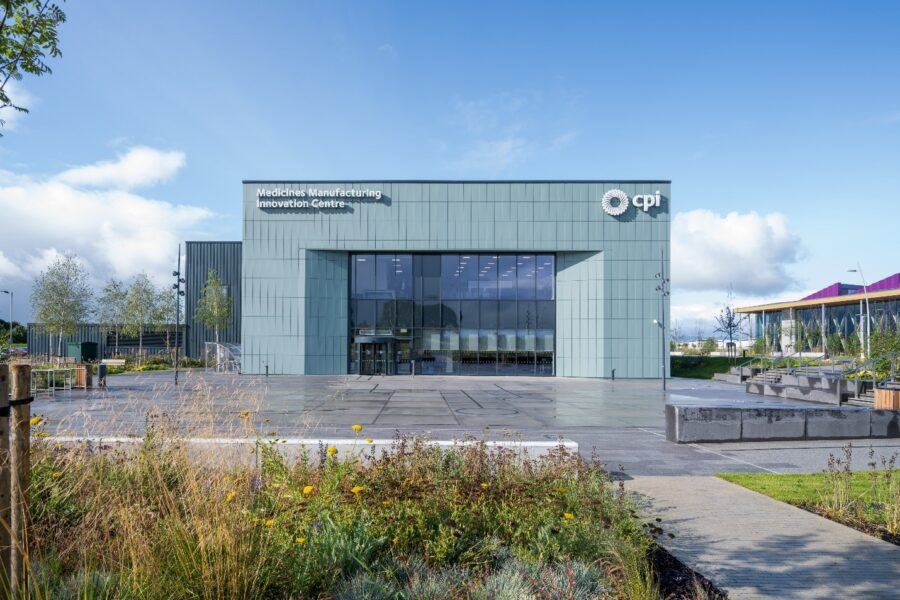
In the heart of Glasgow, Scotland, the Medicines Manufacturing Innovation Centre (MMIC) spearheads a transformative journey within the pharmaceutical (pharma) industry. CPI, technology innovation catalyst, opened the world leading MMIC to raise the bar in pharmaceutical manufacturing by redefining the future of pharmaceutical production with cutting-edge digital technology, collaborative expertise and more sustainable manufacturing practices. The MMIC is a unique collaboration between CPI and 23 partner organizations from all different sectors.

MMIC is an open-access collaborative innovation center specific to pharma manufacturing, meaning they work with numerous partners, such as industry giants like GSK, Pfizer and Novartis as well as partners from business, academia and government agencies Their collaboration for pharma manufacturing aims to deliver innovation that drives new processes and products into the pharma industry using Siemens digitalization solutions to tackle issues such as the development of more sustainable manufacturing processes.
The unique pharma manufacturing challenge

MMIC works with pharma companies, as well as technology companies and equipment manufacturers that provide technology to help the industry. However, one of the center’s challenges relates to maintaining the truest sense of collaboration through digitalization by creating a standard architecture that allows the factories to build consistently. This includes streamlining processes, accelerating development, and reducing waste and energy consumption, which is where Plant Simulation in the Tecnomatix® portfolio comes into play. By creating a digital twin based on real data, Tecnomatix empowers operators to optimize processes, minimize waste and enhance efficiency. Driving the center’s innovation engine is the digital twin. With it, pharma companies can design everything from the smallest single product, to manufacturing processes, to the entire factory, and detail and tweak each as needed. From identifying which materials work well to storing the the finished products, Tecnomatix Plant Simulation lets operators choose the right modules, conduct tests, and avoid bottlenecks.

The tool that we’ve used most for our digital twins for design is Tecnomatix. Our industrial partners set our digital ambition and my team delivers it.”

The major pharma’s success also lies in leveraging Siemens Opcenter™ Execution alongside Tecnomatix. This seamless integration among Siemens digital manufacturing software is a perfect example of how the Siemens Xcelerator portfolio ensures a streamlined experience for software users. Opcenter is a key element of the digital twin, ensuring the manufacturing execution is performed correctly and provides full traceability of the product and process. MMIC can now ensure information tracking, regulated process control and simplified approval processes. With customized dashboards consolidating data from various systems, personnel can make faster, more informed decisions, driving efficiency and agility.

Tecnomatix Plant Simulation and Opcenter software drive manufacturing success

At the core of innovation lies the digital twin, powered by Tecnomatix. The factory simulation software enables pharmaceutical companies to design and fine-tune every aspect of manufacturing processes, from individual products to entire factories. By simulation scenarios and identifying optimal solutions, Tecnomatix drives efficiency and minimizes waste. Not to mention, real-time data further enhances simulation accuracy, with Simatic® Real-time Location Services (RTLS) providing insights into object movement within the facility. This integration closes the loop between simulation and reality, facilitating continuous improvement and optimization.

Beyond efficiency gains, the center embraces sustainability as a core principle. Collaborating with Siemens consultants, MMIC was able to deploy automation, optimize processes and adopt smart building solutions to reduce their carbon footprint. The strive for sustainability is paramount for MMIC, which is enabled by Siemens digitalization solutions. Tecnomatix Plant Simulation emerges as a cornerstone in the pharmaceutical industry’s journey towards sustainability and efficiency. By optimizing processes, reducing waste and embracing digitalization, the MMIC sets a precedent for clean and sustainable manufacturing practices. With Tecnomatix as a driving success factor, the future of pharma manufacturing looks brighter, greener and more efficient than ever before.

Siemens Energy announces the implementation of 1 megawatt of power generation through solar panels in Mexico.

Following Siemens Energy’s strategy to reduce carbon emissions globally, the company has announced that its plants in Querétaro and Guanajuato will begin generating electricity from solar photovoltaic energy. This initiative marks a significant step forward in its commitment to carbon neutrality.

During an event held at Siemens Energy’s plant in El Marqués, Querétaro, Javier Pastorino, General Manager for Mexico, Central America and the Caribbean, emphasized that the company’s goal is to achieve carbon neutrality in all its operations by 2030. In line with this goal, the electricity consumption of both plants will be completely covered by renewable sources, complemented by the acquisition of Clean Energy Certificates (CEL’s) for any additional consumption.

“By using electricity from renewable sources, our plants become 100% carbon neutral facilities,” the executive explained during his speech. He also shared Siemens Energy’s vision of the energy transition, which focuses on three pillars: energy efficiency, transmission and deep decarbonization.

In the first phase, the company aims to leverage its resources and the technology currently available in the market. “To achieve carbon neutrality by 2050, emissions need to be reduced by 43% by 2030. The use of transition technologies, such as combined cycles, can help to far exceed this goal,” the executive pointed out.

In addition, the executive stressed that “There can be no transition without adequate transmission infrastructure”, which implies improving the development of the infrastructure available in the country to bring renewable energy to consumption centers. Finally, deep decarbonization implies the use of new technologies, such as green hydrogen. In this regard, he revealed that the company’s objective is to advance with this technology in the medium term until it becomes predominant in the market.

Regarding the development of hydrogen and energy transmission, Javier Pastorino stated that Mexico has great potential due to its renewable energy resources and infrastructure, such as ports, to export products derived from this technology. “We seek to have responsible operations, with a social commitment and respect for human rights, the environment and natural resources,” he said.

To date, Siemens Energy is involved in four combined cycle projects of the Federal Electricity Commission: Tuxpan, El Sauz, González Ortega and San Luis Río Colorado. In this sense, the company participates as a supplier of integral solutions, contributing 28% of CFE’s installed capacity in Mexico.

Siemens Energy’s presence in Mexico is also reflected in its 50% participation in the transmission network, more than 1,200 km of compressors in the gas compression networks, 3,000 MW installed in the national territory, and three factories in the Bajío region: high voltage switchgear in El Marqués and two transformer production plants in Guanajuato.

During his speech, Marco del Prete, Secretary of Sustainable Development of Querétaro, emphasized the collaboration of Siemens Energy in accordance with the public policy promoted by the state authorities. “The mission of the Secretariat is to promote economic development through projects such as this one. Today, global companies that adopt ESG (Environmental, Social and Governance) policies recognize the importance of environmental protection, which complements the Secretariat’s efforts.”

In addition, the official highlighted the State Seal in Low Carbon Emissions initiative, unique at the national level, driven by a tax on carbon dioxide emissions into the atmosphere. “The funds generated go directly to the preservation and care of the forests of the Sierra Gorda de Querétaro. It is an economic benefit that goes hand in hand with environmental protection, and Siemens is one of the pioneers in adopting it,” he concluded.

BASF reduces batch production time by 5 – 10%


Using Siemens Opcenter, leading chemicals company streamlines production with digital manufacturing

BASF, one of the world’s largest chemical companies, has achieved the highest levels of operational excellence by streamlining the production of their crop protection solutions for soil management, plant health, pest control and digital farming. Their Xemium® product is an active and environmentally safe fungicide that enables highly reliable crop protection for greater yields, helping growers combine profitability with environment protection.

Xemium production runs 24 hours a day, 365 days per year and involves both continuous and batch processes as well as laboratory analyses for quality control and end-of-line packaging. BASF sought a digital solution that would help them reliably produce and package their fungicides, improve production transparency, and maximize productivity. They chose Siemens Opcenter as their foundation for digital manufacturing.

Opcenter allowed BASF to create vertical process integration, closing the digital gap between ERP and SCADA systems. Quality control was integrated throughout their digitalized production processes, with handheld scanners improving their data acquisition from operations.

The result was a complete digital thread that streamlined their manufacturing operations, reducing their batch production time by 5 to 10 percent. They were able to eliminate 5 days of manual paperwork per month by digitalizing their processes and capturing production data automatically. Their fungicide supply was delivered on a more timely schedule for their customers, promoting sustainable, high-yield farming.

Solid Edge earns the #1 spot on G2’s 2024 Best Software Awards for CAD/PLM Products

The best award, for the best product

Our Solid Edge Community has accomplished a new feat! We’re so excited to share that Solid Edge has been named the best CAD and PLM product by G2 for its 2024 Best Software Awards.

Since 2021, Solid Edge has consistently ranked as a leader in CAD/PLM products across G2. This honor is thanks to the trust and support of our customers around the world; without our Solid Edge community, none of this would be possible. We will continue to excel to be the best across our complete portfolio of product development tools which includes: mechanical and electrical design, simulation, manufacturing, technical publications, data management, and so much more.

“Nothing but the best software.” – G2

What is G2?

Operating a software marketplace used by more than 60 million software buyers annually, G2 is a leading online software marketplace.

What are the G2 Best Software Awards

G2’s Annual Best Software Awards rank the world’s best software companies and products based on authentic, timely reviews from real users.

How G2 rankings work

The top 100 software sellers are ranked based on a combination of Satisfaction and Market Presence scores for each seller, and the top 100 products are ranked based on reviews across all categories they are a part of. To be included in one of G2’s Software Sellers or Software Products “Best Of” lists, a software seller or product must receive at least 50 approved and published reviews during the 2021 calendar year. Scores reflect only data from reviews submitted during this evaluation period. 

Learn more about what real users have to say (or write a review) on G2’s Solid Edge review page!

About Siemens Solid Edge

Solid Edge® is an integrated portfolio of powerful, comprehensive, and accessible software tools that advance all aspects of the product development process. Solid Edge addresses today’s complexity challenges with automated digital solutions that cultivate creativity and collaboration.

By harnessing the latest innovative technologies in mechanical and electrical design, simulation, manufacturing, publications, data management, and cloud-based collaboration, using Solid Edge dramatically shortens time-to-market, provides greater production flexibility, and significantly reduces costs with its collaborative and scalable solutions.

Solid Edge is a part of the Siemens Xcelerator™ portfolio, the comprehensive and integrated portfolio of software and services from Siemens Digital Industries Software, and provides an innovative and comprehensive approach to product development for the mainstream market.

Wipro PARI reduces commissioning time by 70%

Product: Tecnomatix
Industry: Automation

Leading automation developer uses Tecnomatix Process Simulate from Siemens to validate engine assembly line in three months

Wipro PARI is a leading global developer of automation and robotic systems that was founded in 1990. Headquartered in Pune, India, its customers include established automotive original equipment manufacturers (OEMs) such as Daimler, Mahindra, Ford, FCA, TATA, VinFast, Renault Nissan, and The PSA Group.  Wipro PARI designs, manufactures, and installs complete, automated systems, including multi-station lines for machining and powertrain component assemblies.

Wipro PARI sought to digitalize their manual engineering efforts.  The company wanted to reduce work in manufacturing, eliminate unexpected software bugs that were delaying the physical commissioning process, and accelerate the time from machine commissioning to live production.

Wipro PARI selected Process Simulate in the Tecnomatix® portfolio from Siemens for their virtual commissioning (VC) solution. The VC process uses simulation technology to create a digital twin of a plant for testing changes before physically implementing them.  VC enables manufacturers to perform end-to-end virtual verification, mechanical and control systems design, as well as risk and failure mode and effects analysis (FMEA).  This solution ultimately enables engineers to avoid cost-intensive rework.

By incorporating VC into an automotive OEM project for a large machining line, Wipro PARI minimized rework by as much as 50 percent and reduced delivery time by as much as 10 percent.  “Virtual commissioning enables us to validate and optimize equipment performance for all complex use cases and failure modes early in the project lifecycle,” claims Dr. Ranjit Date, chief executive officer (CEO) of Wipro PARI.

Wipro PARI completed another VC project of a production volume-up on a brownfield engine assembly line in three months from design to shop floor commissioning.  This could have been a six-to-eight-month job in normal conditions.  In addition to improving process reliability and resolving design and process issues early on, they reduced on-site commissioning time by 70 percent.

“With Siemens’ solution, we have significantly improved performance ramp up and mitigated risks,” states Date.  They also improved collaboration between design and manufacturing by removing barriers between mechanical, electrical, and controls engineers.

The collaboration between Tecnológico de Monterrey in the Mexico City region and Siemens has resulted in the certification of students

Tecnológico de Monterrey in its Mexico City and Santa Fe campuses has introduced the Mendix Rapid Developer certification for students of the School of Engineering and Sciences. This certification, carried out in collaboration with Siemens, is unique in the country and has been awarded to students in the Cyber-Physical Systems concentration in Mexico City and the Cybersecurity concentration in Santa Fe. According to Softserve, 77% of organizations currently use low-code platforms, and Mendix is one of the most popular and highest rated globally. David Navarro, professor at the School of Engineering and Science in Mexico City, emphasizes that this certification has professional recognition and seeks to boost students’ career paths.

“Technology is advancing day by day, so it is a priority to receive certifications of this type.”

“This certification helps future engineers to boost their careers, to be more visible in the labor market and develops skills for the implementation of emerging technologies such as design and web applications.

“For engineering students it is important to be constantly updated, since technology advances day by day, so it is a priority to receive certifications of this type,” he emphasizes.

So far, the certification will continue to be offered at the Santa Fe and Mexico City campuses.

However, Professor David Navarro comments that this certification is the beginning of more collaborations.

“It is expected that more companies will seek to collaborate with us, to be able to offer different certifications and in other Tec campuses outside the Mexico City region”.

The Mendix Rapid Developer certification covers the configuration of projects in Mendix and the creation of applications with pages, as well as the deployment of these applications in the cloud.

This level of certification validates that the person has the necessary knowledge to effectively use the Mendix platform and can develop prototypes autonomously. Mendix is a low-code application creation platform used in various industries, such as industrial, pharmaceutical, banking and manufacturing, to address specific problems and improve efficiency. At the same time, this certification strengthens problem-solving skills, improves understanding of software development processes and encourages systematic thinking.

×