
Node-Audio Evolves Hi-Fi Sound with 3D Printed Speakers

Product: SLS Printer
Industry: Consumer products

Nearly every piece of high-fidelity (hi-fi) equipment seeks to claim live-performance sound quality, yet many of these products are manufactured very similarly to their box speaker counterparts. The HYLIXA loudspeaker by Node-Audio represents a true departure and hi-fi industry breakthrough, made possible by using selective laser sintering (SLS) 3D printing to produce a distinctive, complex cabinet structure. According to David Evans, industrial designer and co-founder of Node, this revolutionary new speaker was not only produced with 3D printing; it was inspired by the capabilities additive manufacturing makes possible.

Seizing the opportunity to create a high-value product

Industrial designers Ashley May and David Evans entered the hi-fi world because they saw an opportunity to do something that had never been done. With access to a 3D Systems SLS 3D printer in their production facility, they put their heads together to devise a high-value, high performance product that took advantage of the additive process.

“It was like a fresh start for us as designers,” says Evans. “We’ve always known how to design things so they could be manufactured in a particular way, whereas this sort of threw everything out the window and opened up our imaginations to what was possible.”

SLS, or selective laser sintering, is an additive manufacturing technology that fuses powdered materials together in a self-supported build style. Because of this layer-by-layer manufacturing process, it is possible to achieve far more complex and organically shaped components than conventional manufacturing methods allow.

Using 3D sound simulations to iterate the ideal design

With the industrial design component under control, Evans and May enlisted the help of an acoustic engineer to guide the technical development of a new loudspeaker. Their vision was to create a loudspeaker that produces audio quality that rivals a live experience, with beautiful, sculptural aesthetics.

The development process began with 3D designs from Evans and May that then ran through specialized 3D audio simulation software to inform the next iteration. As the simulation output began to confirm the next-level sound the team was after, they began to prototype and refine further, until finally arriving at Node’s flagship product, HYLIXA.

HYLIXA speakers feature a conical cabinet with a patent-pending helical transmission line that spirals for 1.6 meters around the cabinet interior. This line is fed by a dedicated bass driver and releases the sound through a circular vent around the mid and the tweeter. Because the rounded cabinet is designed and manufactured as a single piece, there are no edges to produce diffraction (a disruption to sound precision). This results in smooth sound travel and an enhanced listening experience. According to a review on the hi-fi music gear website The Ear, “the [more complex] the music gets, the better [HYLIXA] sounds, which is the opposite of what you get with most speakers.”
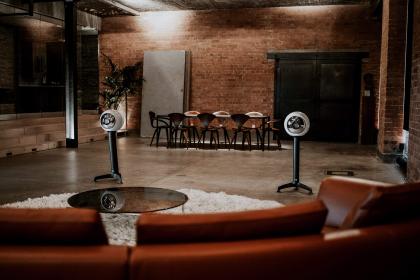
HYLIXA loud speakers by Node Audio

Maximizing technology in design and production

Production and prototyping for the HYLIXA speakers are done on a 3D Systems sPro™ 60 SLS printer. The speakers, which are sold in a set of two, are each printed separately within the printer’s 381 mm x 330 mm x 460 mm build volume. Evans says the team maximizes each build by nesting the other components within the speaker cabinet.

The cabinet and front baffle components of HYLIXA are printed in DuraForm® GF, a glass-filled engineering plastic that delivers an excellent surface finish that is machinable and paintable. As the primary display piece of the speakers, Node puts the HYLIXA cabinets through a methodical post-processing regimen to evacuate all material from the pieces and prepare the surfaces for whatever finishing the customer requests. 

“We learned through the prototyping process that DuraForm GF actually worked very well acoustically,” says Evans. “It has almost a ceramic-like quality to the touch, which helped us both structurally and sonically. As designers, we could freely exploit SLS production to create the internal structure, but also design something that looked as beautiful as it sounds.”

“Every component that we 3D printed, we’ve done for a reason,” says Evans. “We’ve used the technology to benefit the product in one way or another, and pushed to take everything to the absolute limit.”

Close up of SLS produced loud speaker HYLIXA

Reception in the industry and future products

After launching HYLIXA in 2019, Node sent several pairs of speakers to hi-fi industry experts for their unbiased take. In addition to descriptions such as “radical,” “unusual,” and “seductive,” publication Hi-Fi+ praises the speakers for “an almost unbelievable ‘out of the box’ sound” with “an exceptional dynamic range.” 

“The feedback has been even better than we first hoped, to be honest,” said Evans. Having now earned credibility within the industry, Node has more up its sleeves and is looking to grow. Evans says what’s to come is still “very top secret” at the moment, but Node remains committed to its process. 3D printing will be an integral part of the company’s strategy to differentiate itself by doing things that haven’t been done before.

Learn more about this story here.

Mao Zedong’s horse was turned into a 3D model, twice

Producto: Artec EVA
Industry: Design and Art

A controversial figure in the Western world, Mao Zedong stands out from the crowd of national leaders and other historical personalities for hundreds of millions of Chinese. The legacy of the founder of the People’s Republic of China is revered, thoroughly studied, and passed down from generation to generation.

A chapter in Great Helmsman’s life story was recently updated as 3D scanning technology was called upon to preserve for posterity the appearance of Chairman Mao’s favorite horse, which was taxidermied shortly after he died of old age.

What makes the horse so special?

Legend has it that the horse, nicknamed Little Blue One, saved its owner’s life during the Chinese Civil War (1927-1949). Who knows if modern China would be the way it is today if Mao’s horse had made a move at the wrong time during a military withdrawal operation called The Long March (1934-1935)

One afternoon, while Mao and his comrades were being chased by rival Kuomintang squads, Little Blue One with his owner on his back stopped under a cliff they were passing by. No one could understand why the horse simply refused to move until they heard a roar coming from afar – moments later, enemy combatants buzzed overhead. Thanks to Little Blue One, the group went unnoticed in the shadow of the cliff.

At the end of the Civil War, Mao brought his Little Blue, a horse with military merits at the time, to Beijing, where he lived his life in a special enclosure at the Beijing Zoo, until his death in 1962.

Conservation project: completed and reopened

Soon after, the Beijing Museum of Natural History ordered a taxidermy mount of the legendary stallion. After the work was done, the precious relic was taken to the Revolutionary Memorial Museum in the city of Yan’an, northwest China, where the Communist Party had its headquarters from 1935 to 1947.

As time passed, small cracks began to show up here and there, threatening to cause the entire mount to crumble, making the urgent need for restoration really pressing.

Before embarking on the project, the museum administration decided to make a high-precision digital copy of the support to compare its condition before and after restoration. The work was commissioned to Artec 3D Beijing Onrol Technology Co., Ltd. Gold Partner, who had the required experience in 3D digital archiving.

Choosing the right 3D scanner

Every day counted. The scan should be done in the shortest time possible. The Onrol team was given just one day to scan the horse in 3D and convert the collected data into a flawless 3D model.

Attaching targets to the object for better tracking was just out of the question. Even touching it was forbidden, not to mention the use of any hardware that could pose a risk to its condition.

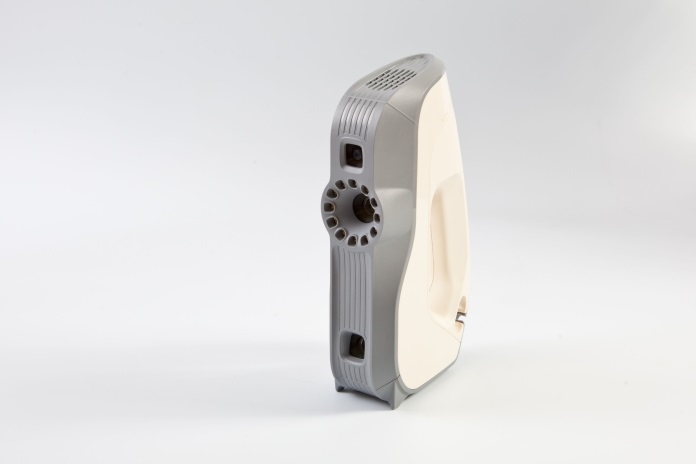
It didn’t take much deliberation to choose Eva as the 3D scanning tool for the project. This portable scanner has been the device of choice for quality control and heritage preservation with companies and institutions ranging from Tesla to the British Museum.

Absolutely safe to use, Eva has a flash bulb and a set of LED lights, the same as in lamps found in any room, to project a structured light beam onto the surface of an object and detect its curves with a precision of up to 0.1 mm.

Along with the object’s shape, Eva captures the texture with a color depth of 24 bits per pixel, giving more than 16 million color variations – more than the human eye can perceive. Capturing Little Blue One in true color was vital to the project.

Scanning speed mattered no less than the quality of the scans. Eva can take up to 16 frames, or snapshots, per second. Each snapshot covers an area approximately the size of a sheet of paper from A4 to A3. This field of view is ideal for working with medium and large objects, such as horseback. When moving around the object, the user takes several snapshots with the scanner of it to 3D digitize the entire surface in a minimum time, preserving all the necessary details.

Ultimately the scanner is very light (0.9kg) and easy to handle, which was another factor that tipped the scales in Eva’s favor.

On-site 3D scanning

On the appointed day, Little Blue One’s taxidermy mount was taken to a designated workshop, where scan specialists from Onrol performed scans, one holding the scanner and the other holding a laptop to which data from the scanner was transmitted.

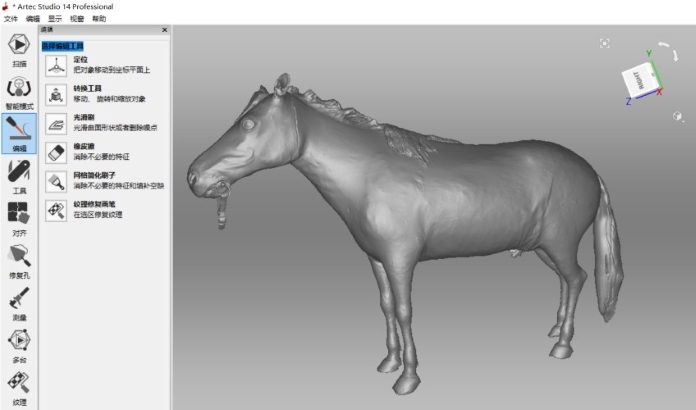
The team used Real-Time Fusion, a tool from Artec Studio’s 3D scanning and processing software that merges the raw data into scans on the fly. In most cases, especially if the object is large and has complex geometry, full processing is required after scanning, but thanks to real-time fusion, the user can see a preview of the final 3D model on their screen during the scan and immediately understand if the collected data is complete or if some parts of the surface have been lost. Since the possibility of a second scan session was ruled out, Artec Studio’s real-time fusion played an indispensable role.

Simplified 3D data processing

Initial processing of the raw data was done on-site, taking only a few minutes. After verifying that they had gathered all the necessary data, the Onrol team headed back to their office to process the scans into a high-resolution 3D model in Artec Studio.

Artec Studio is loaded with a number of powerful features, allowing you, for example, to automatically remove the base on which the object was scanned, or to organically repair and seal holes and gaps in your scans. The software even takes care of the brightness while scanning, adjusting it to avoid overexposure. When is it really useful? If the lighting conditions were far from ideal during the scan, you may end up with one side of the object being brighter than the other and then having to spend hours fixing that. With automatic brightness adjustment, there is nothing to worry about.

The finishing touch, the texture mapping, was done at a rapid pace, all thanks to the fact that version 14 of the software, which was used in the project, saw an 800% increase in the speed of mapping textures.

Now, the 3D model was ready, and its measurements (length, width, and height) were taken.

All objectives met

Obtaining the 3D model of Little Blue One, the museum proceeded to the restoration. After it was completed, the montage was 3D scanned with Artec Eva and measured in Artec Studio again. No critical discrepancies were found between the two 3D models of the horse, attesting to the high quality of the restoration work.

The Onrol scanning team and museum administration agreed to collaborate further to monitor the condition of the restored mount so that it can be preserved centuries ahead.

The timely three-dimensional digitization of precious artifacts is key to preserving cultural heritage and advancing research in anthropology, paleontology, and a number of related fields. If they are shared or posted online, the high-resolution 3D models of artifacts can be accessed by anyone with an interest, regardless of where they are located. 3D scanning technology is an easy way to create digital doubles of fossils and specimens at excavation sites, or museum exhibits, avoiding the need for any physical contact with the object. Ultimately, 3D models can be displayed through interactive virtual reality platforms, expanding the reach of museums both locally and around the world.

×