
Virtual commissioning with Siemens solutions reduces launch time by three weeks

Product: Tecnomatix
Industry: Intralogistics
Experts in intralogistics and warehousing operations

Intelligent Distributed Controls (IDC) was founded in 2003 to support customers with intralogistics and warehousing operations in the U.K. and Europe. The engineering, management and IT team at IDC have a broad range of skills including HV Control Panel Design, PLC Software Development, with C# .NET and Android supporting the WCS and WMS development. The team is also supported by project managers with an in-depth knowledge of intralogistics and warehousing and advises customers on automation and warehouse control and management systems (WMS).

One of IDC’s customers, a retail distribution center serving major mail order and e-commerce businesses, had begun planning in spring for the upcoming Christmas seasonal peak. One of the key machines in the distribution center is a high-speed tilt-tray sortation machine that processes more than 6,000 items per hour. The customer wanted to update the machine’s systems due to unsupportable SCADA and controls systems, and asked IDC to complete the upgrade in a narrow two-month window during May and June.

Besides its short time frame, the project posed additional challenges for IDC. IDC wanted to explore how much work could be completed remotely, to reduce the time required for final commissioning checks at the customer site.
Experts in intralogistics and warehousing operations

Partnership with Simsol

IDC decided to use a combination of virtual and on-site commissioning techniques to reduce lead time on the project, and for this purpose partnered with Simsol, a Siemens Digital Industries Software solution partner.

Simsol is focused on Siemens’ Tecnomatix® portfolio of digital manufacturing solutions, and has gained recognition as a Expert partner, providing specialized expertise in digital manufacturing technologies and production simulation. Simsol trained IDC on the Tecnomatix software and offered best-practice advice on how to use and construct its models throughout the project.
Partnership with Simsol

Leveraging the digital twin

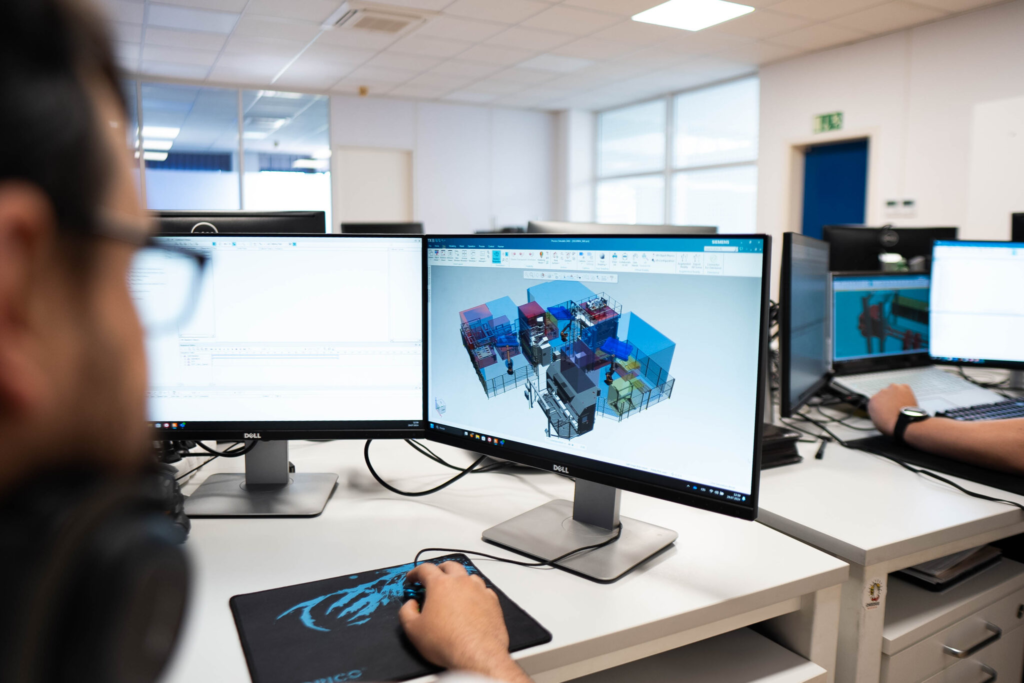
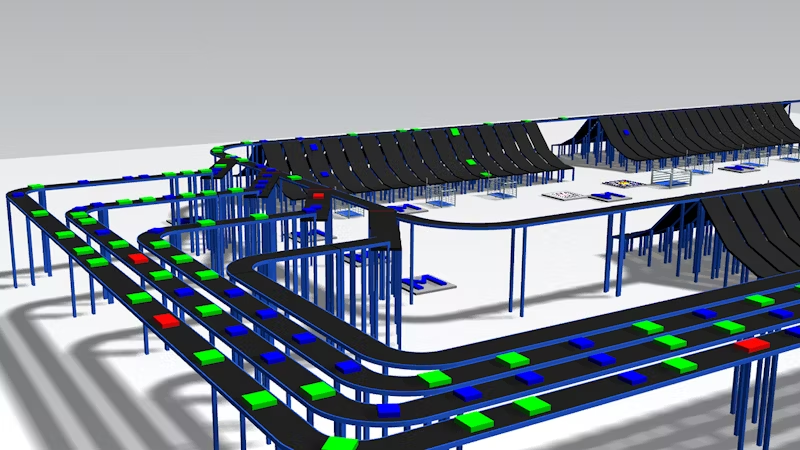
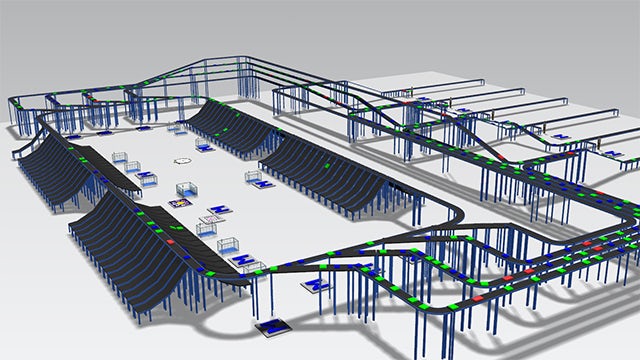
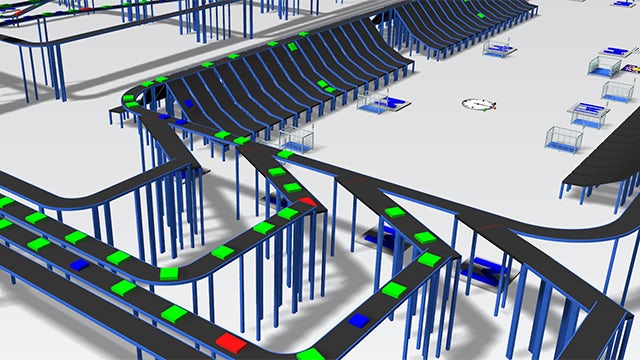
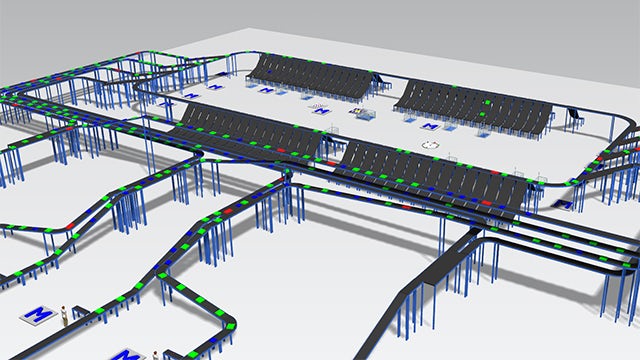
IDC used Plant Simulation in the Tecnomatix portfolio to build a comprehensive digital twin of the retail distribution center – a complete and accurate 3D model of the logistics systems and their processes, including control logic. The digital twin gives a strategic overview of the entire operation, rather than just a single cell or line. This gives more opportunity to focus on key areas identified for investigation and to continually improve across the whole production. IDC used the digital twin to explore and optimize the distribution center for performance, and to accurately simulate the tilt-tray sortation machine and more importantly the induction logic, which is critical to optimizing the throughput.

To make the most of the time available, the IDC team focused on the more complex areas of the machinery, investigating the dynamics and relationships among components and simulating mechanical changes to moving parts.

With the digital twin, the team was able to consider oversized (or “ugly”) items. Instead of building from the general throughput rate for standard items, the team generated virtual stock data in a range of item sizes that closely represented the packages to be processed by the distribution center. The dynamic data yielded a more realistic view of machinery performance. Performing this work remotely was crucial to meeting the customer’s deadlines.

“Without access to the actual sortation machinery, we had to use standard warehouse control system design models to construct code for testing,” says Richard Towne, Managing Director at IDC. “With the simulation model that IDC created, we could simulate almost all aspects and know that the code was validated against the system design, so we didn’t need major changes when we got on site.”
Leveraging the digital twin

Tangible results

IDC realized tangible results from the use of digital twin plant simulation. The company was able to upgrade the controls and commission the tilt-tray sortation machine in just five weeks, well within the time frame proposed by the customer. With remote commissioning, IDC also minimized costly on-site time, reducing overall commissioning time by three weeks as compared to a similar upgrade project that required eight weeks using on-site commissioning only. The controls upgrades also increased the throughput of the sortation machine.
Tecnomatix solutions help improve steel foundry plant planning

Product: Tecnomatix
Industry: Industrial machinery

Leading the world in roll production

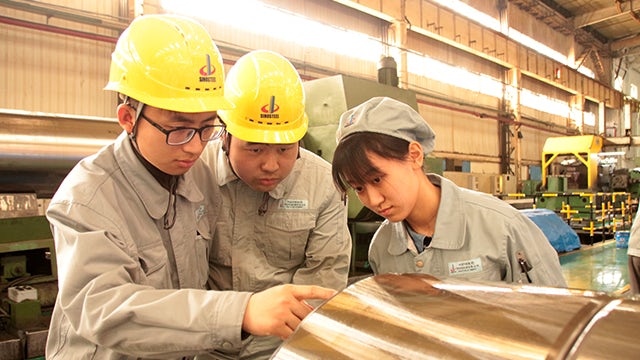
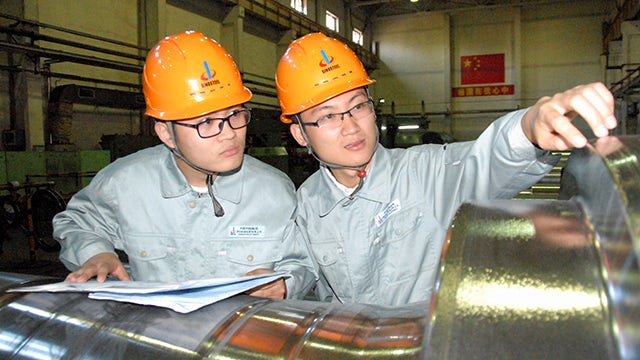
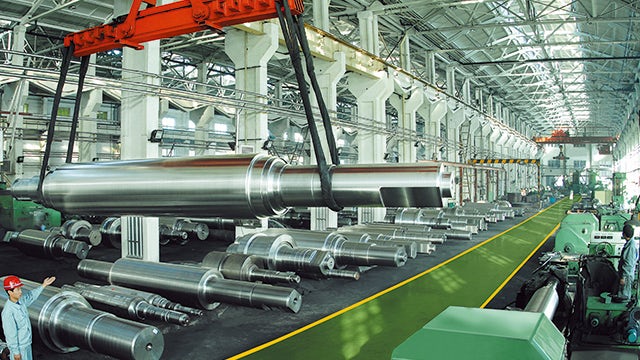
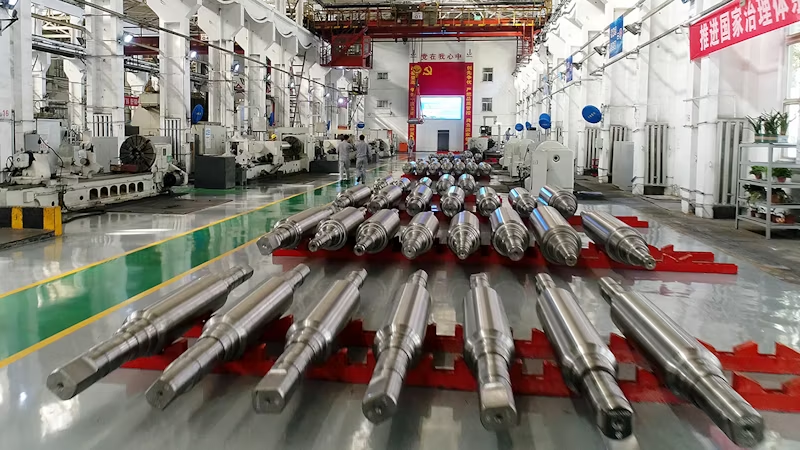
Sinosteel Xingtai Machinery and Mill Roll Co., Ltd. (Sinosteel Xingtai) is the world’s largest producer of mill rolls with an annual output of 180,000 tons and a global market share of more than 20 percent. Pursuing the China 2025 national industrial manufacturing strategy, the company began upgrading its plants in 2018. The company moved to the Xingtai economic development zone to build new plants, investing nearly 10 billion RMB. Xingtai Machinery and Mill Roll aims to become the world’s first intelligent digital roll production enterprise.

Sinosteel Xingtai Machinery and Mill Roll verified and optimized a new plant using Siemens digital manufacturing solutions.

Implementing Tecnomatix digital manufacturing

In the earliest phase of new plant planning, the company adopted the Tecnomatix® portfolio of digital manufacturing solutions, part of the Siemens Xcelerator business platform of software, hardware and services. With the assistance of IPS, a Siemens Smart Partner consultancy, Xingtai Machinery and Mill Roll collected production and logistics data and imported a new plant blueprint into the Tecnomatix Plant Simulation 2D/3D simulation environment.

Tecnomatix Plant Simulation includes tools for simulating, exploring, and optimizing logistics systems and their processes. The plant models enable analysis of material flow, resource utilization, and logistics for all levels of manufacturing planning, well in advance of production execution. Using these tools, Xingtai Machinery and Mill Roll conducted the plant simulations, verified the layout and logistics, and optimized the total manufacturing plan.

Sinosteel Xingtai Machinery and Mill Roll verified and optimized a new plant using Siemens digital manufacturing solutions.

An effective way to discover plan deficiencies after the static design phase

By simulating the production and logistics processes, the Xingtai Machinery and Mill Roll team effectively discovered several problems that are otherwise difficult to detect at the static design phase. For example, the simulation results revealed that the inventory of pig iron and steel scrap was negative when studying the cross-region material distribution. By checking the input data table, the team found that the daily demand for pig iron and steel scrap was greater than the planned capacity of the storage tanks.

In another example, the team used Plant Simulation to discover that a flat car did not return to the waiting position for the next batch of material according to the batching schedule. The flat car was still in the melting span, and the material on the flat car had not been consumed, so the next batch of material could not be distributed on time. The error in the logistics design was easily understood when the team compared the simulation data with the input data table. The problem was finally solved by adding a spare material plate. Simulation has helped to accurately identify and correct other problems, such as the interference of a moving crane with other cranes and equipment. The ability and efficiency of Plant Simulation to help discover problems introduced at the static planning phase is highly valued by the company.Sinosteel Xingtai Machinery and Mill Roll verified and optimized a new plant using Siemens digital manufacturing solutions.

A powerful platform for plan optimization

Using Plant Simulation, Xingtai Machinery and Mill Roll optimized the plant plan. For example, one of the optimization considerations for a steel sand box area was whether to add a flat car track. Plant Simulation helped the team to easily verify the option by running the simulation and comparing the results. The simulation determined that adding a flat car track would reduce the moving distance of the overhead traveling crane by 1,600 meters and reduce working time by 27 minutes per day. Similarly, in a cast crossing and other areas, the team proposed a series of optimization solutions that were quickly verified by the simulation. These optimizations helped eliminate logistics collisions and increase the efficiency and utilization rates of high-value equipment. By the end of the first phase of the plant simulation project, the team had found six important design deficiencies and proposed two important optimization solutions for layout and logistics.

“With the help of Tecnomatix solutions and IPS consultants, we have improved the plan of the new plant in a relatively short time at a limited cost,” says Wang Jingjun, director of information management at Sinosteel Xingtai Machinery and Mill Roll. “The project not only helped avoid several important design deficiencies, but also helped save 100 million RMB in equipment investment by optimizing the layout and logistics.”

Sinosteel Xingtai Machinery and Mill Roll verified and optimized a new plant using Siemens digital manufacturing solutions.

Leading automation machinery manufacturer improves safety with Process Simulate Safety Robots Manager

Product: Tecnomatix
Industry: Automation

Hear from Ondřej Pažout, Benthor head of robotics and simulation, about how the leading automation machinery innovator uses Siemens Process Simulate software to help elevate robotic safety and efficiency. Benthor is a leading innovator in the manufacturing industry, specializing in the design and integration of advanced robotic systems.

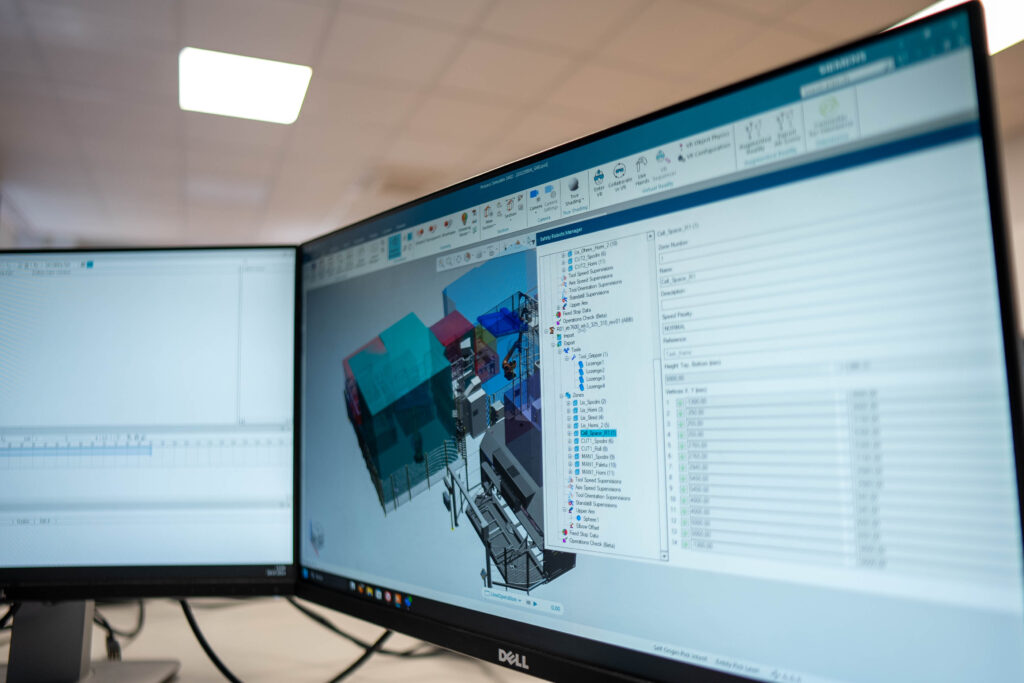
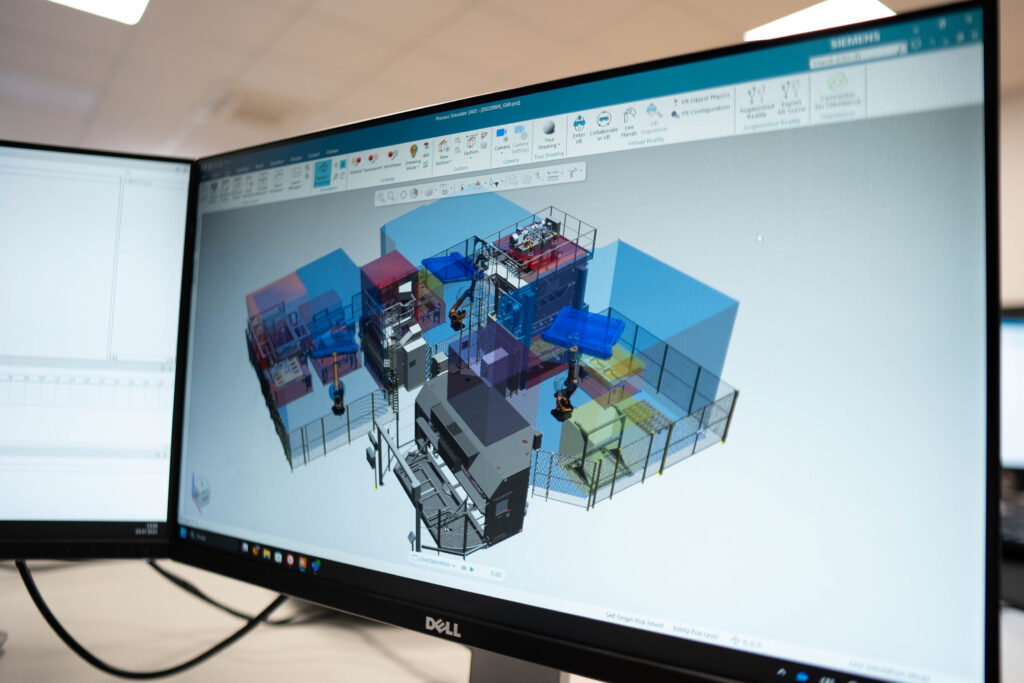
process-simulate-robot-safety-manager-2
Benthor engineers can monitor the status of robots in a simulated environment where there is no risk of injury or hardware damage.

Automation solutions for machines and production facilities

Benthor Automation, based in Mladá Boleslav, Czech Republic, develops automation and information technology (IT) systems for industrial manufacturing. The company’s customers are primarily in the automotive industry and include domestic and foreign car makers. Benthor’s core competencies include automation solutions for machines and production facilities with superior control technology and material flow management, and it offers services throughout the process chain, including consulting, technical solutions, hardware planning, software development, system deployment and after-sales service.

At Benthor, we prioritize the safety of robotic systems, and thanks to our collaboration with safety experts, we are able to design cutting-edge manufacturing equipment with integrated safety elements from the very first concepts of the workstations. This way, we provide our customers with transparency — visualizing the future workstation while eliminating additional costs caused by misinterpretation or misunderstanding of functionality.”Ondřej Pažout, Head of robotics and simulation for Benthor automation s.r.o.

In the industrial automation space and as robotic systems become more prevalent in densely populated automated lines, functional safety remains crucial to prevent human injury and equipment damage. When planning a new robot station or lines, whether implementing changes for new products or layout adjustments, prioritizing robot safety is paramount. The intricacies of addressing robot safety in production systems started only as a discussion between Benthor and Siemens team, and now it has evolved into a strategic business priority for Benthor. That is when the leading automation machinery manufacturer realized the value of using Process Simulate Safety Robots Manager to address the safety of robotic workstations.

Meet the robot safety experts part of this collaboration:

eddy-finaro-siemens
Eddy Finaro
Product Manager Siemens Digital Industries Software
Alex Greenberg
Director of Advanced Robotics Simulation
Siemens Digital Industries Software

Hear from Ondřej Pažout, Head of robotics and simulation for Benthor

process-simulate-robot-safety-manager-1
Ondřej Pažout, Benthor

Priority at Benthor

At Benthor, we fully recognize the crucial importance of safety in the integration of robotic systems. We design robotic workstations with the goal of minimizing risks for both  operators and the equipment itself. Our integrations include not only physical barriers, but also sophisticated software tools for simulation and safety management. We address safety right from the start of the project by using simulations that consider all possible scenarios and potential safety incidents arising from risk analysis.

This approach allows us to eliminate potential risks even before the construction of the workstation begins. This helps us avoid costly adjustments to equipment or software during or after deployment. Thanks to our collaboration with the Siemens team responsible for Tecnomatix Process Simulate Safety Robots Manager, Benthor is able to implement advanced simulation technologies and methodologies that ensure detailed analysis and optimization of robotic workstations.

Solution: Process Simulate Safety Robots Manager

One of the key tools we use at Benthor is Process Simulate Safety Robots Manager (SRM). This application enables detailed management of robot safety functions and helps us simulate safety scenarios before physical implementation. With SRM, we can set up safety zones, define allowed movements, and monitor the status of robots in a simulated environment where there is no risk of injury or hardware damage. This allows us to quickly respond to any safety deviations and take appropriate measures during the design or virtual commissioning phase. This approach not only increases safety but also the efficiency, reliability, and profitability of automated systems. 

Robot safety use cases

By utilizing solutions from the Tecnomatix Process Simulate portfolio, we have integrated more than 2,000 robots at Benthor, with nearly half of the installations using Safety Robots Manager to simulate safe robot behavior at the software level. Recently, we successfully implemented a robotic system project for the production of interior textile linings in the automotive industry. The core focus was the safety of operators when handling materials and preventing collisions with pressing tools. This resulted in more than 40 safety zones were successfully deployed and simulated across three robots. Thanks to simulation with SRM, Benthor was able to optimize robot movements and the production cycle without compromising safety standards.Ondřej Pažout, Head of robotics and simulation for Benthor automation s.r.o.


A robust partnership and the future of robot safety

The collaboration between Benthor and Siemens has proven invaluable in advancing the safety and effectiveness of our robotic workstations. By leveraging advanced simulation tools like Process Simulate Safety Robots Manager, Benthor continues to innovate and ensure that its systems meet the highest safety standards. Looking ahead, Siemens and Benthor are excited about future projects and the ongoing improvement of advancing safety protocols, which will further strengthen Benthor’s commitment to providing next-level solutions for its customers.

Automating and standardizing PCB engineering planning

Product: Valor
Industry: Electronic

Standardize and unify manufacturing operations

Connect Group NV (Connect Group) is a multinational electronics manufacturing services (EMS) contractor, providing printed circuit board (PCB) assembly and cable assembly services for various customers in the automotive, railway, healthcare, infrastructure, defense and avionics industries. The company is headquartered in Kampenhout, Belgium, and maintain production facilities in Belgium, the Netherlands, Germany, Romania and the Czech Republic.

Connect Group was established in 1987 and, in recent years, has acquired a series of European electronics manufacturers including IKOR, a company with locations in Spain, China and Mexico. Wouter Peene, operations manager for Connect Group, was faced with coordinating the activities of its new subsidiaries and reorganizing company-wide work practices.

“My goal was to standardize and unify manufacturing operations in all of our sites,” says Peene. “This wasn’t an easy task. We had machines from different vendors at each site. All of our engineering and testing departments were using different software and methodologies, including legacy solutions such as UNICAM 6.2 and Test-Expert 7.3. In addition, we used a lot of manual processes, such as offline board inspection, to discover incorrect component positioning and rotation.

“At first, we wanted to keep using some of our existing legacy software to leverage our knowledge and save time and money. But none of our existing solutions could support our entire operation. They lacked interfaces to many of our machines and couldn’t generate the documentation we needed.

“We needed an end-to-end solution that would serve all our production sites,” says Peene.Standardize and unify manufacturing operations

The Valor solution

Since Connect Group was already using Valor™ Process Preparation software in some of its factories, the company decided to expand its use of the software to access more of its engineering capabilities. Valor Process Preparation is part of the Siemens Xcelerator portfolio, the comprehensive and integrated portfolio of software, hardware and services.

“We were already using the vPlan function in Valor Process Preparation and realized we could benefit from additional functions,” says Peene. “For example, we used the Valor Process Preparation automated stencil tool across the organization. Getting the stencil right requires special expertise that wasn’t always available. Using the stencil tool helped us reduce soldering errors and the lead time required by the stencil-cutter service provider.

“Currently, we use the virtual sticky tape feature to verify component position and polarity before starting production. The comprehensive digital twin approach enables us to shorten the verification process and reduce downtime. Using Valor Process Preparation allows us to connect to all of our machines so we can implement it as a company-wide solution.”

Connect Group used Valor Process Preparation and the comprehensive Valor Parts Library software component database to accurately simulate each component’s shape. “Using Valor Parts Library helps us eliminate costly design errors before production starts,” says Peene.

In addition, Connect Group used Valor NPI software, Siemens’ on-premise design-for-manufacturing (DFM) platform. “We offer the Valor NPI DFM as a service to our customers,” says Bart Allaert, head of the company’s technology is a service group, “It is part of the shift left concept, encouraging the designer to be aware of manufacturing constraints.

“They use DFM to ensure their design is manufacturable, so we spend less time afterward tweaking the design for them. Then, we use Valor NPI to perform checks and generate an analysis of the PCB assembly and tests. Using Valor NPI helps us bring higher quality products to market, faster, as part of a First Time Right strategy” says Allaert.The Valor solution

Return-on-investment

Connect Group established an execution team with Siemens that provided training sessions to implement a solution for all production locations in a few months. The centralized solution enabled Connect Group to easily move production between sites whenever necessary.

Following implementation of the Siemens solution, Connect Group reported a return-on-investment (ROI) within six months based on increased company profits of approximately €400,000 per year thanks to improved manpower and reduced downtime on its production lines.

Connect Group has major profitability factors, including product engineering, flying probe testing (FBT) and project migration.

The product engineering solution helped engineers reduce manpower requirements by about two hours per project, multiplied by 2,500 projects per year, for a total of 5,000 hours.

Using Valor Process Preparation saved Connect Group engineers approximately two hours of FPT programming per project multiplied by 500 projects per year, for a total of 1,000 hours.

When transferring a project to a different site, the process took an average of eight hours. Using Valor Process Preparation, the task is now completed within minutes. Connect Group migrates an average of 75 projects per year, resulting in a savings of 600 hours.

As a result, Connect Group has reduced manpower requirements by 6,600 hours per year. In addition, each of the above factors contributed to a reduction in line downtime. These improvements helped the company improve profitability by €400,000 per year.

Additional features for the future

“To optimize our use of the Siemens solution, we’ve made requests for additional features that are scheduled for upcoming releases. Siemens fully understands our requirements and supports us in adapting the software to our needs,” says Peene.

Reaching for the stars: Top 10 insights from Tom Stoumbos on space exploration

Product: Simcenter
Industry: Space

Space exploration is one of engineering’s most demanding arenas. The unforgiving conditions and the necessity for precise, reliable technology present formidable challenges. Recently, on the Engineer Innovation podcast, Tom Stoumbos, Director of Engineering at Northrop Grumman, shared his insights on why space exploration is both difficult and exhilarating. He delved into the critical roles played by simulation, testing, AI, and data management.

From the home office in the cosmos, where the stars align and rockets soar, we have the top 10 quotes from Tom. Buckle up because we’re about to launch into some stellar insights.

10
“Operating in the virtual world is much easier than the prototypes in the real world with all the constraints about volume, space, mass that that takes. “

9
“Lunar exploration was a success of the ’60s. We worked hard together with a lot less resources to accomplish something inconceivable and now 50 years later it’s still difficult.”

8
“The models are complex, which means…there’s a lot of fidelity. For example, a space vehicle, it comprises of a lot of subsystems. So, it’s just not the structure. We have motors, we have mechanisms, we have complex joints that we need to simulate or operate. We have software that controls robotic arms. So, we need to make sure we understand how these things are controlled from the control system of that space vehicle. “

7
“In the virtual world, you can do design updates quickly…you can engage AI through custom algorithms that search for optimum solutions based on design constraints.”

6
“It’s difficult to establish a launch site here on Earth, furthermore in the moon that has no infrastructure.”

5
Simulation is critical to space exploration
“Simulation is critical to making mission operations and design decisions better.”

4
“We’re basing a lot of the work we do on HEEDS. We think it’s an invaluable tool to do that first step of tying all the solvers that we’re using together and allowing us to do these design of experiments or Monte Carlo simulations for our missions quickly and efficiently.”

3
“With computing power exponential increase…we need to make sure the algorithms are properly conceived, and they help us reach that optimum solution, but [AI and Machine Learning] definitely make it much faster”

2
“AI is definitely much faster…we can save 50% of the time to market time by engaging as soon as we can with AI and ML.”

And finally, the number 1 quote from Tom Stoumbos:
“Teamcenter Simulation allows you to track what tools you use, what requirements you tied those to, and all the data that has been generated…it’s easily searchable.”

Pioneering new frontiers in space exploration
Space exploration is a challenging but rewarding field that pushes the boundaries of human knowledge and capability. Tom Stoumbos’s insights underscore the importance of robust simulation and testing processes and the transformative potential of AI and data management. As we continue to explore the cosmos, these technologies will play an increasingly vital role in ensuring the success of our missions.

Leveraging simulation to determine a single airbag is safer and more reliable than a multi-airbag system

Product: Simcenter
Industry: Exoskeleton 

Getting wheelchair users back on their feet

Millions of people are confined to wheelchairs due to illness or injury. Despite some advancements in wheelchair technology, the lack of significant progress since its invention still falls short in providing individuals with the ability to stand and walk. First, there is the social aspect of being at a different height from those around you. Second, the prolonged sitting position associated with wheelchair use can lead to health issues, such as reduced bone density, osteoporosis, muscle atrophy, pressure sores, spasms, changes in blood pressure, joint problems and even cardiovascular conditions.

Nicolas Simon has several family members who suffer from Charcot-Marie-Tooth, a degenerative condition that in its advanced stages often requires patients to use a wheelchair.

With no known cure, Simon wanted to provide an alternative. So in 2012 he founded Wandercraft with the aim of developing an exoskeleton that would allow people disabled below the waist to walk again.

The company has built and implemented the Atalante X in rehabilitation settings in hospitals, but it wants to expand that vision beyond a healthcare setting. “We want to give people more autonomy and to be able to use these exoskeletons in the real world, not only in a controlled environment with a doctor or physiotherapist,” says Fabien Expert, chief technology officer (CTO) of Wandercraft. “In the United States alone, we estimate there are 300,000 people with spinal cord injuries that could benefit from the exoskeleton in its current form. As we adapt the design in future versions, we hope to make it suitable for even more people by extending it to other pathologies, stroke rehabilitation and multiple sclerosis.”

To achieve this goal, Wandercraft adopted Siemens Digital Industries Software’s Simcenter™ Madymo™ software. Simcenter Madymo, which was developed primarily for the automotive industry, is used to develop better occupant and pedestrian safety solutions faster. Simcenter Madymo is part of the Siemens Xcelerator business platform of software, hardware and services.

null

Mitigating the risk of further injury

Taking the device to the streets is a big step. “Safety is absolutely critical,” explains Expert. “The people we are helping can get around by themselves in a wheelchair. The exoskeleton allows them to stand and walk, but we need to mitigate the risk of further injury. For instance, if they were to fall and suffer fractures or head injuries, this would put them in an even worse position than before.”

With the exoskeleton already proving functional, Wandercraft needed to adapt it to protect users so that they didn’t fear the possibility of an accident that would cause additional long-term injuries.

null

Personal airbag system

Wandercraft was inspired by airbags used in vehicles as they are designed to cushion impact on humans and minimize injuries. The exoskeleton is designed so the center of mass of the system is on the back, so if there is a power failure an imbalance occurs, the person using it would naturally fall backwards. This means they could install the airbag on the back to protect the user.

However, ensuring the effectiveness of the airbag required considerable analysis and assessment. It needed to be easy to add to the exoskeleton without incumbering the user, but also provide enough protection to significantly reduce the risk of injury in the event of a fall.

“We first had to understand if it was even feasible,” says Expert. “We must be able to detect that a fall is happening and then deploy the airbag within a half second. It was important to determine whether multiple airbags or just one would be better, and to get the sizing correct so that it provided enough protection without adding too much weight to the exoskeleton.”

Building physical prototypes to test this would have been a very time-consuming process because each airbag had to be made by hand. Using physical dummies would also not give full data on potential injuries to users. Wandercraft needed a faster solution that could fully replicate the human body and predict how well the airbag protected it during a fall.

null

Combining FEA with multibody simulation

Initially, Wandercraft used a finite element analysis (FEA) simulation tool, but this wasn’t sufficient to give them the data they needed. “We had no way of accurately modeling the patient to understand what injuries might be incurred,” explains Maxime Beck, head of mechanical engineering. “We had a separate multibody simulation tool, but we needed a solution that would combine both.”

To help them, Wandercraft reached out to the University of Strasbourg. “The university introduced us to Simcenter Madymo,” says Beck. “We could measure acceleration and angular speed, but we didn’t know how to use that to predict the impact on the patient. The University of Strasbourg showed us how to create the simulation with Simcenter Madymo and use its human body models to measure the effect on the user.

“The fact that Simcenter Madymo has been used for safety simulations in vehicles really helped as it has lots of models for how an airbag should perform. With Simcenter Madymo, we were able to match up the simulation results with physical test results, which gave us confidence to continue with it. Then we could optimize with each iteration without having to create a new prototype every time we changed the design.”

null

Simplified design and shorter development time

One of the most important outcomes from the simulation was to determine how many airbags should be used – primarily to maximize safety but also to make the device as cost-effective as possible. “Simulation allowed us to experiment with multiple airbags, but we found this didn’t add any more protection for the user,” says Beck “Each airbag needs its own gas and trigger mechanism, so the more you have, the more complex the setup is. Knowing that one large airbag gave as much protection as two or three smaller ones meant that we could reduce the complexity, making the whole unit easier and cheaper to manufacture.”

In fact, having just one airbag is not only more cost-effective but safer too. A multi-airbag system relies on each airbag to trigger at exactly the right moment. If one fails, then it’s the same as having no protection at all. The more complex a system is, the more chance there is of failure. So, by having just one airbag and one trigger the system immediately became more reliable.

Expert says that using Simcenter Madymo saved significant engineering development time, too: “The physical prototypes took one engineer three days to make each time. And it’s such a unique process that we only had one person with the necessary skill set. Without simulation, we would have had to wait this long between each iteration to test our theories. It would have taken so much time to reach the optimal design that it simply wouldn’t have been practical.

“Once the prototype is built it takes another full day to set up the test, but we can configure a simulation with any parameters we want in just a couple of hours.”null

Regulations, improvements and new features

Now that Wandercraft is confident in the safety of its exoskeleton, the company is carrying out further testing to pass the necessary regulations. “We hope to achieve full regulatory clearance before the end of 2025,” says Expert. “Then we’ll be able to get it to market and we’ll see people using our exoskeleton in everyday life.”

But that is only the start. Thanks to simulation that made the first device possible, Wandercraft will continue to make use of it as they improve future products. “We’ve achieved the first target of getting patients out of wheelchairs,” says Expert. “But the aim is to give them more. We know they will demand more once they begin to experience their new freedom, whether it’s freedom they haven’t had since an injury or freedom they’ve never had due to being born with a certain condition. We intend to work on additional features to meet that demand. “Thanks to Simcenter Madymo, we’ll always be able to ensure that devices with these new features will be safe for the users.”

Reducing design error probability by 25 percent

Product: Capital
Industry: Agriculture

Improving farmers’ work and quality of life

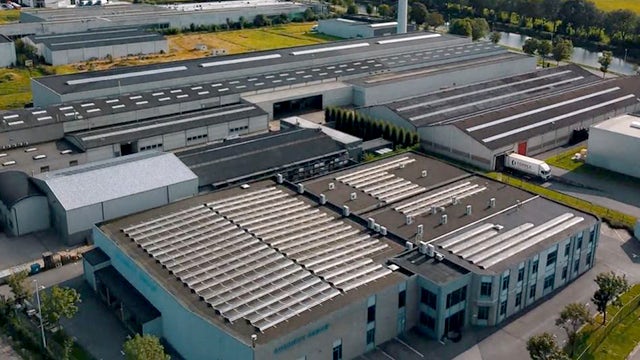
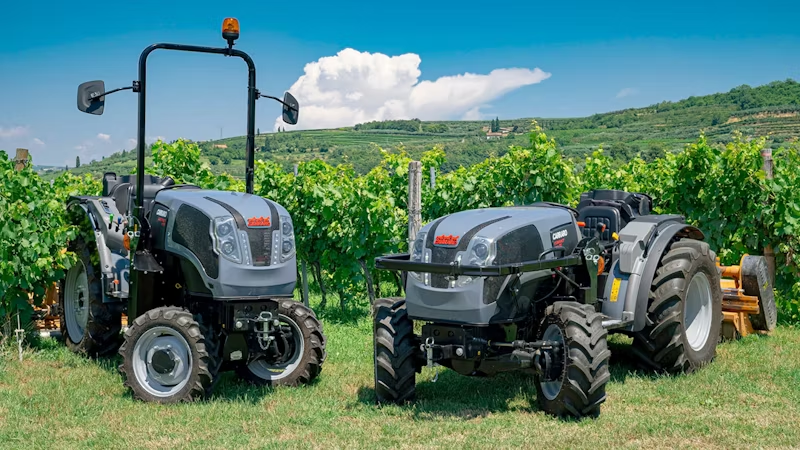
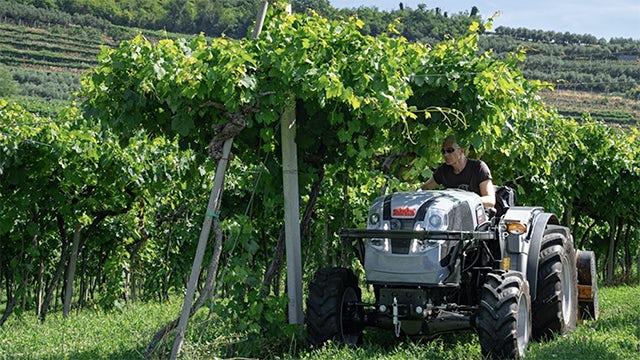
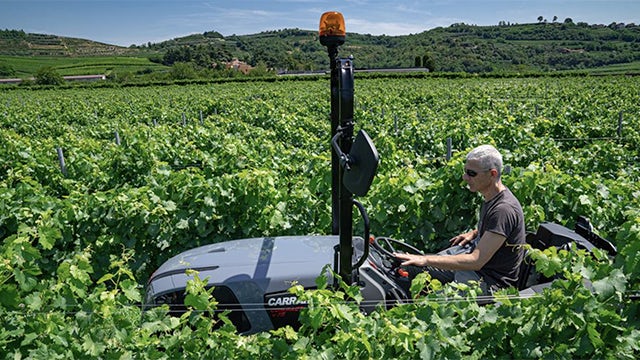
Carraro Group was founded in 1932 with the goal of improving farmers’ work and quality of life. It designs and manufactures solutions for agricultural machines from tractors to combine harvesters. Since establishing its axles and transmissions division, Carraro Group has become a key partner for the world’s leading manufacturers of agricultural machinery. This global organization has nine manufacturing plants and over 3,000 employees.

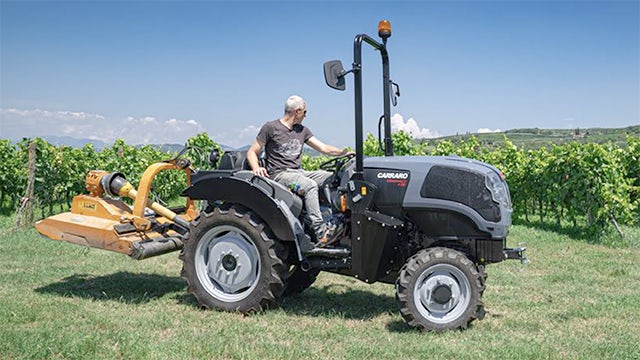
Additionally, Carraro Group is creating a new paradigm in the agricultural equipment sector with the introduction of its hybrid tractor models and a line of zero impact eTransmission products, designed for hybrid and fully electric vehicles. The company’s lean team of 11 harness and electrical engineers creates roughly 50 wire harnesses per year.

“Today, our focus is reducing emissions and maximizing machine efficiency for earth moving machines and orchard and vineyard equipment,” says Paolo Righetti, electrical competence center director at Carraro Agritalia, Carraro Group’s tractor division. “Technology, innovation and people are our pillars – the starting points to position ourselves as the world’s leading manufacturer of gears and transmission systems.”

Improving farmers’ work and quality of life

Keeping up with accelerated production

In 2014, Carraro Agritalia’s rapid growth prompted its busy research and development (R&D) team to look for new tools for streamlining electrical wiring and harness design.

“Wiring and harness design is critical for Carraro Agritalia, because it is the heart of the vehicles we manufacture,” states Righetti. However, the changing design requirements for creating powertrains for heavy equipment challenges primitive simulation and analysis tools. To accommodate the growing number of complex software-driven product features, functions and operating systems, sophisticated software validation and revision management are required.

“Our existing electrical design environment was sufficient when we were just getting started,” Righetti explains. “However, as we expanded our team and began taking on more projects, quickly and efficiently tracking errors and troubleshooting mistakes became critical and the tool we had in place made this slow and cumbersome.” The existing tool did not provide the ability to perform design rule checks (DRCs), which was an important next step as the company ramped up project volume.

Carraro Agritalia’s R&D team needed a solution that could integrate harness design with wiring, so data could be easily transferred and reused throughout development. They also needed to minimize errors and reduce the time required for parts assignment by eliminating tedious manual tasks. The ability to automatically generate custom reports was also essential.

“Reducing errors during design is of paramount importance,” states Righetti. “Manufacturing errors can significantly delay production and require time-consuming manual changes before manufacturing can continue.” Design mistakes that persist into the finished product can result in mandatory recalls, impacting brand credibility among customers and prospects. “To prevent post-production faults, we needed a single-source data management system and a way to test and validate the designs early in the process when they are easier to correct,” Righetti explains.

Keeping up with accelerated production

Enabling the right design, the first time

After the discovery and pre-sales activity with Siemens Digital Industries Software solution partner, Har-Tech, Carraro Agritalia’s R&D team selected Capital™ Essentials software. They used the software to handle the demands of designing electrical schematics and harnesses for its growing catalog of tractors and agricultural machinery, including its line of hybrid tractors and eTransmission products. Although Carraro Agritalia evaluated other solutions, Capital Essentials stood out due to its ease of use and value for the price. Capital Essentials is part of the Siemens Xcelerator business platform of software, hardware and services. 

Capital Essentials helps wire and harness designers achieve dramatic return-on-investment (ROI) with powerful, intuitive functionality. The software is also optimized for rapid deployment and easy installation. Design and harness tools can be used individually or deployed together, which enables wiring design data to flow seamlessly to the associated harness designs, reduces effort and minimizes the risk of errors.

“Capital Essentials is a next-generation tool that provides us with an easy and streamlined way to track, share and analyze engineering data and information throughout the design cycle,” Righetti says.

Using Capital Essentials enables the engineering team to rapidly achieve error-free electrical and harness designs the first time and take advantage of numerous validation features in the future. They can automatically create production-ready drawings, bill-of-materials (BOMs) and all the files and reports needed for costing and manufacturing activity. Capital Essentials integrates with 3D computer-aided design (CAD) systems so engineers can model the design then engineer the electrical details in Capital Essentials. “One of the big selling points for Capital Essentials is its strong integration capabilities and the potential to pull data from a variety of CAD, MCAD and PLM solutions,” Righetti says.

Capital Essentials is intuitive and easy-to-use and comes with video tutorials, online training, extensive documentation and support from an active user community. Additionally, Capital Essentials offers full data compatibility with Siemens’ Capital™ software electrical engineering (E/E) systems development solution, making it seamless for Carraro Agritalia to partner with original equipment manufacturers (OEMs) who use Capital solutions.

“By using Capital Essentials and this new approach, we can eliminate errors, accelerate time-to-market with new products and be confident that customers will not waste time or productivity fixing machinery,” states Righetti.

Enabling the right design, the first time

Integrating code library to enable early verification and eliminate errors

As part of the deployment, Righetti worked with Har-Tech to create a library of electrical component models that correspond to the electrical symbols and Carraro Agritalia code and integrated this library into the Capital Essentials tool.

Additionally, Har-Tech created checklists and automatic test sessions to validate schematics prior to creating the prototype, which enabled Carraro Agritalia’s R&D team to perform the first phase of validation and checks before placing the first harness order.

By simplifying the process of designing and verifying complex modern wire and harness designs, Capital Essentials is helping Carraro Agritalia establish a presence in the electric tractor market. According to the Global Autonomous Electric Tractor Market 2021 research report, this is projected to grow at a compound annual growth rate (CAGR) of 32.7 percent from 2021 to 2027 and reach about $4,233.50 million by 2027.

Gaining a competitive edge with fewer errors and faster test times

Since implementing Capital Essentials, Carraro Agritalia’s R&D team has expanded its use of Capital Essentials from two licenses to seven, substantially reducing costs and increasing productivity. They have reduced the probability of design errors by 25 percent, increased functional team to clearly understand connectivity and circuit behavior and correct any issues early in the design cycle. Har-Tech will be an integral part of that process, planning to introduce simulation into the design process for continuity, as well as voltage drop and current directions and calculations. In this way, Carraro Agritalia’s engineers can work faster and more accurately than they can with traditional systems.

“Our goal is to improve the lives of workers operating agricultural and construction machinery,” says Righetti. “With Capital Essentials in our toolbox, we can deliver top-quality machinery to market faster, reduce operational overhead and risk and deliver our promise to reduce emissions while maximizing machine efficiency.”

Gaining a competitive edge with fewer errors and faster test times

Enhancing Automated Optical Inspection with Siemens’ Valor Process Preparation

Product: Valor
Industry: Optical Inspection

As technology continues to advance, the demand for streamlined processes that can handle complex designs and diverse product types is ever-increasing. MIRTEC, a renowned specialist in optical inspection solutions, has recognized this need and taken a significant step forward by integrating Siemens’ Valor™ Process Preparation software into its automated optical inspection (AOI) and solder paste inspection (SPI) machines.

Complexity in Manufacturing Processes

Electronic manufacturing services providers and contract manufacturers often face challenges in adapting to high-mix environments. With varying design formats and data sources like Gerber and ODB++, programming AOI and SPI machines manually can be time-consuming and prone to errors. The need for a seamless transition from design to programming is critical to optimize production efficiency and maintain high-quality standards.

The Solution: MIRTEC’s Collaboration with Siemens

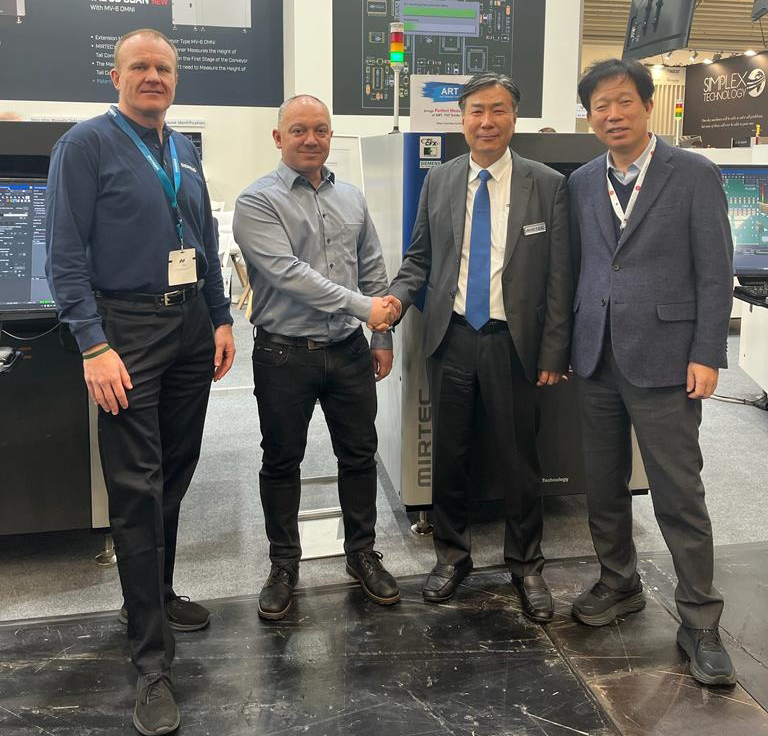
Through a strategic global partnership, MIRTEC has joined forces with Siemens Digital Industries Software to leverage the advanced capabilities of Valor Process Preparation. This integration allows MIRTEC’s customers to streamline the programming of AOI/SPI machines, facilitating accurate inspection programming directly from design files. By automating this process, MIRTEC aims to enhance manufacturing productivity and elevate the new product introduction (NPI) process to unprecedented levels of efficiency.

Streamlining Programming for Enhanced Efficiency

Valor Process Preparation from Siemens supports a wide range of assembly machines and product types. It empowers electronics manufacturers to automate and simplify programming tasks, reducing the time and effort required to set up inspection equipment. This automation not only saves valuable time but also minimizes the potential for errors that could impact production quality.

The Impact: Elevating Manufacturing Standards

The collaboration between MIRTEC and Siemens brings tangible benefits to electronics engineers and manufacturers worldwide. By embracing digitalization and automation, the need for physical assembled boards for programming inspection equipment is eliminated. This not only accelerates the programming phase but also optimizes the overall quality output, reducing debugging time and enhancing operational efficiency.

Customer-Centric Approach

Chanhwa Park, CEO of MIRTEC, underscores the significance of this partnership in delivering consistent and reliable solutions globally. The combined offering of MIRTEC’s industry-leading machines with Siemens’ Valor Process Preparation software instills confidence in customers, reaffirming MIRTEC’s commitment to meeting the evolving needs of electronics manufacturers.

Final Thoughts

In conclusion, the integration of Siemens’ Valor Process Preparation software with MIRTEC’s AOI and SPI machines marks a significant advancement in electronics manufacturing. This collaboration underscores a commitment to innovation and efficiency, empowering manufacturers to navigate high-mix environments with greater ease and precision. As technology continues to evolve, partnerships like these pave the way for enhanced productivity and quality in the realm of automated optical inspection.

[Hyster Yale] How to convert a conventional lift truck into an electric truck?

Product: Simcenter
Industry: Heavy machinery

The estimated volume of international freight movement for 2020 was around 4 million tons per day. Or an average of 1.3 million containers handled daily. To optimize their logistics at major ports and terminals, FREIT uses high-performance and reliable container handling equipment. Hyster-Yale is one of the biggest suppliers of handling equipment. It offers its customers a broad line of products and power options.

As a responsible global operation, the company has begun to address climate and environmental concerns. In doing so, has focused on the emissions of their handling equipment. To maintain its position as the market leader in heavy forklift machinery, Hyster-Yale has to consider the conversion of its machines from fuel-powered to fully electric versions. Converting a 120 tons gross weight machine (80 for the machine and 40 tons for the lifted load) into an electric vehicle is not a straightforward process. Indeed it should offer similar or better operational performance as a conventional machine over duty cycles.

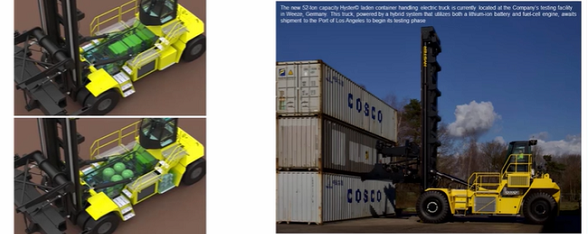
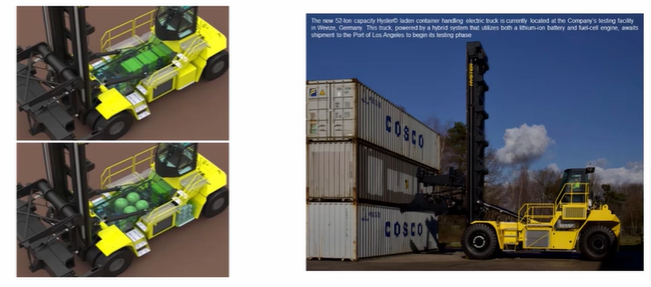
Rob Damen is a project engineer at Hyster Yale, based in the Netherlands. He is part of the Innovation & projects team at Hyster Yale Big Truck development center. He has a focus on testing and simulation of the equipment. During the last Siemens Realize Live event, Rob explained how, with his team, they succeeded in converting a Laden Container Handler into an electrified machine. That vehicle is now in a testing phase. The team used simulation to virtually explore all the possibilities. They came up with one design to fit all the market expectations and regulations without compromising development time or cost.

Know your kilowatt

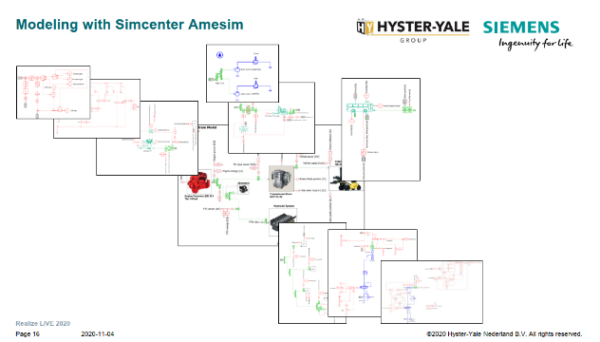
Before exploring what the power options for electrification were, the engineering team virtually modeled the current truck. Using Simcenter Amesim, the Simcenter system simulation solution, the team captured the machine behavior into a virtual environment. They analyzed the energy flows through different areas of the machine. To proceed, they divided the machine model into different systems and sub-systems. They also identified all the parameters of the machine components that they could virtually capture in the model.

From that model of the truck, Rob’s group was able to identify where they could simplify and make some assumptions but still keep a model that would deliver accurate results. “We were able to develop our model thanks to pre-defined components on Simcenter Amesim”, said Rob.

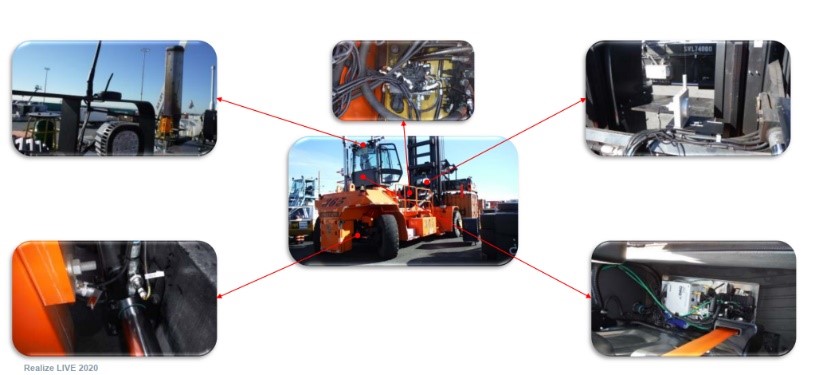
To make the model even more representative of a real-life system, the team instrumented one truck at their premises. There they captured data over predefined cycle steps. That analysis allowed them to compare the test-data results (vehicle speed, lift height, engine speed/power/torque, fuel consumption, etc.) with the Simcenter Amesim model results to refine and validate the model.

Modeling Hyster Yale's conventional truck systems using system simulation before electrification
Modeling the conventional truck systems using system simulation

Collecting real-life data to refine model complexity

However, in real life, machines are subject to so many different duty constraints and usage. Consequently, the team went to various customers to capture multiple types of data (GPS, lift, hydraulic pressures, etc.). They measured the performance of their machines with sensors over long durations. Those measurement campaigns enabled the team to define various duty cycles, depending on the nature of the application, with different patterns of energy distribution.

Capturing real life data on different duty constraints and usage to optimize the energy recovery system

One major finding identified during this benchmark test was the need to improve energy recovery. Over the measurement campaigns, Rob’s team identified an opportunity to recover up to 15 percent potential energy especially during load lowering and braking phases. This energy can be recovered using electric storage.

Virtually explore and validate the Hyster Yale’s electric machine concept

“Once we got our benchmark model and our truck duty cycle, we were finally set to come up with an electric powertrain concept that fits the truck needs”, explains Rob. The group made the selection based on ranking categories and drivetrain concepts to determine the best-ranked concept.

The team chose a hybrid approach combining fuel cell and battery. In this case, the battery can store and benefit from energy recovery from load lowering and breaking. Such a system enables the recharge of the battery and improves systems’ lifetime.

At that stage, Rob converted the conventional benchmark model into the electrified version. From that defined concept, the group was able to precisely virtually assess where energy recovery could happen during braking and load lowering. This next step in virtual benchmarking using Simcenter Amesim helped to define 3 main things. The battery state of charge, how to size the battery, as well as hydrogen consumption.

The model analysis for the opted strategy opened the discussion to a new set of questions about thermal management of the battery, related to a dissipated heat and battery cooling strategy definition. Rob explains that “the list of topics that we can cover with simulation is so wide. This is definitely a good thing for us. Indeed, it can help on reducing a large number of physical testing. That is a win in terms of development cost and time for our company”.

Develop an energy recovery system on load lowering

A highlight of the project is the development of the energy recovery system on load lowering, which Rob and the team collaborated on closely with Hyster-Yale’s supplier. “In that collaboration, the use of Simcenter Amesim made it easier to answer questions that require specific data with our suppliers”. The system uses one electric motor on load-lifting but split the flow over two motors during lowering as it is almost twice as fast and with that, the power is also twice high.

“From our initial simulation model, we continued further detailed work of the truck systems”. The team worked on 3D simulations based on an advanced electric model design. Then they performed tests on a machine to compare simulation and real-life results of the electrified version of the vehicle. “The test bench results and the Simcenter Amesim models results matched really well” concludes Rob.

Comparing simulation and real-life results of the truck electrified version

Next step: going faster and deeper into details for future electrification project

“With that laden container handler experience, we are now ready to initiate a new project on one of our other big machines”. For that new project, Rob and his team will use a similar approach. With their learning of the previous project, they are able to go faster and deeper into details through the overall process. “We clearly benefit from Simcenter Amesim into our innovation project. It gave us the ability to simulate, analyze and adjust the truck systems in a very short time frame”.

Modal Survey Testing for an unscathed journey to space

Product: Simcenter
Industry: Space

All structures have natural frequencies, and it is often the most important feature of the structure, especially when it comes to dynamic response. Very often the vibrations must be investigated to quantify the structural response in some way, so that its implication on factors such as performance and fatigue can be evaluated.

Modal testing is a very useful and widely used technique to verify and investigate this behavior. It looks at the natural frequencies, mode shapes and damping of a structure and helps engineers understand how a design will respond to different dynamic loads.

In the space industry, this technique is also referred to as modal survey testing and is intended to calibrate and increase the accuracy of finite element (FE) structural dynamics model of spacecraft and space launchers. The validated models are important, among other things, for the prediction of the launcher vibrational characteristics, the aeroelastic stability and the dynamic environments to which payloads and on-board equipment are submitted to during the launch.

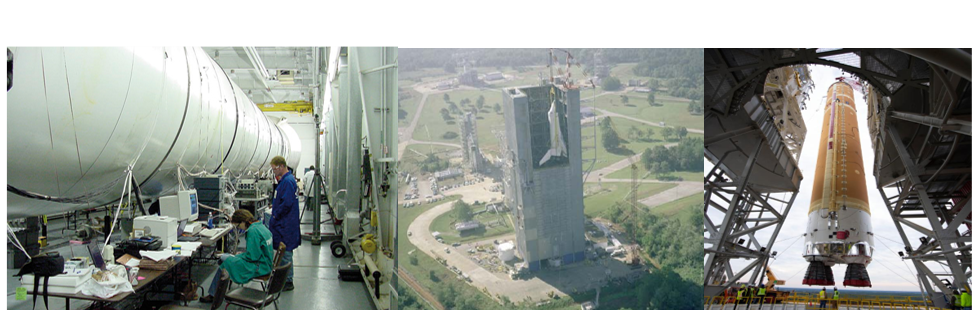
Courtesy NASA: Modal survey testing on Ares launch vehicle (left), Space Shuttle Challenger (middle) and SLS core stage (right)

A modal survey test consists of injecting forces, using electrodynamic shakers or in some cases also a modal impact hammer at a number of carefully chosen inputs. In the case of shaker excitation, burst random excitation is usually used because it is fast and efficient. When higher excitation levels are required, or for the assessment of nonlinear characteristics, stepped sine techniques are used. The forces are measured during the test, along with the response accelerations at many locations throughout the structure. During this test, the spacecraft is mounted in well-known boundary conditions, clamped or free-free, or a combination thereof. During the excitation, FRFs are measured.

After the test, modal curve-fitting technology is applied to extract modal information: resonance frequencies, damping values and mode shapes. The test results are used for the purpose of validating the entire FE model and correlating frequencies, mode shapes and damping assumptions. The significant mode shapes and frequencies are those that are primary contributors to launcher/spacecraft interface loads and internal loads.

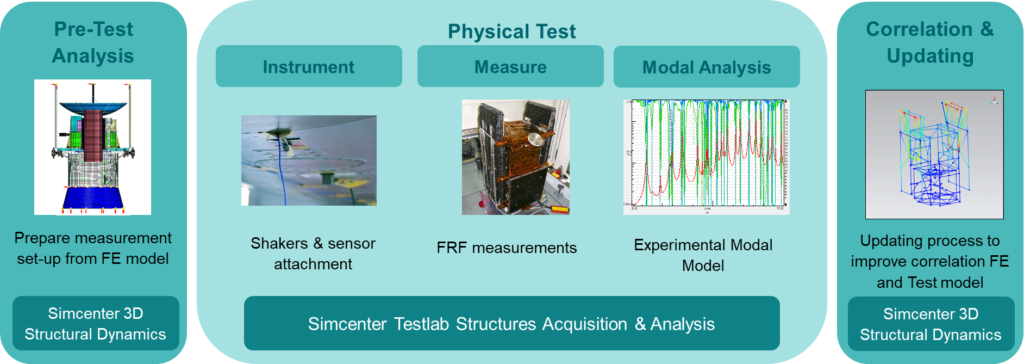
This process is illustrated schematically below. It shows how early FE models of the spacecraft can be used in Simcenter 3D Structural Dynamics to perform pre-test analysis and optimally design the test campaign. Simcenter Testlab and Simcenter SCADAS are then used to efficiently and reliably measure FRFs and accurately determine the best experimental modal model. Finally, the experimental results are further exploited to correlate the preliminary model with experimental results and to update the FE model to better reflect reality.

Different stages of the modal survey process: from test preparation, to the test execution, analysis and reporting.

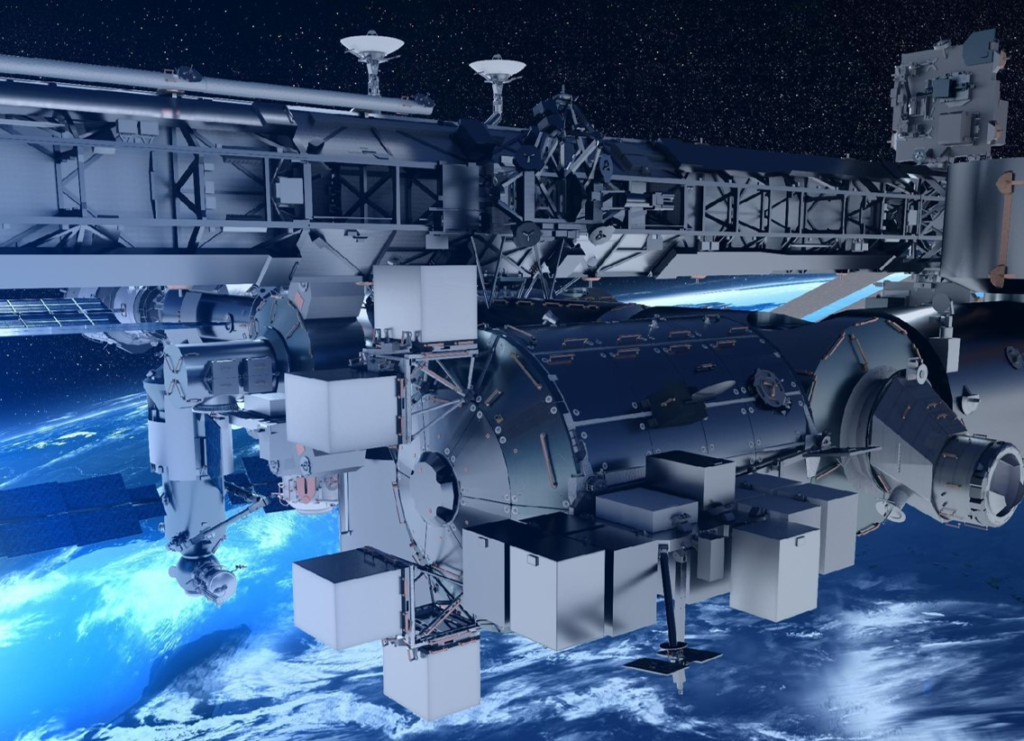
A good example of a program where a modal survey test was conducted is the Bartolomeo project from Airbus Defense & Space, carried out by Deutsches Zentrum für Luft- und Raumfahrt (DLR). Simcenter SCADAS Mobile hardware has been used as the critical measurement equipment for the modal survey test that was meant to update the FE simulation model of the Bartolomeo platform. This enabled the team to simulate and predict aspects that could only be done using simulation and analysis, such as how the platform would couple with the launcher.

×