
ATK: Transforming data into a corporate asset

Product: TEAMCENTER
Industry: Aerospace and Defense

Using the Teamcenter solution for Reporting and Analytics, ATK pulls information from multiple enterprise systems, providing intelligent insight for smarter decisions.

Innovation delivered through PLM

ATK is a premier aerospace and defense company with approximately 17,000 employees working throughout the United States, Puerto Rico and internationally. The company develops and manufactures highly engineered materials and products that support mission-critical applications for its defense, aerospace, and security and sporting customers.

ATK’s business objective is “Innovation Delivered.” To fuel innovation, the company has fully embraced a product lifecycle management (PLM) strategy across its divisions and value chain. Siemens Digital Industries Software solutions – NX™ software, Tecnomatix® software and Teamcenter® software – form the foundation of ATK’s PLM strategy, which spans the product lifecycle. “Our use of PLM extends from portfolio management, to gathering requirements, and then using those requirements throughout all the organizations inside ATK, and even our supply chain outside of ATK, to deliver products that meet our customers’ needs,” explains Jon Jarrett, director of engineering processes and tools at ATK.

The information exists, but how to get at it?

ATK’s PLM database contains a wealth of product and process data, yet it is just one source of information that managers tap as they carry out their programs. Other relevant data resides in financial systems, the company’s enterprise resource planning (ERP) system, the company’s scheduling system, and so on. With critical business information segregated in “silos,” it had become difficult to answer common business questions such as, “What is my first-pass yield?” or “How many documents are needed to support this program and will they all go out on time?”

ATK had been answering such questions by assigning a person to comb through the relevant databases, contact the appropriate people, and prepare a report. Some of thosead hoc reports required as many as 80 hours to generate. And while the company was able to get answers to specific questions this way, managers were not able to use data easily or proactively. In fact, many had created their own spreadsheets and other documents for tracking programs and processes. “People were doing duplicate work and there was no consistent format for those documents,” says Jarrett. “And people were constantly being pinged for information. Those interruptions are very detrimental to productivity. We wanted more efficiency in getting the data out, and we wanted it displayed in a way that everyone could benefit from.”

A BI solution that works with PLM

A business intelligence (BI) solution – software designed to identify, extract and analyze data – seemed to be what ATK needed. The company’s first use of a BI solution for PLM data, however, was a failure. “We went down the path with a certain BI solution to pull PLM data, but it couldn’t understand PLM data models or security rules,” says Paul Nelson, PLM architect at ATK. “We didn’t want people to see data they shouldn’t have access to. We wanted to be able to mine that data for gold, but not make it a free-for-all.”

Next, ATK tried the Teamcenter solution for Reporting and Analytics, which turned out to be a much better solution. Not only is Reporting and Analytics able to work with the Teamcenter data models and security rules, companies can utilize it to extract information from multiple sources, including commercial applications like ATK’s financial systems as well as home-grown programs. In addition, with Reporting and Analytics, users can aggre-gate data from multiple sources into reports and dashboards. Users can explore varying degrees of lower-level data to understand project specifics or higher-level data to get the big picture. ATK’s reports and dashboards typically contain three categories of information – for executives, managers and individual workers.

“Using Reporting and Analytics, we can quickly pull out data that helps us run our business,” says Nelson. “We’re getting gold out of that data now. It’s unlocked, and it can be presented in a way that people understand immediately.” For example, ATK has established a Science and Engineering dashboard that is accessed through a SharePoint portal. “With just a glance, people can see that screen is red or green, and know the status immediately.”

Report writers reassigned; everyone is more efficient

A dashboard showing costs and schedules is displayed continuously on a big-screen TV in a well-traveled place where everyone can see it. In addition to dashboards, ATK has used Reporting and Analytics to develop a number of highly useful reports. This work is done by Tim Gleason, an ATK software engineer, who is now handling a volume of work that required four people previously. “Tim can barely keep up with all the requests for reports, which come from managers and occasionally even from customers,” says Jarrett. “But we used to have four people doing this work. Now it’s just Tim. The others have been reassigned.” Reporting and Analytics’ tools allow Gleason to create reports much faster than anyone could previously, and he appreciates the fact that he can easily arrange the information in any format anyone requests.

A great example of the kind of “gold” that ATK now easily mines from its business systems is one called the “Automated Requirements Volatility Metric (ARVM)” that draws from Teamcenter System Engineering data. “One of the predictive metrics established by the International Council on Systems Engineering (INCOSE) to determine program success is how often requirements change during the life of the program,” explains Nelson. “You’re not going to have a successful program if you’re trying to hit a moving target. The ARVM reports track how many of those baseline requirements are changing on a monthly basis. If they are changing more than a certain threshold, the screen turns red. It’s a way for a program manager to monitor the health of the program.” ATK did track this information in the past. In fact, they had assigned one person to gather data and provide the monthly report. That person has been reassigned.

Other reports used at ATK include one that lets people see all the items they have due within a certain timeframe. “Typically people just get the hammer when they’re behind. This shifts the focus from firefighting to being proactive,” says Nelson. Another report shows managers how many documents must still be completed for a given program. By combining information from the PLM system and the scheduling system, this report can also tell the manager exactly how many hours are needed to complete that work.

In general, the deployment of Reporting and Analytics has made everyone, from executives to engineers, more efficient, according to Jarrett. “People are not being bugged all the time, and they’re not having to do their own Excel reports,” he says. “We are saving thousands of hours this way.” Another advantage of the Teamcenter solution is that information is more current. With reports that formerly took up to 80 hours to create now avail-able automatically, many reports are generated on an hourly, daily or weekly basis rather than monthly. This real-time visibility helps drive data integrity and accuracy. Finally, ATK is seeing its executives take greater advantage of the information in the company’s enterprise systems. “Sure they could do an advanced search of a database, but they are too busy for that,” Nelson explains. “If you break down the barriers, as we have done by giving them a dashboard that’s very graphical and user-friendly, you get more leadership engagement with the data.”

easyJet Cuts Aircraft Damage Assessment Time by 80% with Geomagic Control X

Product: Control X
Industry: Aerospace

If you’ve flown anywhere in Europe in the past two decades, chances are good that you’ve flown on easyJet. This leading European low-cost airline brings travelers to more than 30 countries on 600+ routes safely and conveniently, all while offering some of the lowest fares across the continent. How do they do it? With a focus on safety, simplicity, and operational efficiency. easyJet’s engineering organization epitomizes this ethos by putting safety at the heart of everything it does and innovating to continually improve performance and reduce costs.

easyJet assesses aircraft damage faster with Geomagic Control X

Minimizing Aircraft on Ground Time

One of the most important ways that easyJet can minimize delays and keep ticket prices low is reducing Aircraft on Ground (AOG) time. Unplanned AOG events happen when any of the company’s 298 Airbus aircraft are damaged or experience mechanical failures, and can be very costly — not to mention inconvenient to passengers. It’s clear that the faster a damaged aircraft can be checked, the better it is for the airline and its passengers. 

“One of our biggest challenges is to try and reduce the AOG time of aircraft and maintain accurate records when damage occurs,” said Andrew Knight, Fleet Structures Engineer at easyJet. While rare, hail, bird strikes, and other events can potentially damage the wings and fuselage and require inspection before flying again. Checking damage from these types of events has traditionally been a low tech, manual, and time-consuming process that requires maintenance staff to assess aircraft damage using manual measuring tools such as rulers and vernier calipers. Worse still, interpreting the extent of any damage using this technique is highly subjective and not repeatable between staff members. easyJet’s structural engineering team went looking for a modern solution to speed things up and provide more accurate, traceable results.

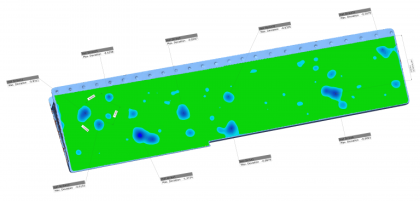
3D scanned deviation location using Geomagic Control X

Repeatable, Accurate, Mobile 3D Inspection

“We’ve been looking for a system that is easy to use for the maintenance engineer but has the ability to provide more in-depth reports if required by support staff. It must be accurate, repeatable and most of all, mobile, as AOG events can occur anywhere within our network of 136 destinations across Europe,” Knight continued. “The biggest challenge was the software side because it needed to be a simple, easy-to-use interface to obtain a basic damage report, but powerful enough to provide more in-depth details in the support offices. 3D scanning should provide us with accurate, fast damage assessment with repeatable results independent of the experience of the user.”

For these reasons, easyJet turned to 3D Systems reseller OR3D, a UK firm with expertise in 3D scanning and Geomagic software. Robert Wells, a 3D scanning expert at OR3D, reported that “based on easyJet’s requirement to quickly scan large areas — such as the entire wing length of an Airbus A320 — on the tarmac, we recommended a portable handheld 3D scanner. And we knew Geomagic Control X™ was the right software because they needed an automated way to assess dents that was easy for their staff to learn and use.” With this solution, performing a damage assessment on the roughly 70 feet (21 meters) of an A320’s flaps takes just a few hours, compared to several days with wax rubbings on tracing paper, saving easyJet tens of thousands of Pounds/Euros per damage event.

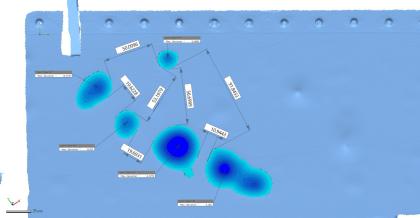
Geomagic Control X inspection shows dent locations to easyJet quickly and accurately

Instant Reporting for Fast Documentation

Once the scans are complete, easyJet engineers can get damage reports from Geomagic Control X software on the spot. They don’t need to load CAD models or align the scan data to anything else in the software, and they don’t need to have deep metrology expertise to get reliable output. Control X uses its CAD engine to automatically create idealized geometry that meets standards for surface continuity that are defined by Airbus, and measures the scanned aircraft against that idealized geometry to provide instant results. Within minutes, easyJet engineers have a consistent, repeatable, and thoroughly documented initial damage report that lets them decide what repairs, if any, are needed before the aircraft can be placed back into service.

Powerful 3D Inspection That’s Easy to Learn

easyJet has embraced Control X for large-scale damage assessments because it’s so accessible for busy engineers with many other responsibilities. Knight remarked on this specifically, saying “engineers will not use the system if it is too complex and requires in-depth software knowledge and/or extensive training.” Control X fulfills these requirements better than any other scan-based inspection software because it’s intuitive, easy to learn, and powerful enough to handle complex measurement scenarios. Anyone familiar with using 3D software can pick up Control X and get results in a matter of minutes, with the flexibility to measure what they need to, without pre-programming or inflexible macros.

What does this new, modern approach to damage inspection mean for easyJet? “We have estimated an approximate 80% savings in time to perform assessments using the 3D systems we currently have with a potential 80% savings in currency terms,” says Knight. There are additional benefits beyond reduced AOG time and better decision-making regarding repairs as well: keeping detailed damage reports, complete with accurate scan data, can help the company years from now when it comes time to sell or return aircraft to their leaseholders.

easyJet’s use of Control X is another example of how simple, intuitive inspection software helps companies ensure quality everywhere by empowering more people to measure more things in more places. Learn more about Geomagic Control X today.

Using NX allows design and analysis to work together more efficiently and productively

Product: NX CAD, Simcenter 3D
Industry: Aeroespacial y Defensa

For more than 30 years, ENGINEERS at ATA Engineering, Inc., (ATA), have provided analysis and test-driven design solutions for structural, mechanical, electromechanical, and aerospace products. The company has worked on a wide variety of projects, including amusement parks, biomedical devices and electronic components.

Most of ATA Engineering’s work is done in the aerospace industry, for clients such as Orbital Sciences, Lockheed Martin Space Systems, Pratt & Whitney, NASA, Jet Propulsion Laboratory, Air Force Research Laboratory and General Atomics. There is no room for errors in this job: it is critical to meet specifications accurately, while facing strict deadlines. ATA engineers often face short production runs, sometimes even for a single unit, as a satellite component. It’s forced that they do well the first time.

ATA staff have used SOFTWARE NX™ for many years. However, they recently applied the mostrecent version of computer-aided design (CAD) and computer-aided engineering (CAE) NX software to complex real-world structures using three representative cases and found significant improvements in time and effort savings during design, analysis, and upgrade cycles.

ATA engineer Allison Hutchings defines it this way: “Real-world structures have complex design definitions and challenging analysis requirements, and both are constantly changing. NX enables you to cope with changes efficiently and productively.”

Changing model parameters without recreating geometry

The first use case involved meshing an isometric grid reflector model, such as those designed for assembly on a spacecraft. Isometric geometry provides advantages for spatial structures that must be rigid, lightweight, and durable, but the large number of surfaces implies that the definition of the initial geometry of the CAD model and the CAE model can be tedious. When the design needs to be updated, such as altering the diameter, focal length, and measurement of cells in this case, “these changes can cause severe headaches,” Hutchings says. In many cases, you may need to completely recreate the geometry instead of simply updating it to incorporate the new dimensions.

Leveraging Synchronous Technology provided by NX along with an intelligent approach to the original design definition, however, these issues are avoided. Several techniques, such as patterns and expressions, facilitated the direct parameterization of key geometry definitions in NX CAD and this capability was leveraged directly for meshing and analysis. As a result, 100 percent of the geometry was automatically updated and 96 percent of the riveting was performed automatically when the associated finite feature model (FEM) was upgraded to the new geometry. Cleaning the remaining 4 percent was relatively quick and easy, particularly compared to the need to recreate FEM altogether.

The second use case was a lightweight support model. Because weight is a pressing factor in aerospace designs, the engineer must struggle with competitive goals to maintain the lightest possible support while meeting stiffness requirements while maintaining the ability to handle the necessary loads. The process often results in supports with complex geometry.

In Finite Element Analysis (FEA), the standard practice is to “idealize” geometry, eliminating details and features that do not affect analysis. It is done to save calculation time, but it is often necessary to repeat the idealization process each time the part is updated.

With NX, this additional step can be avoided. For this task, after the part dimensions were changed, 93 percent was automatically idealized and updated. Although the changes that were made to the support were relatively simple, the time and effort savings were remarkable: the automated idealization of the upgrade was more than 100 times faster than the manual process and meshing of the updated model was at least 3 times faster.

Updating geometry in minutes

The third use case focused on the model of an existing air brake: a assembly that allows an aircraft to slow down to land by generating a turbulent output flow from a fan bypass nozzle and also makes it easier to landing the aircraft slower, from a steeper angle, reducing overall noise.

The blade angles inside the air brake can have a drastic effect on the performance of the air brake under different conditions. By altering these angles in the model, the analyst can evaluate those effects. In this case, the prismatic blades were rotated to analyze configurations between 0 and 25 degrees. With NX, instead of performing a tedious manual process of reshaping the entire system, Hutchings simply changed the aspa angle parameter and was able to update the geometry in minutes, as the idealized part automatically adjusted to the new angle. Hutchings comments, “Map meshing is preserved, creating an identical mesh on the blade surfaces between all angles, then the CAD model propagates to the FEM and the mesh is updated in minutes.

In all three cases, new NX features made it possible to perform geometry updates quickly, Hutchings says. “We were able to parameterize the design definition, create a structural analysis model by leveraging the design for specific analysis requirements, updating design parameters, and propagating changes to analysis modeling much faster than would have been remodeled.”

More efficient engineering with integrated design and analysis

“These are all problems that we thought were difficult to solve before,” Hutchings says. In the past, updating the finite element model due to geometry changes would involve reshaping changes in CAD, resealing the model, and riveting to create FEM, or some very complex manual changes in meshing. Both options took quite a while. “Recent additions to NX have made these efforts much easier. The degree of connection NX makes possible between design and analysis more efficiently supports engineering compared to the use of non-integrated finite element processes,” he says.

The problems Hutchings examined illustrate the advantages of working with the integrated NX range. This is not only an improvement in the refresh rate, but also the possibility of failure between the CAD model and the finite element model is also less due to the way they are linked. “If you work with constantly changing design specifications, it’s very fast and easy to modify dimensions and change parameters with NX, without having to recreate finite element models,” he says. “This saves a lot of time and effort on tedious tasks, as well as providing confidence that the model will be updated to the correct design definition.”

×