
Revolutionizing the defense industry with modular aircraft | The design process and digital thread at AERALIS

Product: NX Design
Industry:
Aviation

The importance of the Digital Thread for AERALIS

AERALIS is a digital enterprise that leverages digital engineering and a digital thread in accordance to AERSIDE: AERALIS Smart Integrated Digital Enterprise. As requirements and technology changes in the aerospace industry, it is absolutely needed to be a digital enterprise. Charlie says, “Aircraft are designed about 20 years before they land on the market in some cases, and by that point, the requirements and technology have completely changed. So, there’s a real push to keep up with that change and reduce the period from ideation to launch.”

Charlie defines digital engineering as “the application of digital processes throughout the entire lifecycle of a system, from concept to manufacture, operation, certification and disposal, but all connected via a single source of truth.” At AERALIS, the entire lifecycle of the aircraft is digitally developed, connected by a single source of truth. Callum says this digital engineering enables efficiency, collaboration and innovation.

With a digital thread, they can design parts based on known requirements, and anyone can see and be notified of changes to requirements or parts themselves. Callum again emphasizes how a digital thread enables efficiency. With everything being digital-first, Charlie notes that AERALIS can easily collaborate in a live design environment with other designers or manufacturers. From simulation and optimization to manufacturing and real world operations, everything is linked together along the digital thread with digital twins.

Model-Based System Engineering (MBSE) at AERALIS

AERALIS adopts the Model-Based Systems Engineering Arcadia Method. Callum explains how they are “breaking down a problem at an operational level and then going into more detail at functional, logical and physical levels.” With this MBSE approach, they are not just using it on the aircraft but to all business operations as a whole. Charlie uses the comparison of just how computer-aided design (CAD) evolved and became a digital step in design as opposed to drawings on paper, MBSE is the development of digital models instead of just documents and drawings.

How AERALIS utilizes Siemens digital tools

Charlie notes that at AERALIS, they are using tools from the Siemens Xcelerator software portfolio including NX CADTeamcenterTeamcenter System Modeling WorkbenchSimcenter (including Simcenter Test Lab and Physical Test Management System) and Polarion. They also may begin to use Opcenter when they get into manufacturing execution.

AERALIS works closely with Siemens with our professional services implementation team. AERALIS engages in agile collaborative feedback with Siemens daily, including identifying new capabilities that they need or trialing different capabilities and methodologies. “Every week, we’re designing something, building it, testing it, changing it a bit more, and working in that real agile sprint,” Charlie says regarding testing new capabilities they request. This workflow of close collaboration helps them launch, deploy and adopt new functionality amongst their engineers quickly.

How AERALIS uses NX to solve challenges

Callum notes that AERALIS has a managed NX environment, where everything in NX is integrated with Teamcenter PLM software to enable collaboration with design partners such as Hamble Aerostructures. With NX and Teamcenter, both design teams located in Bristol and Southampton can work together on the same live digital models with the same requirements. With NX and Teamcenter, they can leverage a full digital thread— “It is a thread and collaboration and efficiency and working on the same stuff. It’s not emails.”

Charlie and Callum also call out specific benefits they realize with NX, such as including maintainability in their aircraft from day one. NX also includes human models, so they can test their designs and make sure anyone from the largest man to the shortest woman can access all parts of the aircraft needed to fly. “You can mock the view of a pilot from their eyes, and you can move their head up and down, and you’ll be able to see what they see in the cockpit. So, you can map out the anthropometrics,” Charlie says.

The design process at AERALIS

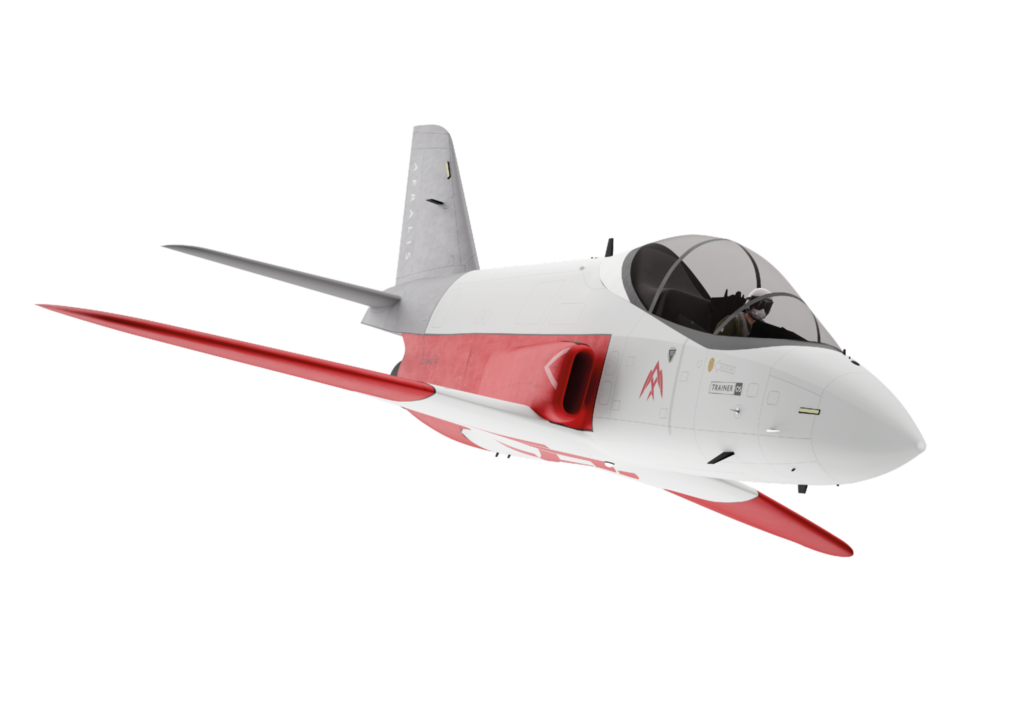
Callum briefly explains the design process at AERALIS, stating that it operates as a “thin prime.” They are modular in their organization and design by a requirements-driven approach. They collaborate with Hamble Aerostructures for some of the design and manufacturing including the Common Core fuselage, and other design firms for system design. With multiple companies, they still design as “one team” as a digital enterprise.

Aerospace industry challenges

Charlie and Callum then describe some of the challenges being seen in the aerospace industry and how AERALIS is responding to them. Charlie notes that aircraft systems have more complexity, take longer to develop, need more resources and require a bigger industrial base. Requirements change quickly, and pilots need to train based on those new requirements, but the trainer platforms have to adjust and adapt. He also notes that traditional companies wrestle with legacy IT estates that are not on new technology and not digital. He acknowledges that while AERALIS does not have a legacy IT estate to deal with which allows them to innovate faster, that it also means they are building an organization, processes and toolsets at the same time as trying to build the aircraft itself.

Callum adds on to the challenge of increasing complexity, saying that certification is getting more expensive as complexity and requirements evolve. “I fear that may be reducing the appetite for people to try new things, and limiting how eVTOLs are progressing,” he states.

Greg asks if there are any challenges that are unique to AERALIS, and Charlie mentions that there are not many new aerospace companies in general, but it is especially a challenge as they are trying to do something that has not been done before in the defense industry: modular aircraft. They have to balance the need to get it to market, getting it flying and getting it certified. But they are leveraging partnerships and collaborations with other companies across the UK and the world to solve these challenges.

When it comes to overcoming challenges, Callum says that at AERALIS they start from a theoretical standpoint and ensure that they are future-proofing and having one single source of truth for solutions as they communicate and share data. He shares an example of a challenge they had with part numbering, but states that their “secret sauce” is simply: “Just think about it as a whole— don’t just jump in— and try to build something for the future.”

The future of design at AERALIS

Before closing out the episode, Greg asks about some trends in the industry. They discuss sustainability, noting that sustainability will only increase and leveraging digital tools will allow them to identify more opportunities for optimized and sustainable solutions. The modularity of an AERALIS aircraft is inherently more efficient and sustainable as it is adaptable.

They also address the Industrial Metaverse and Immersive Engineering and look forward to experiencing the benefits of Immersive tools from initial requirements to design to manufacturing. “You can sit on a chair, put a VR headset on, and play around with potential cockpit designs. That’s only possible because we’ve been designing digitally from day one,” Charlie says.

We conclude the episode talking about AERALIS’ ultimate goal of revolutionizing the aerospace industry with modular defense aircraft, how they think the aerospace industry has evolved in their few years as engineers and how it will continue to evolve and their perspective on the general next generation of design.
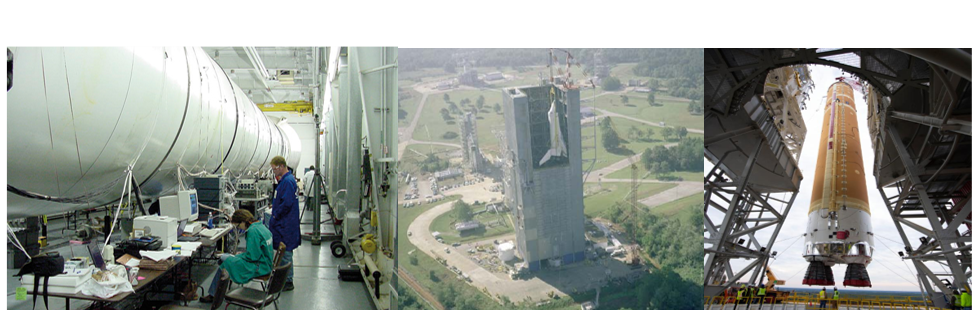
Modal Survey Testing for an unscathed journey to space

Product: Simcenter
Industry: Space

All structures have natural frequencies, and it is often the most important feature of the structure, especially when it comes to dynamic response. Very often the vibrations must be investigated to quantify the structural response in some way, so that its implication on factors such as performance and fatigue can be evaluated.

Modal testing is a very useful and widely used technique to verify and investigate this behavior. It looks at the natural frequencies, mode shapes and damping of a structure and helps engineers understand how a design will respond to different dynamic loads.

In the space industry, this technique is also referred to as modal survey testing and is intended to calibrate and increase the accuracy of finite element (FE) structural dynamics model of spacecraft and space launchers. The validated models are important, among other things, for the prediction of the launcher vibrational characteristics, the aeroelastic stability and the dynamic environments to which payloads and on-board equipment are submitted to during the launch.

Courtesy NASA: Modal survey testing on Ares launch vehicle (left), Space Shuttle Challenger (middle) and SLS core stage (right)

A modal survey test consists of injecting forces, using electrodynamic shakers or in some cases also a modal impact hammer at a number of carefully chosen inputs. In the case of shaker excitation, burst random excitation is usually used because it is fast and efficient. When higher excitation levels are required, or for the assessment of nonlinear characteristics, stepped sine techniques are used. The forces are measured during the test, along with the response accelerations at many locations throughout the structure. During this test, the spacecraft is mounted in well-known boundary conditions, clamped or free-free, or a combination thereof. During the excitation, FRFs are measured.

After the test, modal curve-fitting technology is applied to extract modal information: resonance frequencies, damping values and mode shapes. The test results are used for the purpose of validating the entire FE model and correlating frequencies, mode shapes and damping assumptions. The significant mode shapes and frequencies are those that are primary contributors to launcher/spacecraft interface loads and internal loads.

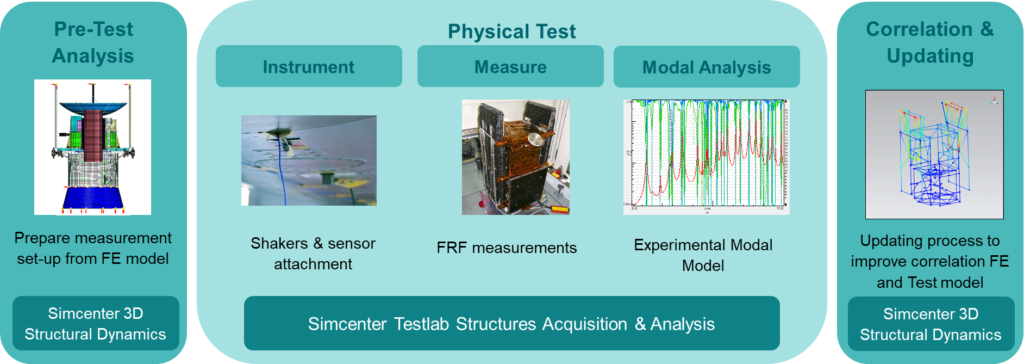
This process is illustrated schematically below. It shows how early FE models of the spacecraft can be used in Simcenter 3D Structural Dynamics to perform pre-test analysis and optimally design the test campaign. Simcenter Testlab and Simcenter SCADAS are then used to efficiently and reliably measure FRFs and accurately determine the best experimental modal model. Finally, the experimental results are further exploited to correlate the preliminary model with experimental results and to update the FE model to better reflect reality.

Different stages of the modal survey process: from test preparation, to the test execution, analysis and reporting.

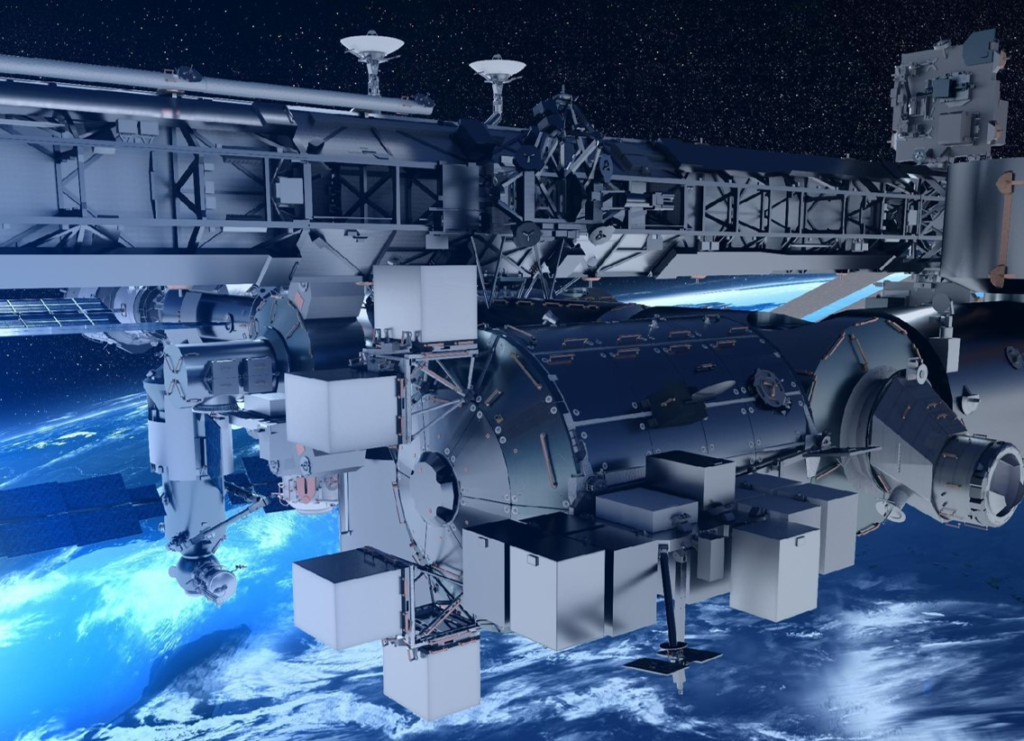
A good example of a program where a modal survey test was conducted is the Bartolomeo project from Airbus Defense & Space, carried out by Deutsches Zentrum für Luft- und Raumfahrt (DLR). Simcenter SCADAS Mobile hardware has been used as the critical measurement equipment for the modal survey test that was meant to update the FE simulation model of the Bartolomeo platform. This enabled the team to simulate and predict aspects that could only be done using simulation and analysis, such as how the platform would couple with the launcher.

Romanian space startup OX Origin can count on Simcenter and other Siemens Xcelerator tools thanks to the Siemens Startup Program

Product: Simcenter
Industry: Space components

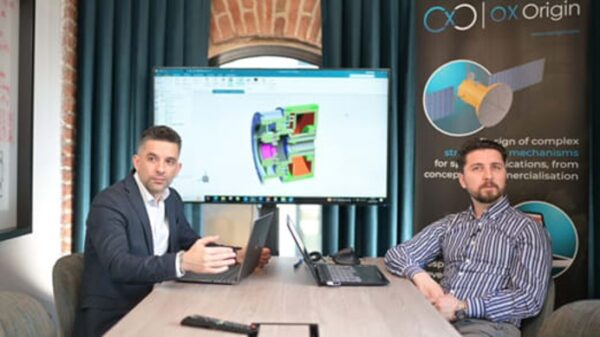
Scrolling through LinkedIn one evening, Ilie Ciobanu saw a post fly by for the Siemens Startup Program, part of the Siemens Xcelerator solution portfolio. He and his partner, Alex Bugnar had recently created their space startup, a design and simulation analysis consultancy, OX Origin, located in the heart of Transylvania in Cluj-Napoca, Romania. As experienced space experts and digital natives, OX Origin designs complex space systems and components that are high-tech one-offs, engineered to space environment performance standards.

“When we started own consultancy in 2019, we wanted to offer our space customers that same seamlessness between NX and Simcenter that a lot of space specialists count on, and also the ability to work with all the Siemens solvers and pre-post processors, like Simcenter Nastran and Simcenter Femap.” Co-founder Ilie Ciobanu, OX Origin adds, “I knew that Simcenter offered — by far — more and better connectivity between the design and analysis processes. It was much more integrated compared to other tools.”

Ilie Ciobanu had worked extensively with Simcenter and NX early in his career for Thales Alenia and as a digital native knew the power and excellence of the NX/Simcenter combo when it came to space design and qualification.

“Thanks to its accuracy and built-in simulation validation tools, you find Simcenter and NX all over the space landscape, whether you are working on the first preliminary design review of a complex electro-mechanical components for solar arrays or preparing for final qualification testing on an opto-mechanical system for an observation telescope,” explains Ciobanu. “So naturally, when we started, we invested in two licenses for Simcenter 3D, which were tailored according to our work requirements — typical space engineering projects in the mechanical and systems engineering field.”

“We wanted a couple of full licenses, and we were curious about integrating some of the other Siemens tools into our internal and customer processes, but as a startup, the budget was just out-of-reach at the time,” explains co-founder Alex Bugnar, OX Origin.

A startup program tailored to advanced engineering

You could imagine their enthusiasm when they discovered that Siemens offers several startup program options tailored to various product development needs – and budgets. One that caught Ilie’s eye was Siemens Xcelerator for Design that included NX for Design, an advanced engineering package of Simcenter simulation tools as well as Teamcenter software.

Ilie Ciobanu dropped an email saying he was interested in the Siemens Xcelerator startup programs and especially the digital tools that he knew were frequently found in the space industry including Simcenter simulation and testing solutions, NX and newer tools like Teamcenter Share (formerly Xcelerator Share).

A Siemens partner ready to help space startups

He shortly heard back from the Siemens Xcelerator Startup Program via a Siemens partner based in Bucharest, Romania, Digital Twin.

Together, they consolidated an affordable package of dedicated space solutions from NX, Simcenter and Teamcenter and adapted them to the OX Origin workflow.

“Digital Twin really helped us regarding the start-up program and software support. Simcenter is a very advanced tool and there are always new things coming up that the team at Digital Twin were happy to help with,” explains Ciobanu.

“From my time at Thales Alenia Space, I experienced the power of the Simcenter/NX combination and the excellent connectivity and integration between NX for the design aspect and Simcenter for more advanced analysis like finite element and system work. The baked-in, step-by-step workflow in the software is very intuitive, but we needed help getting up to speed on the new advances, like space thermal analysis, cost calculations and cloud-based collaboration tools.”

A quest for a better process

As the guys know at OX Origin, the space industry is an exacting place to engineer: everything, every step and every minute detail is scrutinized, double and triple-checked, verified and quality controlled. The rules do not bend. Everyone involved in the process follows strict and specific step-by-step development processes, which can be time-consuming.

Being a small company, OX Origin was surprised to discover that they could save significant time using Teamcenter as well. They had been under the impression that Teamcenter worked well at the bigger aerospace companies to trace data and processes, so they were happy to discover Teamcenter Share, a scalable, secure, cloud-based collaboration version.

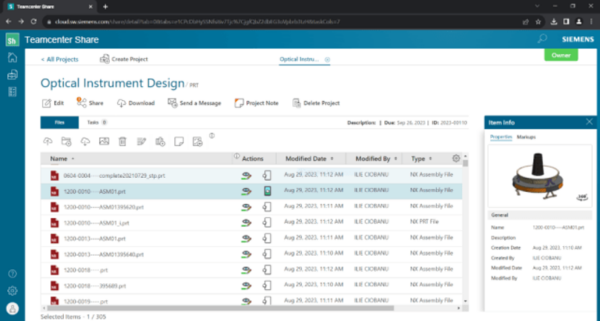
“Teamcenter Share was a nice surprise. It is a good solution for the space industry because you can easily add external partners and sync files with extra security and data integrity; I had an excellent hands-on experience with that tool and we tried it out right away with our major customer projects,” says Ciobanu.

“As consultants, it is so difficult to find time. Anything that helps save us time, like Teamcenter Share, is highly valuable.” He adds, “Less admin-hassle in our process frees up engineering time for other customers and projects as well,” adds Bugnar.

Safe and secure in the cloud

OX Origin appreciated the fact that the Siemens Xcelerator platform is securely in the cloud. Not only did this make life easier for customer collaboration and vital security guarantees, it also made working internally a snap.

“We aren’t always in the same place or country and our subcontractors and customers are spread around Europe,” explains Bugnar. “With the Siemens tools, you can have two guys working on the project almost simultaneously from practically any location without affecting each other’s work or crossing wires. We can look at 2 problems or more at the same time,” concludes Bugnar, “It’s like a 2-for-1 engineering coupon for our customers. It not only saves 50% percent of our time, it also saves money.”

Streamlining planning and scheduling processes to achieve on-time delivery on average 96 to 98 percent of the time

Product: Opcenter
Industry: Aerospace & defense

Applied Composites, founded in 1982, is a global leader in the composites industry, providing composite solutions for air-frames, engines, defense and mission systems, launch vehicles and satellite structures. Overall, the company aims to strategically offer engineering services, programmatic support and vertically integrated manufacturing capabilities to customers in the aerospace and defense industries. Applied Composites has a long customer satisfaction history thanks to their focus on improving their processes to reduce time and costs.

However, as Applied Composites grew, they noticed issues regarding planning, scheduling and their overall processes. As a solution, the company consulted with Lean Scheduling International (LSI), part of ATS Global (ATS), a Siemens Digital Industries Software partner. This led to the company leveraging Opcenter™ software as a solution, which is part of the Siemens Xcelerator business platform of software, hardware and services.null

Keeping up with business growth challenges

Although business growth sounds like an overall win-win situation, there are challenges that come with it. Applied Composites realized that it was becoming more difficult to manage planning, scheduling and overall processes, especially when the company’s growth was affecting all areas. As the customer base grew, the amount of work grew, causing the need for more employees. With these compounding issues, the plant’s work environment also suffered, creating stress for workers to understand where products were and causing orders to go missing. Additionally, not knowing what materials they would need for certain jobs or not being able to schedule enough employees to run available machines was causing the company to fall behind.

During this period, Applied Composites was using spreadsheets and enterprise resource planning (ERP) software to create a detailed production report listing all customer jobs and ship-by dates. The ERP software would set the material dates using its built-in materials requirement planning (MRP) function; however, this system had flaws. It did not consider tooling as a constraint, which is crucial for accurately scheduling downstream operations in the manufacturing process. Due to this, Michael Moses, the master scheduler at Applied Composites, would have to schedule 6 to 8 weeks out after receiving the MRP process report.

Additionally, John Pettit, the operations manager at Applied Composites, describes the challenges of the supervisor’s role in the first operational step (laminating). First, they would have to look at the daily report. Then piece together how to manage the shop floor for the day. This includes figuring out what the delivery dates were, knowing that they had to have everything in their department at least four weeks before the due date and giving other departments a week to finish. Overall, the process was not optimal and left room for error.

Applied Composites knew they needed to find a way to overcome these issues, especially when it came to scheduling and planning. “Overall, we wanted to have a clear indication of what we could be delivering on,” says Moses.

Teaming up to find a solution

To find a solution, Applied Composites solicited help from LSI. At first, the company struggled with adapting to a solution that had an alternative approach to scheduling versus their original ERP software, leading the first implementation to not be successful. However, once the company was confident in LSI’s suggestion of using Opcenter Advanced Planning and Scheduling (APS), they were able to successfully implement it.

Using mini-proofs of concept, LSI worked with Applied Composites to suggest and gather data for driving their schedule. Additionally, by having a hands-on approach for configuring models and validating data requirements, the companies can test various validation scenarios.

Overall, Applied Composites chose Opcenter APS as their scheduling and planning solution because of its capability to manage complex scheduling requirements with multiple constraints active throughout the manufacturing process. This was something the company’s previous ERP software could not do.null

Overcoming planning and scheduling limitations

Before integrating Opcenter APS, Applied Composites experienced numerous limitations using their old solution. This included a lack of visibility for material availability, a reliance on the scheduler’s and shop floor supervisor’s tribal knowledge, a stressful and chaotic environment, exponential amounts of time spent on production scheduling and no solution to aid the scheduler in making decisions. However, thanks to Opcenter APS, they were able to overcome most of them.

To overcome these limitations, using Opcenter APS, Applied Composites was able to configure models to consider all constraints, from materials to tooling or molds to operator capabilities. From there, they could efficiently create a schedule according to the plant’s true capacity and not an estimate. With these configurations, the company could also improve their scheduling processes since the software could automatically make many of the scheduling decisions. Previously, the scheduler took hours to create a high-level report and then use it to create a schedule in a spreadsheet, leveraging knowledge and data from multiple sources.

As for visibility, using Opcenter APS, workers could see where the orders were in the plant, inform customers of actual lead times versus standard lead times and see if there were any potential issues downstream. Further, the ability to set accurate material demand dates and schedules was groundbreaking for the company. Now they could schedule over 30,000 operations quickly and easily, saving time and manual effort.null

Previously, department supervisors handled scheduling and processed downstream operations simultaneously, causing them to miss opportunities to maximize throughput and reduce changeover times. Additionally, Applied Composites considered assigning three schedulers to manage the plant’s activities; however, with Opcenter APS, they required one master scheduler, lowering the need for more workers for a specific task.

Overall, by using this solution, Applied Composites can generate an easy-to-follow schedule, helping them limit the decision-making happening on the shop floor and reducing stress and disorganization.null

Benefiting from Opcenter

Once Applied Composites fully integrated Opcenter APS, they pushed the software’s capabilities to the max, using nearly every out-of-the-box (OOTB) feature without customizations, reducing scheduling time from hours to minutes. Using this solution provided the company with an accurate schedule that respects tooling and machine constraints, labor and materials while maximizing set up time, prioritizing delivery dates and allowing them to flag priority customers. They can also stay on top of any issues or delays that may arise, allowing the company to immediately notify the customer and inform them of the recovery date.

“Using Opcenter APS ties it all together, giving us an opportunity to be upfront with our customers and to help identify what’s going to contribute the most success to the program,” says Moses.

Thanks to the constraint capabilities, Applied Composites can now streamline their tooling and labor processes. For tooling constraints, the company had unique challenges concerning molds, which multiple operations used. Once a mold was in use for one operation, it was used for multiple stages until the system released it later during a downstream process. This means that technicians cannot schedule that mold again until it is released. To overcome this challenge, the solution needed to commit those molds to each consecutive operation that required them, track their use and not allow another operation to schedule them until they were available.

As for labor constraints, the company used these at the department level; however, only certain operators had the specific resource skills or capabilities to use them. Using Opcenter APS, Applied Composites can now see the plant’s capacity, how many additional people they need to hire or if there is a tool constraint issue.null

“How many plants have full scheduling software that can do almost everything?” says Moses. “With Opcenter APS, we can accomplish everything from capacity planning to giving the shop floor technicians a visual board of what they need to work on in order that also allows them to see their monthly on-time delivery stats.”

Another major benefit of this solution was achieving on-time delivery on average 96 to 98 percent of the time. “By leveraging Opcenter APS, we can react to changes quicker,” says Moses. Since the company could react quicker, technicians could solve issues as soon as they received notification.

“Using Opcenter, we haven’t dipped below 96 percent for on-time delivery except maybe one or two times during the COVID supply shortage,” says Moses.

By implementing a data-driven solution like Opcenter APS, Applied Composites needs to keep its data accurate. This not only ensures that the solution continues to work but also helps the company standardize its processes and prioritize correcting data inaccuracies, keeping the company streamlined.

Overall, by implementing Opcenter APS, Applied Composites has a solution that is flexible enough to grow with its business and has almost doubled the number of scheduled operations.nullnull

Revolutionizing Space Engineering: The OX Origin Story with Siemens

In the vast expanse of space, there are pioneers on a relentless quest to unlock the mysteries of the cosmos and push the boundaries of human exploration. One such pioneer is OX Origin, a Romanian startup with a singular mission: to propel humankind towards the stars. Founded by visionaries Alex Bugnar and Ilie Ciobanu, OX Origin is not just another player in the aerospace industry; it’s a revolutionary force redefining how we approach space systems and software engineering.

Breaking Boundaries in Space Technology

OX Origin’s founders are on a mission to bridge the gap between conventional space technology and cutting-edge design and engineering practices. Co-founder Ilie Ciobanu notes, “The tools being used in the space industry are falling behind when it comes to design and engineering technology. Not in the technology they produce, but the technology that’s being used, especially the software tools that tend to be older than the latest state-of-the-art software.”

Ciobanu keenly observes that the challenge lies not in the quality of the technology created but in the tools used to manage these projects. He believes that the industry’s reluctance to embrace the latest technology is holding back progress, and this is precisely what OX Origin aims to change.

The Visionaries Behind OX Origin

The journey of OX Origin began when Bugnar and Ciobanu crossed paths during their early professional careers in Oxford, United Kingdom, inspiring the name “OX Origin.” Their qualifications and areas of expertise make them a dynamic duo:

  • Alex Bugnar holds a master’s degree (MSc) in Ultra Precision Technologies and a Bachelor of Science (BSc) in Telecommunications Engineering. He specializes in software engineering at OX Origin.
  • Ilie Ciobanu possesses a BSc in Astronautics Engineering and an MSc in Space Technology, focusing on the design and consulting aspects of their business.

Their collaboration and complementary skills were the catalysts for founding OX Origin in 2020. Beyond personal chemistry, they saw an opportunity to help and educate fellow space industry professionals.

In Pursuit of the Stars: StarLeap and MARS

While OX Origin’s overarching mission is ambitious, they are actively developing solutions to realize it. One such solution is StarLeap, an enterprise web-based platform designed to manage the end-to-end design process of complex space systems. Additionally, they offer MARS, a solution designed to assist mechanical engineers in verifying bolted joints and ensuring associated safety margins through bolt static analysis.

In addition to their proprietary solutions, OX Origin harnesses the power of Siemens software solutions in their projects:

  • NX for design
  • Simcenter for simulation
  • Nastran for computations
  • Teamcenter Share for collaboration

Ilie Ciobanu, the primary software user, shares his perspective, stating, “Compared to other solutions on the market, I feel Siemens’ is the most connected.”

He highlights the seamless integration between NX and Simcenter, allowing for extensive design analysis. This compatibility enables OX Origin to explore various configurations, assess mechanical, thermal, and static performance, and select the best design to meet client requirements.

Collaboration Made Effortless with Teamcenter Share

With Teamcenter Share, OX Origin effortlessly collaborates with clients across the globe. This cloud-based platform facilitates the secure sharing of files, models, and simulation results. Permissions can be assigned to ensure data security. Clients can then actively participate in processing, modeling, and simulating the data while providing feedback and desired adjustments.

Beyond collaboration, Teamcenter Share serves as a central hub for storing and managing data and streamlining client tasks and activities. According to Ciobanu, “It makes life easier and helps us manage the tasks and activities of the clients we work with.”

How Northrop Grumman supercharged their digital transformation with PLM

Product: Teamcenter
Industry: Aerospace

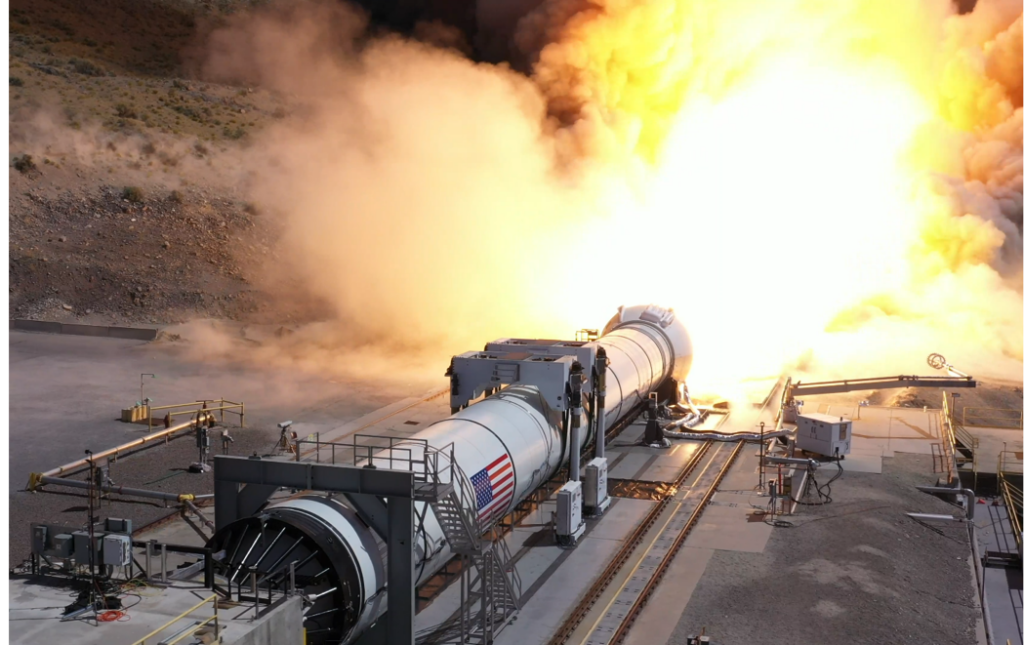
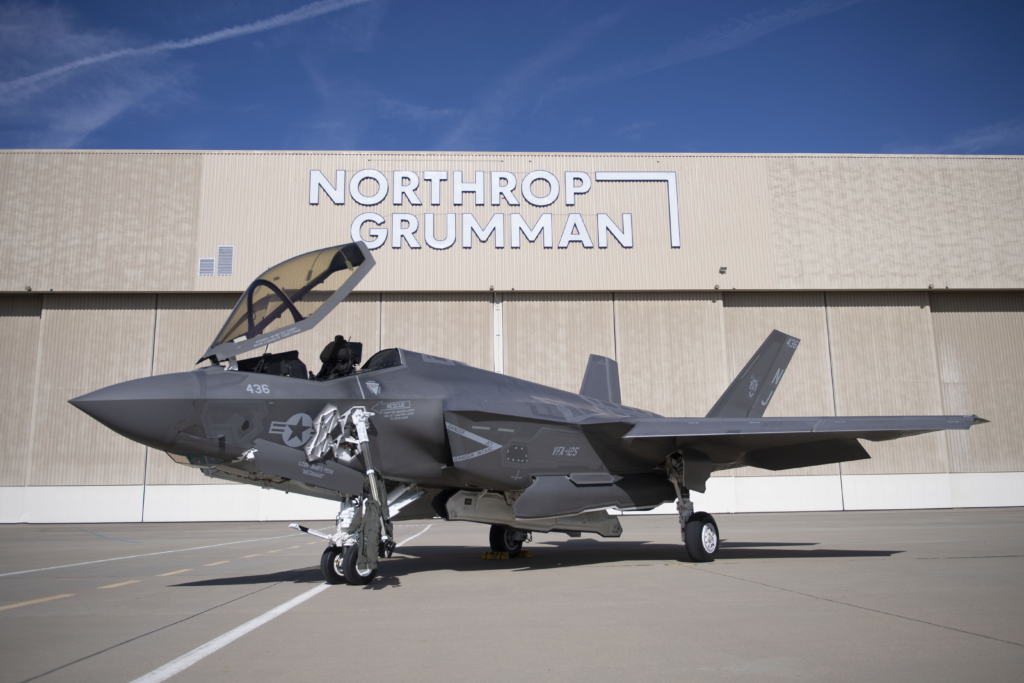
Northrop Grumman Corporation is an American multinational aerospace and defense technology company focused on digital transformation. With 90,000 employees and an annual revenue in excess of $30 billion, it is one of the world’s largest weapons manufacturers and military technology providers. Altair Kaminski, PLM Systems & Digital Strategy Manager, works in the propulsion systems division, which develops solid rocket motors for the space sector.

The propulsion systems division of Northrop Grumman uses Siemens’ product lifecycle management products to support its digital transformation goals, including for CAD management and manufacturing applications.

Verification management in complex product development environments

For aerospace manufacturers, certification is everything. In addition to already strict regulations, today’s aerospace and defense companies face additional demands for advancements such as aggressive sustainability targets and autonomous aircraft options, which require more integrated systems driven by software and electronics.

While managing the development of their highly complex product line, Northrop Grumman are acutely aware of these challenges. First and foremost, they must meet customer expectations to deliver new products and updates to existing products to market as fast as possible.

To expedite certification and bring products to market faster, it is essential for Northrop Grumman to drive efficiencies to their business processes and operations. When presented with a challenge like change management, product developers need to understand not only why a change is being made, but what impacts a change will have across the entire array of the product.

Reconciling a single change can be extremely tedious when the product data isn’t connected or in context for certification. The problem becomes exacerbated when one change must be multiplied across millions of parts and hundreds of suppliers. To ensure they have the right tools in place to support their programs, Northrop Grumman enlisted Siemens to aid them in their journey toward organizational digital transformation.

Embracing digital transformation

Kaminski and her group have embraced the concept of digital transformation. Digital transformation refers to the adoption of data and digital solutions for business activities and processes. With their PLM system serving as the backbone for enablement, digital transformation engages people with digital workflows to promote the full advantage of technology investments across an organization.

“Data is key to gaining information, but connecting it is where the real power of digital transformation comes from,” said Kaminski.

PLM is used by Northrop Grumman as a massive hub for storing and managing the information required to establish a digital thread throughout their product lifecycle. It helps to tie the relationships between data together, bring in additional information, and connect to external systems.

A system of systems approach in action

To support their digital transformation, Northrop Grumman has established a product lifecycle digital thread. The PLM system serves as the digital thread backbone, connecting information across functional domains and operational disciplines to enable individual functions to operate as a collaborative unit. This “system of systems” approach opens the door to explore powerful cross-functional capabilities like digital twins.

We were able to see a 25% weight reduction by being able to have access to both the model and run a bunch of iterations on the design in order to get optimal efficiency.

– Altair Kaminski, PLM Systems & Digital Strategy Manager

For their launch abort system manifold, Northrop Grumman leveraged digital twins, coordinating physical and virtual testing to achieve significant product weight reduction. With the ability to integrate simulation and virtual testing into their project plan, Northrop Grumman can plan the certification testing and documentation in real time. The digital thread creates a fully traceable and auditable chain of data from requirements through service, reducing the reliance on physical parts testing by linking virtual and physical testing for proof of compliance.

Armed with a digitalized virtual verification and validation strategy backed by PLM, Northrop Grumman can more efficiently produce and more confidently show proof of compliance of their advanced products and achieve certification faster.

Microsoft Flight Simulator, one of the most beautiful games in the world, uses Artec Leo to recreate ultra-realistic aircraft

Product: Artec LEO
Industry: Aerospace and Defense

Microsoft Flight Simulator

Cockpit view in the game Flight Simulator

Fourteen years following the last release of the world-famous flight simulation game, on Aug, 18, 2020, Microsoft and Asobo Studio unveiled the newest edition of Flight Simulator.

Already number one on the best-selling PC games chart since its release, Microsoft Flight Simulator is a worldwide hit, boasting more than 1 million unique players, with 26 million flights already having been flown in this super realistic simulation.

To recreate the game environment, the graphics, and the plane cockpits to the peak of perfection, Asobo Studio needed to faithfully include every last detail. This is even more important since the majority of players are pilots, passionate airplane enthusiasts, and other expert gamers with extensive knowledge of flight simulators.

3D technologies to help with performance imperatives

Engineers from Asobo Studio, France’s leading independent game developer for PC and consoles based in Bordeaux, used 3D scanning technologies to recreate with true-to-life precision the planes’ cockpits in the game, making even the tiniest details more realistic in this new release of Microsoft Flight Simulator.Microsoft Flight Simulator

Asobo vehicle designer scanning the inside of an aircraft with Artec Leo

This is why teams from Asobo Studio had to visit various runways to digitize multiple planes, ranging from aerobatic two-seaters all the way up to jumbo jets, with every aircraft scanned meticulously.

Those scanning operations took only a few weeks, and were accomplished with the help of the handheld 3D scanner Artec Leo, a device capable of scanning 80 frames per second, and operated via a simple touchscreen. The scanner was provided by 3D Numérisation, an Artec 3D partner.

This way, Artec Leo was used to rapidly capture the colors, shapes, and precise dimensions of a Robin DR 400 aircraft, as well as many other planes.

Once the planes are scanned, the data is then processed in Artec Studio software, where the scan mesh densities are reduced and optimized to match the game engine requirements before the scans are exported for further development. Artec Studio allows the user to create, edit, and process all the 3D data at hand, whatever the size, or resolution of the object being captured. Each scanned aircraft needs around one working day of software processing in order to be ready for export.

Ease of use, ultra-realism, and time saving

Artec Leo, which is capable of scanning any type of object, was also used to digitize other parts of the aircraft, such as the landing gear and fuselage.

It is obviously much faster to scan an existing object than to recreate it from scratch using 3D modeling software. 3D scanning technologies allow users to digitally bring to life an object identical to its real-world counterpart. To show how fast the process is, scanning a plane took from half a day to one day, depending on its size. Entire cockpits and landing gear could be captured in merely an hour.Microsoft Flight Simulator

Ultra-realistic aircraft models are tested inside the simulator

“We could capture a huge amount of data in such a short time, while changing the angle of scanning very quickly,” said Nicolas Favre, Vehicle Artist at Asobo Studio. “During the digitization process, the only difficulty was to find enough distance to scan the instrument panel inside the cockpit, which is a narrow cabin. Without 3D scanning, it would have been way longer and more difficult to reproduce such a high level of precision, especially for the many knobs and buttons inside the cockpit.”

“3D scanning was crucial in regards to time savings, and let us skip some quality control checks from different aircraft manufacturers who had to give us their authorization to validate our work. With 3D scan technologies, we could go directly to the modelization phase while earning trust and credibility from the manufacturers, who could verify the accuracy of our aircraft and cockpit models in our game,” explained Gabriel Turot, Vehicle Artist at Asobo Studio.

Asobo Studio, always up-to-date with the latest technologies, considers this 3D scanning project as a “Laboratory for ideas” to eventually use on other future projects, with the objective to create even more realistic video games.

Andrey Vakulenko, Chief Business Development Officer of Artec 3D, concluded “With this approach to simulation game development, anyone can virtually step inside an aircraft cockpit that’s vividly identical to the original. It is simply stunning to experience the results delivered by Asobo Studio for creating the planes in Flight Simulator. The Artec Leo scanner is normally used for the design of actual aircraft, and ensuring quality control of their parts. It is exciting to know that now everyone can enjoy 3D models of these planes with a level of quality chiefly used by aeronautical engineers. This opens the gates for countless developers across the video game industry, but also in virtual reality and augmented reality as well.”

easyJet Cuts Aircraft Damage Assessment Time by 80% with Geomagic Control X

Product: Geomagic Control X
Industry: Aerospace and Defense

If you’ve flown anywhere in Europe in the past two decades, chances are good that you’ve flown on easyJet. This leading European low-cost airline brings travelers to more than 30 countries on 600+ routes safely and conveniently, all while offering some of the lowest fares across the continent. How do they do it? With a focus on safety, simplicity, and operational efficiency. easyJet’s engineering organization epitomizes this ethos by putting safety at the heart of everything it does and innovating to continually improve performance and reduce costs.

easyJet assesses aircraft damage faster with Geomagic Control X

An easyJet Airbus A320 at the company’s maintenance hangar, where 3D scanning is being leveraged to improve and speed up aircraft damage assessments.

Minimizing Aircraft on Ground Time

One of the most important ways that easyJet can minimize delays and keep ticket prices low is reducing Aircraft on Ground (AOG) time. Unplanned AOG events happen when any of the company’s 298 Airbus aircraft are damaged or experience mechanical failures, and can be very costly — not to mention inconvenient to passengers. It’s clear that the faster a damaged aircraft can be checked, the better it is for the airline and its passengers. 

“One of our biggest challenges is to try and reduce the AOG time of aircraft and maintain accurate records when damage occurs,” said Andrew Knight, Fleet Structures Engineer at easyJet. While rare, hail, bird strikes, and other events can potentially damage the wings and fuselage and require inspection before flying again. Checking damage from these types of events has traditionally been a low tech, manual, and time-consuming process that requires maintenance staff to assess aircraft damage using manual measuring tools such as rulers and vernier calipers. Worse still, interpreting the extent of any damage using this technique is highly subjective and not repeatable between staff members. easyJet’s structural engineering team went looking for a modern solution to speed things up and provide more accurate, traceable results.

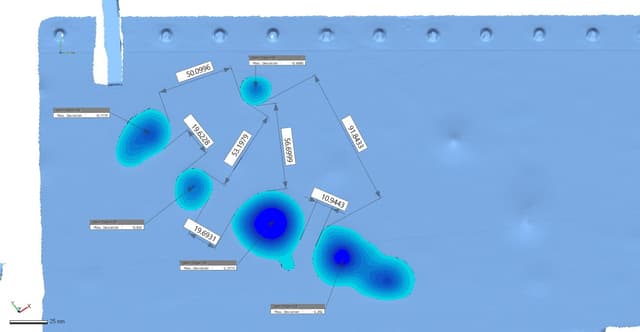
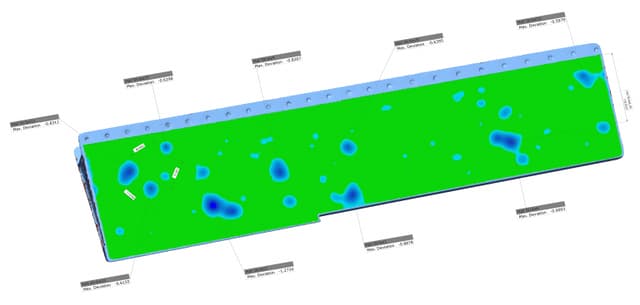
3D scanned deviation location using Geomagic Control X

Geomagic Control X displays the results of a dent analysis, including maximum depth and distance between each dent, based on a 3D scan of a wing flap.

Repeatable, Accurate, Mobile 3D Inspection

“We’ve been looking for a system that is easy to use for the maintenance engineer but has the ability to provide more in-depth reports if required by support staff. It must be accurate, repeatable and most of all, mobile, as AOG events can occur anywhere within our network of 136 destinations across Europe,” Knight continued. “The biggest challenge was the software side because it needed to be a simple, easy-to-use interface to obtain a basic damage report, but powerful enough to provide more in-depth details in the support offices. 3D scanning should provide us with accurate, fast damage assessment with repeatable results independent of the experience of the user.”

For these reasons, easyJet turned to 3D Systems reseller OR3D, a UK firm with expertise in 3D scanning and Geomagic software. Robert Wells, a 3D scanning expert at OR3D, reported that “based on easyJet’s requirement to quickly scan large areas — such as the entire wing length of an Airbus A320 — on the tarmac, we recommended a portable handheld 3D scanner. And we knew Geomagic Control X™ was the right software because they needed an automated way to assess dents that was easy for their staff to learn and use.” With this solution, performing a damage assessment on the roughly 70 feet (21 meters) of an A320’s flaps takes just a few hours, compared to several days with wax rubbings on tracing paper, saving easyJet tens of thousands of Pounds/Euros per damage event.

Geomagic Control X inspection shows dent locations to easyJet quickly and accurately

The location and severity of damage is instantly recognizable during assessment of flight surfaces. Repair decisions can be made quickly and with a high level of confidence.

Instant Reporting for Fast Documentation

Once the scans are complete, easyJet engineers can get damage reports from Geomagic Control X software on the spot. They don’t need to load CAD models or align the scan data to anything else in the software, and they don’t need to have deep metrology expertise to get reliable output. Control X uses its CAD engine to automatically create idealized geometry that meets standards for surface continuity that are defined by Airbus, and measures the scanned aircraft against that idealized geometry to provide instant results. Within minutes, easyJet engineers have a consistent, repeatable, and thoroughly documented initial damage report that lets them decide what repairs, if any, are needed before the aircraft can be placed back into service.

Powerful 3D Inspection That’s Easy to Learn

easyJet has embraced Control X for large-scale damage assessments because it’s so accessible for busy engineers with many other responsibilities. Knight remarked on this specifically, saying “engineers will not use the system if it is too complex and requires in-depth software knowledge and/or extensive training.” Control X fulfills these requirements better than any other scan-based inspection software because it’s intuitive, easy to learn, and powerful enough to handle complex measurement scenarios. Anyone familiar with using 3D software can pick up Control X and get results in a matter of minutes, with the flexibility to measure what they need to, without pre-programming or inflexible macros.

What does this new, modern approach to damage inspection mean for easyJet? “We have estimated an approximate 80% savings in time to perform assessments using the 3D systems we currently have with a potential 80% savings in currency terms,” says Knight. There are additional benefits beyond reduced AOG time and better decision-making regarding repairs as well: keeping detailed damage reports, complete with accurate scan data, can help the company years from now when it comes time to sell or return aircraft to their leaseholders.

easyJet’s use of Control X is another example of how simple, intuitive inspection software helps companies ensure quality everywhere by empowering more people to measure more things in more places.

×