
The city of the future is here, and Dubai’s Micropolis Robotics is at the forefront

Product: Simcenter
Industry: Robotics

Imagine a world where communities are safer, cleaner, more efficient, and more convenient for residents.

In this world, a crime in progress can be immediately identified and reported. Groceries and food are delivered to homes without extra service fees or wait times. Trash is collected and roads are frequently cleaned with zero emissions.

All powered by robots.

It’s not the future, nor is it science fiction.

It’s happening now, and Dubai-based tech startup Micropolis Robotics is making it real.
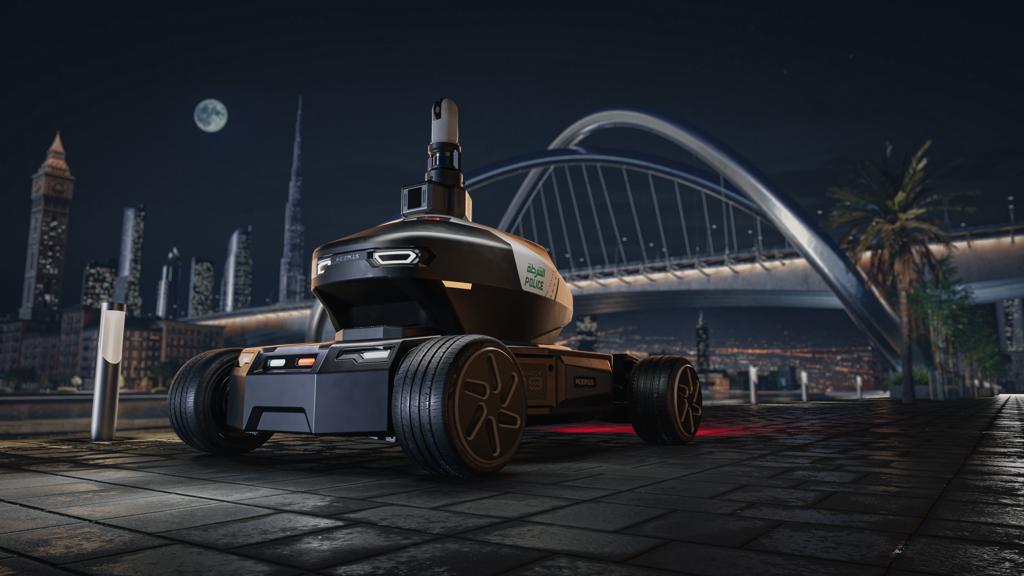
Autonomous robots Dubai

I sat down with CEO and founder, Fareed Aljawhari, to learn more about his company and how they’ve partnered with Siemens to bring this vision to life.

Tell me about your company. What inspired you to start it?

Since I was a small child, I’ve always been fascinated with technology. You could say it’s in my blood. Funny enough, what got me interested in robotics was my discovery of a plotter back in 1996.

I remember watching a storekeeper set up a small sign and complimenting him on the artwork, expressing my admiration of the artist’s precision and quality. His response? “A person didn’t draw this, it was a robot.”

I was shocked. I asked him if he would show me the plotter and he gave me the address, so I went to see it for myself.

When I arrived, I was in awe. I must have watched that plotter run for at least 30 minutes. I asked the machine operator if he would show me how to use it. This turned into my first “job,” but because I just wanted to learn, I didn’t ask to be paid.  

A few months later, I used this knowledge to get a job at a trade center operating the plotters. I wanted the job so badly that I didn’t tell them during my interview that I was underage. Of course, they eventually found out, but I had gotten so good at operating this machine that they agreed to pay my high school and college tuition fees in exchange for my work.

In school, I studied architecture, which gave me a solid foundation in design. Then I learned about product development, and eventually jumped to marketing and brand development. This led to a career as a creative director. All this experience was vital to the founding of Micropolis Robotics, as it gave me a comprehensive understanding of what a product is.

In 2012, I started my own agency with a similar idea as what is now known as the Metaverse. This was the inspiration for the name Micropolis – think “metropolis,” but it’s micro because we want to mimic a virtual city.

In 2014, I was introduced to my first investor, who also founded the Sustainable City in Dubai. He loved the idea of a virtual city, and I began developing a graphic engine to build a virtual city for Dubai.

Fast forward to 2018 and I presented a project called Microspot to Dubai Police. Microspot is a crime deterrence/prevention software we developed based on our graphic engine that we created for the virtual city. It identifies a crime in progress and uses facial recognition software to identify the person committing the crime.

The Commander in Chief loved it and asked, “What if you added embedded this technology into an autonomous patrol robot?”

I knew we could fail, but I also knew that if I didn’t say yes, I would regret it the rest of my life. So, I said yes.

What happened next?

Next, we started to research and learn how to build robots. My background is in design, so I designed a mockup of an autonomous police robot. It was good, but the Commander in Chief told us, “Great, but it won’t work for police. You need to make it bigger.” So we went back to the drawing board.

In 2021, we finalized the visual design for the M01 and M02, our first patrol robots. After that, I started looking for investors to bring this design to life.
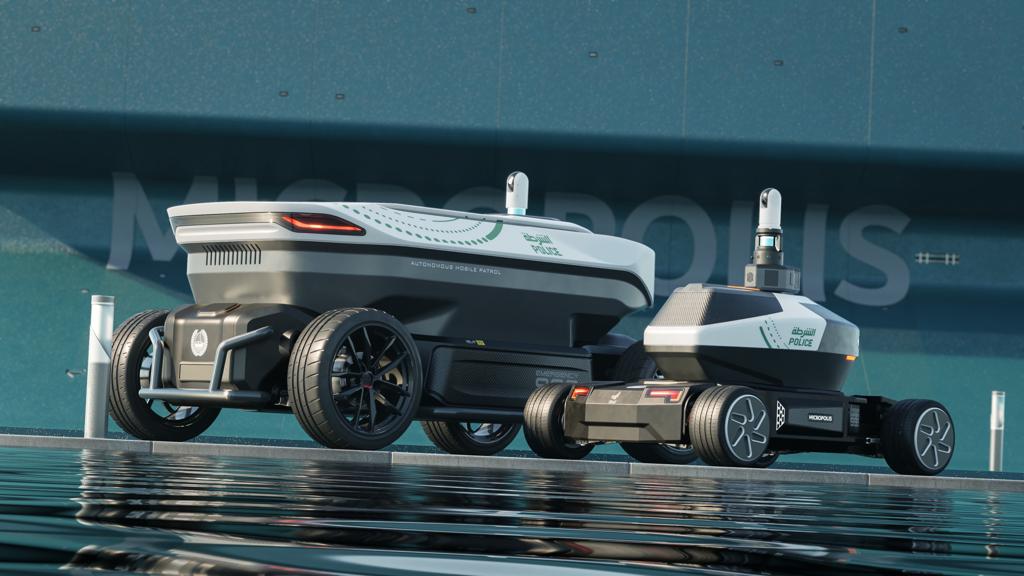
Autonomous robots in Dubai

This is where things got even more difficult. Dubai is very advanced – we have excellent infrastructure with an Internet City, Media Production City, and lots of industrial cities. And the government is very supportive of technologies like this, but the problem is we don’t have a lot of investors who are interested in tech and we don’t have a large pool of engineering talent here. You either need to attract talent from Europe and the United States, which is where engineering talent tends to be concentrated, or you have to make your own.
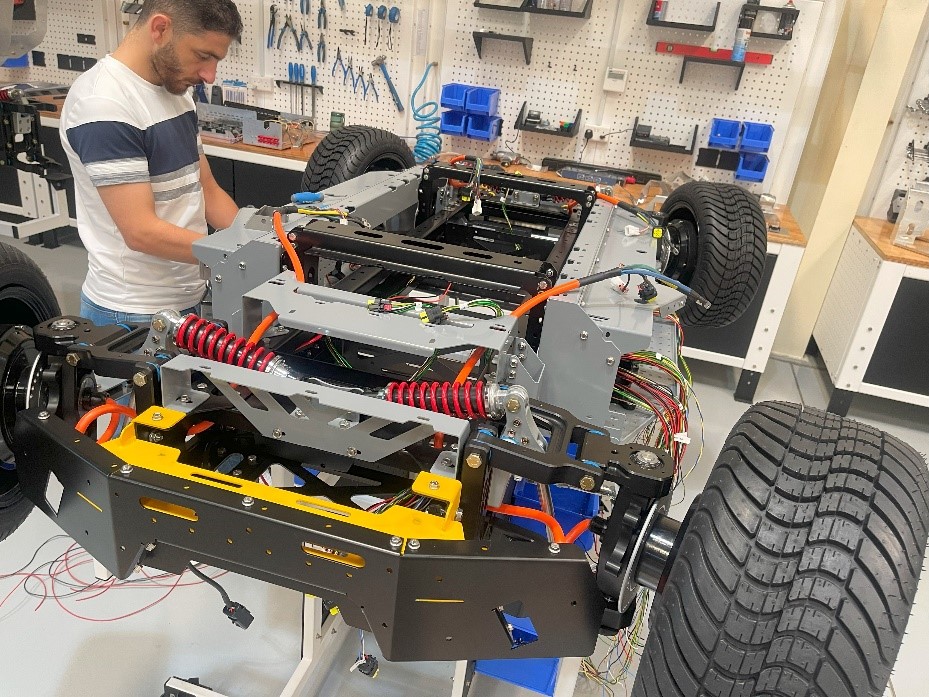
Engineer building an autonomous robot

We hired local engineers and adopted a framework inside of our company where we allowed them to experiment and make as many mistakes as possible. We learned from each other’s triumphs and errors and eventually got organized. We now have a very professional, extremely talented team and presented the first successful models of the M01 and M02 robots in 2022.

In 2023, we received an investment from Dubai Police to build the final stage of these patrol robots, and we succeeded. It’s now a production-level robot.
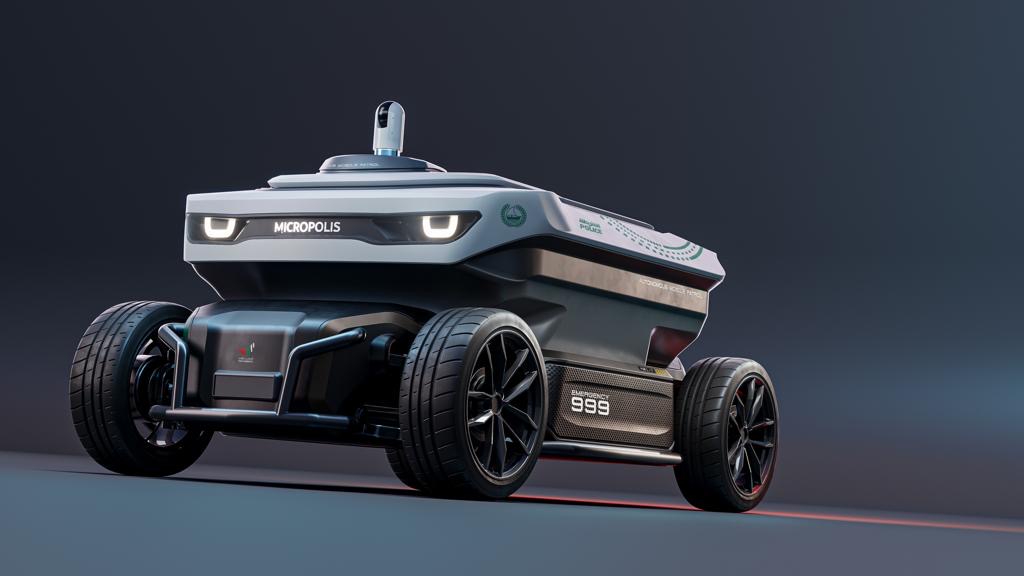
Autonomous robot Siemens Micropolis Robotics

The learning curve is getting shorter and shorter, our team is bigger, and everyone just got very good at what they do. I’m proud of my team. Suddenly they are all like masters of their craft.

Where does Siemens come into all of this?

We got everything right with our robots except autonomous driving. This was the biggest challenge facing our company and we needed a company like Siemens with expertise and know-how in autonomy.

We partnered with the Simcenter Engineering and Consulting Services team to develop algorithms to help us reach Level 4 in autonomous driving. For both the M01 and M02, our plan is to develop a perception layer, including internal sensors with audiometry wheels, encoders, IMU, and steering angles, as well as external sensors such as LIDAR, cameras, ultrasonics, imaging radars, and obstacle detection.

Why did you choose Simcenter Engineering and Consulting Services for this project?
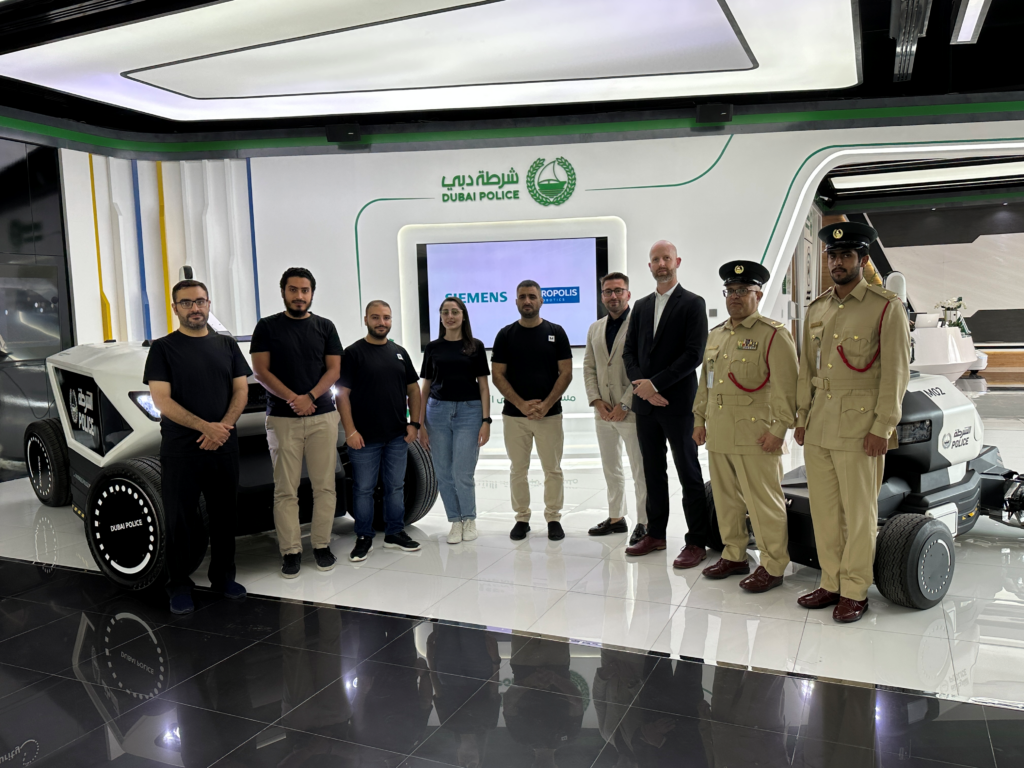
Siemens and Micropolis Robotics partner

Siemens is one of those brands who, when you hear the name, you know you’re going to succeed. We selected Simcenter Engineering and Consulting Services because we needed their expertise, knowledge, and ability to get the job done right. We thought we just needed help developing some algorithms, but they’re taking our autonomous technology to a different level and have really partnered with us to develop a proper autonomous driving program.

Simcenter Engineering Services has been an incredible partner to our company. When we first contracted with them, I thought we would maybe get four or five of their engineers to work with. Instead, we get access to 26 of their engineers. It’s beyond anything I could have hoped for.

We have been delighted by the amount of expertise Simcenter Engineering Services is providing for this project. Their professionalism, organization, and level of knowledge is just extraordinary. My team and I are constantly learning from them and we are getting better every day because of them.

When will these robots be deployed?
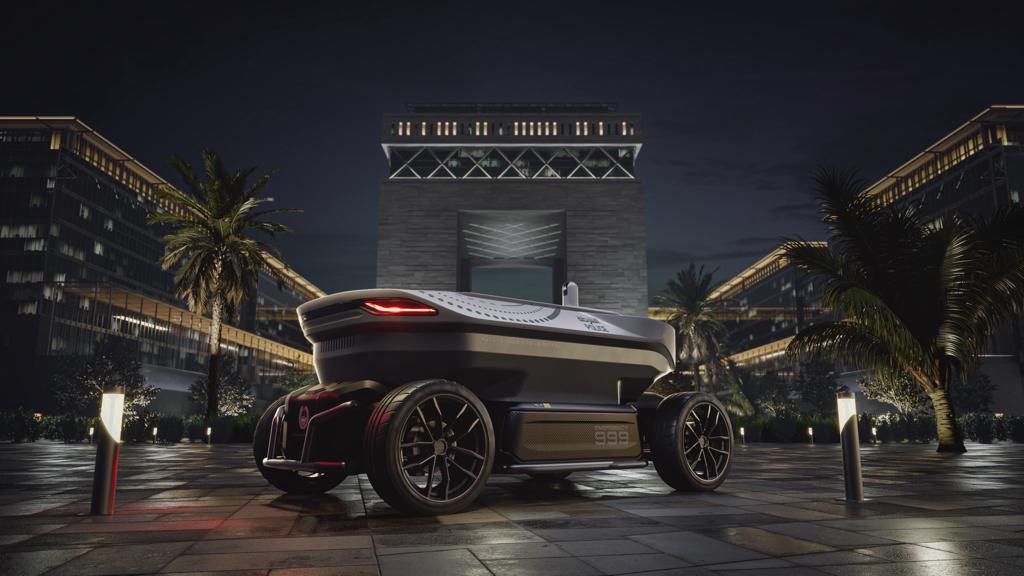
Autonomous robot in Dubai

The Dubai Police have been excellent partners and have been very flexible in their timing with us. We are hoping to launch the patrol robots in summer 2024. We would start with residential and commercial areas first with the M02 because it is smaller. We hope to launch the M01, which is the size of an SUV, in 2025.

The delivery and cleaning robots are a bit further out. We don’t have the capacity to develop all three robots at the same time, so we will take what we have developed and learned from the patrol robots and apply similar technologies to the other robot types.

Are you expanding this beyond Dubai?

Absolutely. Abu Dhabi is also interested. The Emirati Ministry of the Interior is interested. We will first focus on the UAE and Saudi Arabia, but will eventually expand to an international scale. We won’t be regional forever.

What would you say to someone who questions the ethics of using robots to do police work? Or to those who would accuse robots of stealing jobs?
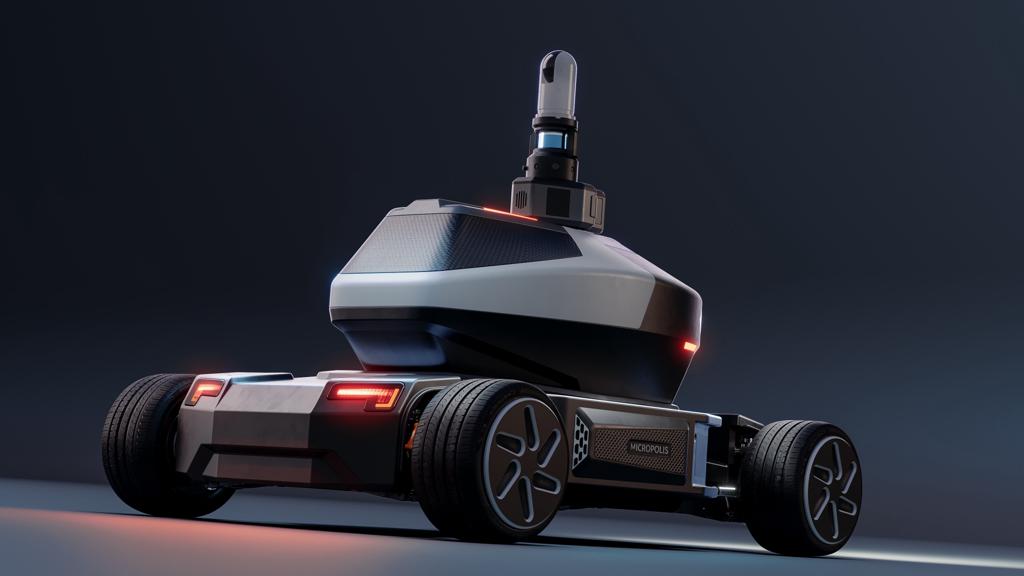
Autonomous robot for police

My response would be that this is simply a reporting robot. It sends a picture of the person committing a crime to the police along with an identification. If it has misidentified the person, the human analyzing the picture can tell the system it is wrong. However, facial recognition software has made some incredible advancements in recent years and is almost always right. But even if the facial recognition software did make a mistake, the AI embedded into the robots will learn from that mistake and use it to get better with time.

As to whether robots are stealing jobs, it is true that some jobs will vanish as new technologies emerge. But we’re also adding new jobs that didn’t exist before and augmenting others. We’re enhancing security for residents of Dubai and improving safety for Dubai Police officers by removing the need for them to go into dangerous situations.

Robots also have the potential to enhance human lives and creativity. If I can send a robot to get my groceries, that is 20 minutes of my day that I have to focus on something else or create something new. We are not only making society safer, we are also giving people time back to think and create.  

You mentioned earlier that it is challenging to hire engineers due to your location in the Middle East. Given this challenge, can you explain why you launched Micropolis Robotics in Dubai rather than somewhere else?

Autonomous robot on street in Dubai

As an entrepreneur, I believe I have a responsibility to my region. Dubai and the broader Gulf Cooperation Council (GCC) region have been actively working to transform the technology consumers in our area into technology innovators. The government of the UAE is taking proactive steps to encourage entrepreneurs from the region to take the initiative and establish their tech firms. They’ve invested heavily in developing advanced infrastructure to foster innovation in technology and attract the best talent from around the world.

Their commitment to innovation aligns perfectly with our vision at Micropolis Robotics. We are excited to be part of this transformative journey, leveraging the promising local market demand. With GCC countries increasingly focusing on developing smart cities and enhancing the well-being of our residents, the opportunities for innovative tech products and solutions are very promising here.

Succeeding here feels like a victory.

What is the future of your company and partnership with Siemens?

Our goal is to be a tech powerhouse that develops technology to automate large operations. We think Siemens will play a huge role in all our future software development – this autonomous robot project is just the beginning. We don’t live alone in this world and recognize that we need big partners like Siemens and NVIDIA in order to be successful. 

But what we’ve talked about today is just one example. Robots are just one piece of technology that is useful for humanity, and our goal is really to develop any technology that is useful for humanity.

For example, one project that is currently in the development stage is an alarm system for forests. I consider myself an environmentalist, so seeing all the recent forest fires in every corner of the earth saddens me. We are developing an idea for a sensor grid that could alert the authorities at the very start of a fire. The sensors would detect whether there is a change in the atmosphere that would indicate a fire has started. Forest authorities could then go to that location and confirm whether a fire has started and stop it before it spreads.

Our overarching goal is to develop technologies that better humanity and the planet.

Revolutionizing Space Engineering: The OX Origin Story with Siemens

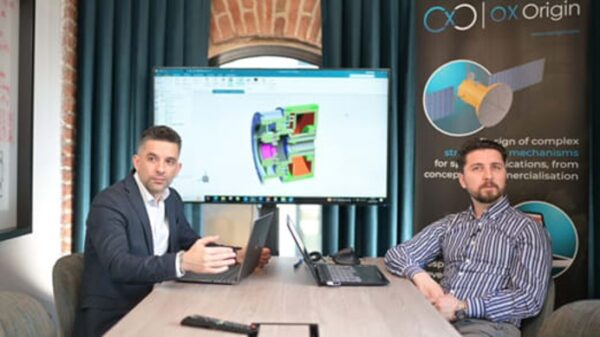
In the vast expanse of space, there are pioneers on a relentless quest to unlock the mysteries of the cosmos and push the boundaries of human exploration. One such pioneer is OX Origin, a Romanian startup with a singular mission: to propel humankind towards the stars. Founded by visionaries Alex Bugnar and Ilie Ciobanu, OX Origin is not just another player in the aerospace industry; it’s a revolutionary force redefining how we approach space systems and software engineering.

Breaking Boundaries in Space Technology

OX Origin’s founders are on a mission to bridge the gap between conventional space technology and cutting-edge design and engineering practices. Co-founder Ilie Ciobanu notes, “The tools being used in the space industry are falling behind when it comes to design and engineering technology. Not in the technology they produce, but the technology that’s being used, especially the software tools that tend to be older than the latest state-of-the-art software.”

Ciobanu keenly observes that the challenge lies not in the quality of the technology created but in the tools used to manage these projects. He believes that the industry’s reluctance to embrace the latest technology is holding back progress, and this is precisely what OX Origin aims to change.

The Visionaries Behind OX Origin

The journey of OX Origin began when Bugnar and Ciobanu crossed paths during their early professional careers in Oxford, United Kingdom, inspiring the name “OX Origin.” Their qualifications and areas of expertise make them a dynamic duo:

  • Alex Bugnar holds a master’s degree (MSc) in Ultra Precision Technologies and a Bachelor of Science (BSc) in Telecommunications Engineering. He specializes in software engineering at OX Origin.
  • Ilie Ciobanu possesses a BSc in Astronautics Engineering and an MSc in Space Technology, focusing on the design and consulting aspects of their business.

Their collaboration and complementary skills were the catalysts for founding OX Origin in 2020. Beyond personal chemistry, they saw an opportunity to help and educate fellow space industry professionals.

In Pursuit of the Stars: StarLeap and MARS

While OX Origin’s overarching mission is ambitious, they are actively developing solutions to realize it. One such solution is StarLeap, an enterprise web-based platform designed to manage the end-to-end design process of complex space systems. Additionally, they offer MARS, a solution designed to assist mechanical engineers in verifying bolted joints and ensuring associated safety margins through bolt static analysis.

In addition to their proprietary solutions, OX Origin harnesses the power of Siemens software solutions in their projects:

  • NX for design
  • Simcenter for simulation
  • Nastran for computations
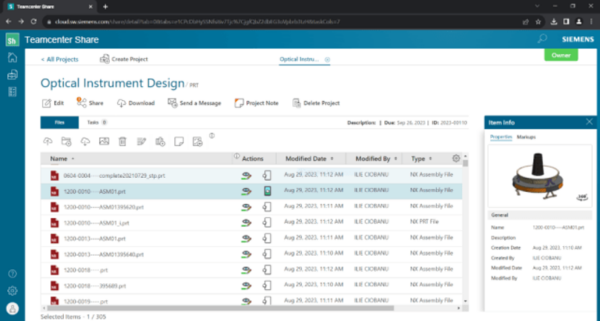
  • Teamcenter Share for collaboration

Ilie Ciobanu, the primary software user, shares his perspective, stating, “Compared to other solutions on the market, I feel Siemens’ is the most connected.”

He highlights the seamless integration between NX and Simcenter, allowing for extensive design analysis. This compatibility enables OX Origin to explore various configurations, assess mechanical, thermal, and static performance, and select the best design to meet client requirements.

Collaboration Made Effortless with Teamcenter Share

With Teamcenter Share, OX Origin effortlessly collaborates with clients across the globe. This cloud-based platform facilitates the secure sharing of files, models, and simulation results. Permissions can be assigned to ensure data security. Clients can then actively participate in processing, modeling, and simulating the data while providing feedback and desired adjustments.

Beyond collaboration, Teamcenter Share serves as a central hub for storing and managing data and streamlining client tasks and activities. According to Ciobanu, “It makes life easier and helps us manage the tasks and activities of the clients we work with.”

How the EDAG Group goes the extra mile to improve pedestrian safety

Product: Simcenter
Industry: Safety

Nearly 20% of all road accident fatalities in the EU are pedestrians. Car manufacturers all over the world want to improve pedestrian safety. In this blog, we share the story of the world’s leading mobility engineering experts, the EDAG Group AG in Germany.

Remember those adverts where a car drives into a wall, and the crash-test dummies inside are left intact? If you watched closely, you might have noticed that different dummies are used in different tests. This is because they are highly calibrated for each test, and any changes will affect their validation. You might have also noticed that the acceleration given to the car is always in one direction. This ensures the dummy does not change position before impact. The dummies are passive objects and can not reposition themselves. A test is ruined if they move out of position before the impact.  

Using dummies comes with three problems

Firstly, you can’t test until you have built a complete physical prototype. Secondly, you will need to destroy multiple vehicles to complete all the validation tests. Thirdly, you can not quickly test pre-crash maneuvers such as lane change.

From physical to virtual dummies

A few decades ago, manufacturers had to crash over a hundred vehicles while designing a single model. Today, only a fraction of that number is required. With the use of virtual models, engineers can design new, safer models quicker and more cheaply.

Simcenter Madymo simulates both dummy and human models, including models that can reposition themselves after and during a maneuver. It integrates Multibody Dynamics, Finite Elements, and CFD technologies in one single solver that includes a database dummy and human models that can be scaled to any size or to population percentiles.

This means that not only can you get the most realistic assessment of what will happen to occupants and pedestrians in a collision, but you can also carry out testing much earlier in the development phase. Once you have your virtual vehicle model, combine it with your Simcenter Madymo model, and you’ll get accurate test results before you’ve built a single prototype.

Crash Test Innovation of the Year

In 2021 Simcenter Madymo was named the ‘Crash Test Innovation of the Year’ by ATTI magazine. It is no wonder that more companies are turning to this simulation software to aid vehicle design.

Keeping pedestrians safe

EDAG Group supplies mobility engineering expertise to the worldwide automotive industry. Its CAE and Safety department specializes in attaining the highest safety levels for vehicles and meeting legal requirements and customer ratings for particular regions or companies.

The Active Hood is a common pedestrian safety solution for minimizing head injuries when a pedestrian is struck by a car. By automatically lifting the hood when a collision is detected, a space is created between the inside surface and the rigid components underneath. This ensures that when the head hits the hood, the head is much less likely to suffer serious damage.

But to develop an effective Active Hood, engineers need to understand exactly how a human body will behave when struck by that vehicle.

This is where Simcenter Madymo comes in

The CAE and Safety department, led by Stefan Hundertmark, uses Simcenter Madymo to simulate the kinematic behavior of pedestrians’ bodies in accidents to help their customers develop the safest possible vehicles. Read the case study to discover how Simcenter Madymo allows them to significantly reduce simulation time for human body behavior from days to hours while meeting all the necessary standards and regulations in pedestrian safety performance.

You can also find out more about how Simcenter Madymo enables manufacturers to meet regulations by watching the pedestrian safety systems webinar featuring Assistant Professor Corina Klug of TU Graz and Cindy Charlot, technical lead of the Safety and Comfort Modeling team of Simcenter Madymo. Corina Klug was instrumental in creating the Euro NCAP guidelines, which reduced EU pedestrian fatalities by 36%. Cindy explains how to use Simcenter Madymo in the validation process and how to comply with all certification requirements.

Vision Zero

The ultimate aim for The EDAG Group and other companies using Simcenter Madymo is to eliminate all traffic fatalities and severe injuries.

That might sound like a pipe dream, but it forms part of a global movement known as Vision Zero.

The campaign began in Sweden in the 1990s and has since proved successful across Europe and is now gaining momentum in the United States.

First and foremost, it challenges the traditional belief that road traffic deaths are inevitable and that saving lives is expensive. Vision Zero accepts that human failure and collisions will happen, but with a systemic approach, we can prevent fatal and severe crashes that lead to deaths.

Simcenter Madymo is a key element of Vision Zero as its occupant and pedestrian safety simulations help manufacturers design vehicles that offer the most protection.

Car manufacturers such as Volvo incorporate zero accidents in their vision. The basic philosophy of the Volvo Group Safety Vision is that accidents can be prevented. At the same time, they are aware that many things are outside of their control. This is why collaboration with other players is important. And change is happening. Also, suppliers such as ZF or Continental go the extra mile to contribute to the zero fatalities future. For more information, read this article on how Continental is heading for Vision Zero.

Pedestrian safety and ADAS & autonomous vehicles

Don’t be mistaken by thinking that ADAS (Advanced Driver Assistance Systems) and fully autonomous vehicles will render accident simulation obsolete.

In fact, they make it even more important.

Even with self-driving vehicles, collisions will still happen. The artificial intelligence controlling the vehicle needs to be able to minimize injury and calculate the best course of action in a split second. It’s no use swerving to avoid one car if that takes you into the path of several cars and causes a bigger crash.

Using Simcenter Madymo, developers of these systems can train them to maximize occupant and pedestrian safety. By understanding exactly how human bodies will be affected by collisions, AI can determine which action will result in the least injury. So instead of swerving, it may simply choose to brake. While not avoiding the collision completely, the reduction in speed, combined with ensuring airbags fire at the right moment and the seat belts do their job, will be enough to prevent serious injury. Ultimately, it will lead to fewer deaths, which is the number one priority on the path toward Vision Zero.

InMotion student team breaks records with 12-minute charging

Product: Simcenter
Industry: Motor Racing

Now that is something to celebrate…

Today to celebrate the fifth UNESCO International Day of Education, we want to highlight quite an exceptional story from the InMotion student team that just happens to use Siemens software – and of course: Simcenter.

Although InMotion has made a serious technical impact with its all-electric, track-ready Le Mans race car, the Revolution, the real beauty of this story is what this team of students has accomplished with their 12-minute fast-charging technology and next-generation battery packs.

Based on the Automotive Campus in Helmond, The Netherlands, InMotion is closely associated with the Technical University of Eindhoven. The InMotion team, which is run as a foundation and rotates students annually, practices continuous innovation. Experienced former members meet weekly with the current team to guarantee knowledge transfer and help solve technical challenges.

Moving forward and making progress

Over its ten-year history (plus), InMotion has built four, successive innovative race cars, including the heritage bio-ethanol Ignition, the fastest student e-Formula 3, the Fusion, the Vision, a more aerodynamic e-concept car and the Revolution, a true pioneer with its 12-minute e-charging time – that is faster than an e-Porsche or even a Tesla.

“Ten years being a student team is quite amazing. I think this is what makes InMotion special. The people that founded it ten years ago are still on the supervisory board. People that built the first electric race car, the Fusion, are still providing us knowledge on the Revolution. That’s unique. It’s about moving forward, making progress, and keeping continuity in the team,” states Ewout Timmermans, former Team Manager, InMotion.

Digital twin work experience

Working in a digital thread with a digital twin was new to some of the engineers on the team. Old school tactics, like prototyping and on-the-fly troubleshooting, are things left in the past for the new generation of InMotion engineers.

“I think for most of the engineers, it was a true eye opener that you can work in this detail and represent advanced design and engineering performance this accurately in a virtual world,” explains Thomas Kuijpers, former Technical Manager, InMotion.

The team is quick to point out that getting everyone up to speed on all the Siemens Xcelerator tools, pretty much the same package that many F1 teams use, btw, was far from an out-of-box experience. They had help from cards PLM Solutions, a Siemens Platinum Smart Expert Partner, based nearby in Best, The Netherlands.

“The consultants from cards PLM were always really quick to respond and help point us in the right direction when we got stuck,” explains Kuijpers. “Another plus point about Siemens, especially for students, is the Siemens Xcelerator Academy. Most of us had already followed courses online with university, but once we started working as a new team, we even had more access to more specific material and tutorials. This was very useful for us.”

Innovation on the mobility side

“We really try to innovate on the mobility side. We believe that fast charging is way too slow at this point, and that might be a reason that people do not drive electrically,” explains Martijn Scholtus, former Account Manager, InMotion. “With the Revolution, we want to make the charging time as fast as possible. It is charging in 12 minutes. That’s a big leap. And it’s a Le Mans race car.”

“The most prestigious race is the 24 Hours of Le Mans. It is really a dream of the entire team to race there with this technology.” Adds Scholtus, “If it works at the 24 Hours of Le Mans, then it’s going to work everywhere.”

The importance of hands-on experience

Clearly the InMotion team has put its footprint on the power of innovative technology and, without forgetting International Day of Education, the importance of getting out of the classroom for some hands-on experience and on-the-job training in the world of engineering education (or any higher education for that matter). But more importantly, the team shares passion for engineering innovation to make the world a better place. And, at Siemens and Simcenter, all we can say is that we are happy that we could help.

A short InMotion Photo Gallery

A rotating student team going into its 11th season, InMotion aims to inspire students, organizations, and society with its unique concept to accelerate the energy transition in the automotive industry. The team’s vision is to make future charging as fast as “filling up”. To showcase its unique electric refueling technology, the team is setting a goal to race in the toughest endurance racing environments, the 24 Hours of Le Mans.

The simulated top speed of the Revolution is 300 km/h. Either way, it definitely outpaced our famous technology demonstrator, the Simcenter SimRod, on the track. (Although you have to argue that even though SimRod never set out to be a famous race car with a need for speed, it can pack a bit of punch…and keep up with the big guys.)

Putting sound quality on the e-bike metric map with the award-winning Fuel EXe

Product: Simcenter
Industry: Bicycles
Trek Bicycle
Trek Bicycle (Trek) is based in Waterloo, Wisconsin and was founded in 1976. Trek designs and manufactures various types of bikes including electric mountain bikes, road/city bikes and other accessories.

Using Simcenter SCADAS XS and Simcenter Testlab Neo software let me focus less on how to get correct answers and more on what those answers were teaching me.

Paul Harder, Principal R&D Engineer
Trek Performance Research Group, Trek Bicycle

Trek Bicycle (Trek) is based in Waterloo, Wisconsin and was founded in 1976. Trek designs and manufactures various types of bikes including electric mountain bikes, road/city bikes and other accessories. Trek aims to achieve continuous innovation and high-tech performance throughout its entire product range.

Trek Bicycle continues to innovate with the Fuel EXe bike, a pioneering line released in July 2022. The Fuel EXe is a high-powered electric mountain bike designed to provide riders with a quieter riding experience. The Fuel EXe includes high-quality Trek design, high-standard components, a lighter-weight yet tough frame and a comprehensive e-motor designed to enhance the sound experience for riders. Trek put e-bike acoustics on the map and is known for its innovative bike engineering group, including experienced mountain bike (MTB) engineers and dedicated bike-minded analysts who bring measurements and quantitative insight into new performance metrics like acoustics.

E-mountain bike acoustics

Trek is pioneering the concept of putting sound quality on the e-mountain bike metric map as it continues to be a hot topic in the industry.

“As Trek’s acoustics testing and analysis expert, which was not only a new role for me but a new type of role for the bike industry, we aimed to take Trek’s acoustics competency to the next level while applying new test and analysis methods to the Fuel EXe development cycle,” explains Paul Harder, principal research and development (R&D) engineer within the Trek Performance Research Group at Trek.

“It was quite the endeavor with a lot of firsts happening at the same time.”

The R&D engineers in Trek’s Performance Research Group tend to stay on the experimentation and simulation side of things, testing new prototype ideas and conducting experiments to seek out new knowledge in bike physics and human performance. This quest for new knowledge landed the team in the sound quality realm.

“Over the years, the industry has made a lot of progress to make e-bike motor and battery systems smaller, lighter, more integrated and more ‘natural’ to pedal,” says Harder. “But the inherent noise of electric motor and gearbox systems often remained a common downside. With the Fuel EXe, we had a unique opportunity to improve that last piece of the puzzle and make an e-bike that really has no downsides.”

To produce this e-bike, Trek partnered with Siemens Digital Industries Software to use Simcenter™ software as part of the design process to bring the Fuel EXe to life. Simcenter is part of the Siemens Xcelerator business platform of software, hardware and services.

Inspired by EVs

The team looked to the electric vehicle (EV) industry for inspiration. They realized that, like the early days of automotive EVs, the world of e-bike acoustics presented opportunities. The Trek team took acoustics full circle when investigating the options for the Fuel EXe in terms of the sound experience and unpleasant sounds. This included looking at industry-first acoustic metrics for the e-bike sector, like tonality and the articulation index.

“Since I almost always ride with other people, any noise that distracts from the ability to converse bothers me. This relates to the articulation index,” adds Harder. “Using tonality as our key metric for unpleasantness came from quite a bit of exploration and research into the many sound quality metrics that are commonly applied to electric motors.”

Integrating sound science with advanced engineering

Harder and the MTB engineering team at Trek knew the acoustic experience for the Fuel EXe depended heavily on the e-motor. The team was working with TQ’s HPR120 motor, which is a powerful but fairly loud motor. The team was looking for a smaller, quieter version of the motor. They found that TQ’s harmonic pin ring technology with minimum moving parts and unique gear meshing could play a role in making a new, quieter motor.

“We have an exclusive partnership with our e-motor OEM, TQ, so that means we can effectively collaborate when creating specs and testing our e-motors,” says Harder. This collaboration resulted in the HPR50 e-motor that’s in the Fuel EXe and Domane+”.

Making a great first impression

After the usual back and forth between Trek and TQ, the prototypes with the HPR50 were ready to hit the test trails. The Trek test riders thought the prototypes with the HPR50 e-motor sounded really good. This was great news, but Harder knew they would have more work to do.

“Our team had developed solid acoustics test and analysis capabilities, but we still needed to figure out how to quantify what ‘sounded really good’ meant in the context of an e-bike,” explains Harder. “We had acoustics as a key goal for the new TQ motor and we used the analysis to quantify that, understand it and track it as we decided between the many prototype iterations throughout the development process.”

From subjective opinions to objective measurements

The team started by measuring loudness and found out that Fuel EXe was nearly two times quieter than other e-bikes but the test riders subjectively thought this understated how much better it sounded.

“At this point, we realized just how important sound quality is to the e-bike experience and how important tonality as a key metric is for quantifying the pleasantness of electric motor noise,” says Harder. “We knew we had to get a little bit smarter about how we quantified these sound descriptions. So, we moved to the sound quality aspect, which has a ton of options. We looked closely at the EV acoustic space where we knew that tonality was a best practice.”

Executing the test on the trail and the sound studio

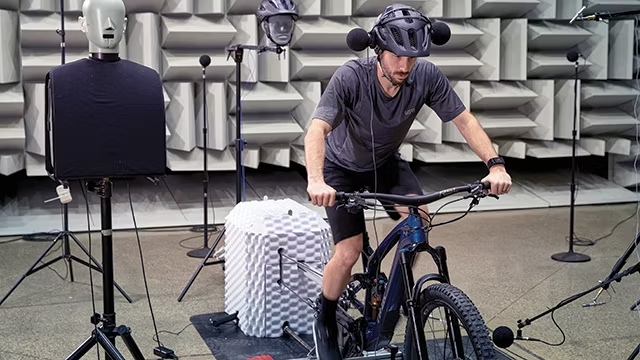
After the initial test rides, the team needed more concrete acoustic data to work with. They headed to the sound studio at the Trek factory headquarters in Waterloo, Wisconsin, which is where Trek’s private mountain bike trails are, to run more exploratory acoustic analyses. This included sound power and sound quality metrics such as loudness, tonality and articulation index using Simcenter testing solutions, like the portable, Simcenter SCADAS™ XS hardware and Simcenter Testlab™ Neo software, the next-generation software platform for multidisciplinary test-based performance engineering.

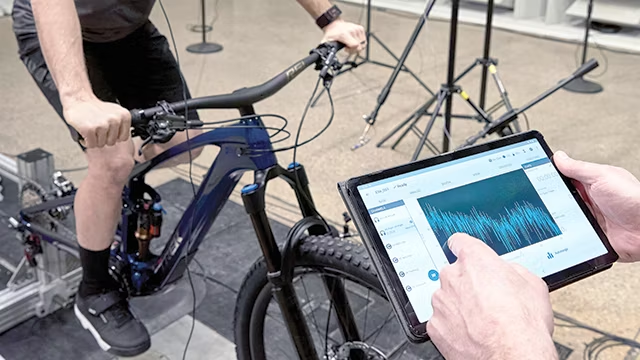
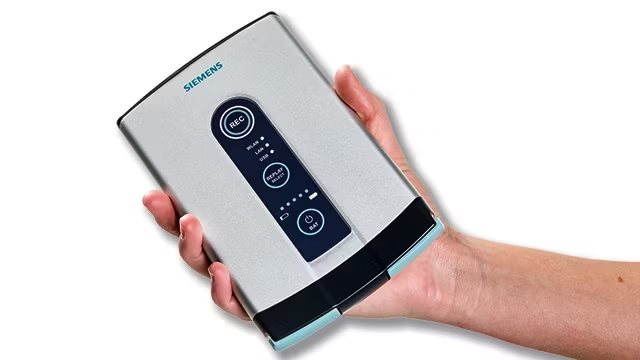
“Using Simcenter SCADAS XS to perform field testing is pretty easy because it fits in a bike jersey pocket, integrates seamlessly with the binaural headset and can be controlled wirelessly with the Simcenter Testlab Scope App on a tablet outside,” adds Harder. “During the trail tests, we also used a GPS and action camera to visualize the data in Simcenter Testlab Neo.”

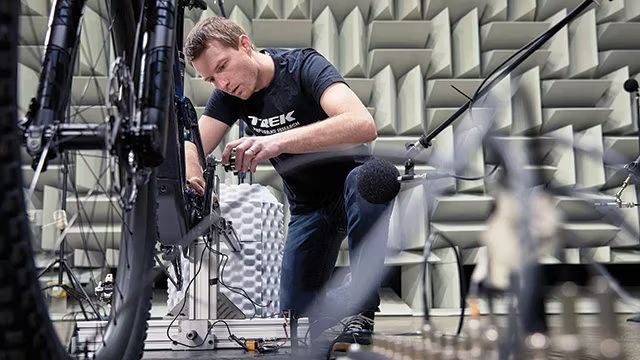
The lab test setup included the Simcenter SCADAS XS, professional microphones, an acoustically-isolated stationary trainer set to 300W total resistance and, of course, the Trek Fuel EXe adjusted to maximum assist mode. The Trek team used Simcenter Testlab Neo according to the ECMA-74:2019 standard to calculate tonality.

“After researching various sound quality metrics, it became clear that tonality was the most representative of what our riders were hearing,” says Harder. “Thanks to using Simcenter Testlab, we could easily explore other relevant metrics like prominence ratio and articulation index. Nothing is worse than coding an algorithm by hand for a couple of days only to realize it’s not a useful metric for this test.”

Harder and team provided feedback throughout the prototyping process and ended up creating an advanced set of methods to diagnose and improve e-bike motor acoustics. As a final step, they verified the field and lab results on the final production motor for two days in an anechoic chamber. The final results proved that using Simcenter helped them design the Fuel EXe to sound five times more pleasant and nearly two times quieter than other popular e-mountain bikes.

The future of e-bike acoustics

As the HPR50 and Fuel EXe rolled into production, the Trek Performance Research Group realized that they were working on cutting-edge e-bike acoustics.

“Quantifying human sound perception is extremely complicated”, says Harder. “Using Simcenter SCADAS XS and Simcenter Testlab Neo software let me focus less on how to get correct answers and more on what those answers were teaching me. The ability to quickly test different metrics and interactively visualize, filter and playback data led to much quicker and more confident insights than we couldn’t have gotten otherwise.” Harder says, “The really exciting thing is that we can now leverage these tools and acoustic knowledge in even earlier stages of future e-motor and e-bike R&D projects.”

Using Simcenter SCADAS XS to perform field testing is pretty easy because it fits in a bike jersey pocket, integrates seamlessly with the binaural headset and can be controlled wirelessly with the Simcenter Testlab Scope App on a tablet outside.

Paul Harder, Principal R&D Engineer
Trek Performance Research Group, Trek Bicycle

Automotive testing firm uses Simcenter Testlab and Simcenter SCADAS to help customers meet regulatory standard for noise

Product: Simcenter
Industry: Automotive and Transportation

Working in partnership with Siemens, UTAC CERAM is looking to the future of automotive acoustic design, including virtual homologation, predictive pass-by noise design and sound optimization of AVAS-fitted vehicles.

Louis-Ferdinand Pardo, Acoustic Expert Leader and Department Manager, Electromagnetic Compatibility and Noise, Vibration and Harshness
UTAC CERAM

Passing the first time

Scientists are confident that noise pollution can harm the health and behavior of all beings, so reducing the noise levels generated by cars, airplanes and machines is a requirement for supporting a sustainable future.

Governments worldwide, especially in Europe, are taking drastic measures to enforce more stringent vehicle pass-by noise (PBN) levels. In June 2016, Europe issued a plan for diminishing regular passenger car noise levels from the current level of 72 decibels (dB) to a maximum of 70 dB by 2020 and 68 dB by 2024. Achieving a 4-dB reduction will take an enormous effort, as vehicle manufacturers are already pushing engineering limits to remain below the current target.

Vehicle manufacturers and part suppliers will simply have to work hand-in-hand to deliver systems that meet individual and overall acoustic targets. Special attention will have to be given to the components generating the most noise: the powertrain, intake, exhaust and tires.

Every vehicle needs to be certified by the International Organization for Standardization (ISO) 362 standard, which has been revised in recent years. It now requires more extensive tests in order to even better represent the reality of urban traffic. Testing teams are already spending lots of effort on performing the regular homologation tests and have little to no time or resources to spare.

The reality is clear: Vehicles need to be designed to be able to pass the test the first time.

Getting ready for the future

For decades, UTAC CERAM has helped vehicle manufacturers pass certification and homologation tests. UTAC CERAM is a private, independent group providing services in many areas of land transportation: regulation and approval, testing and technical expertise (environment, safety, durability and reliability), certification, public automotive events and driver safety training. UTAC CERAM also works in an official capacity with two French regulatory institutions that oversee standards for roadworthiness (Central Technical Organization) and standardization (Office for Automotive Standardization).

Over 400 employees work at two test centers in Linas-Montlhéry and Mortefontaine, France, as well as at customer sites in France and abroad. In addition, UTAC has subsidiaries in the United Kingdom, North America, Russia and China.

Vehicle pass-by noise homologation is one of many UTAC CERAM activities. Numerous vehicles are tested each year according to the ISO 362 standard on the exterior pass-by noise track at the Linas-Montlhéry site. Yet UTAC CERAM’s involvement in the automotive industry goes beyond simple homologation. The company offers solutions for automotive design and testing so manufacturers can be confident their vehicles will pass the ultimate homologation test.

For the purpose of mastered pass-by noise design, UTAC CERAM has invested in a state-of-art acoustic chamber. The large facility features fine-tuned sound insulation, a four-wheel drive roller bench and two rows of microphones combined with Siemens Digital Industries Software’s Simcenter Testlab™ software for analysis and Simcenter SCADAS™ hardware for acquisition. As such, it is designed to reproduce the conditions of exterior pass-by noise tests as accurately as possible.

The benefits of indoor pass-by noise testing are huge. Indoor pass-by noise testing lets teams perform accurate, perfectly reproducible tests in a controlled environment, independent of changing weather conditions. Since vehicle speed and gear shift are robotized, risk of human driver error is eliminated. However, tire noise is more difficult to accurately reproduce in a room, as it sounds different on a roller bench than it does on road surfaces. This is why Simcenter Testlab Pass-by Noise Testing software, part of the Simcenter™ portfolio from Siemens, features a tire noise model calculation that corrects tire noise data according to the ISO 362-3:2016 procedure.

Thanks to the repeatability of tests, results are more reliable. In the intermediate term, it is expected that indoor pass-by noise tests will be performed for vehicle homologation and will complement or replace exterior tests. Louis-Ferdinand Pardo, acoustic expert leader and department manager of electromagnetic compatibility (EMC) and noise, vibration and harshness (NVH) at UTAC CERAM, confirms this trend based on his experience as a member of the ISO committee defining the standard for pass-by noise level.

But the benefits of indoor testing go beyond eliminating the occurrence of chance, errors or incidents in a test. Testing in a controlled environment allows the user to implement advanced pass-by noise engineering techniques. The noise contributions of individual sound sources, such as powertrains, exhausts and intakes, can be evaluated and calculated to help set precise acoustic targets for the components.Getting ready for the future

Shaping the sound of electrical vehicles

Vehicle sound design is not about the reduction of noise levels alone. Today, an increasing number of hybrid and electrical vehicles are being used in urban areas. These vehicles drive fairly softly. The risk of accidents rises when no sound alerts pedestrians or cyclists of the presence, speed and direction of an approaching car. To preempt this risk, governments and institutions have been debating the necessity of equipping hybrid and electrical vehicle with noise-generating warning devices described as acoustic vehicle alerting systems (AVAS).

In 2016, the United Nations (UN) published a new regulation (UN 138) on minimal noise requirements that would enforce the fitting of such systems on new vehicles within a couple of years. In the same year, the United State National Highway Traffic Safety Administration (NHTSA) drafted a final rule establishing the federal motor vehicle safety standard (FMVSS 141) of minimum sound requirements for hybrid and electric vehicles.

Testing of AVAS-fitted cars will be best performed indoor as noise levels are by definition low and background noise should be excluded. Simcenter Testlab Interior Pass-by Noise Testing supports the definition of minimum noise levels by integrating the ISO 16254 standard (Acoustics – Measurement of sound emitted by road vehicles of category M and N at standstill and low speed operation – Engineering method) in its worksheets. With its state-of-the-art acoustic facility equipped with Simcenter testing solutions, UTAC CERAM is well positioned to support manufacturers of hybrid and electrical vehicles design sound for the alerting system.Shaping the sound of electrical vehicles

Optimal testing productivity

To perform an indoor pass-by noise test, the vehicle is positioned and secured on the four rolls of the roller bench. The vehicle stands in the middle of the large chamber with two rows of about 20 microphones, each positioned on the sides of the chamber at an exact distance of 7.5 meters from the vehicle and a height of 1.2 meters. The microphones send their signals to the two Simcenter SCADAS hardware mobile data acquisition systems, part of the Simcenter portfolio, at each side of the room. Once the vehicle is positioned on the roller bench, the engineer starts the test. From that moment on, most of the procedure is automated. The engineer leaves the acoustic room for the control room, where he or she will be able to set up the parameters for the test and run it remotely. If necessary, the test can also be adjusted and started manually from a control box in the room.

At UTAC CERAM, the installation has been designed to ensure maximal testing productivity.

“We have selected the Simcenter testing solutions from Siemens for three main reasons,” says Pardo. “First, it offers excellent data quality and processing capabilities for indoor pass-by noise with algorithms that deliver accurate results, comparable to the ones obtained with actual exterior pass-by noise tests. Second, using Simcenter testing solutions ensures continuity and compatibility of tests performed indoor with tests executed outdoor with similar Simcenter systems. Third, we really appreciate the long-standing partnership with Siemens for acoustic engineering and testing.

“Siemens’ involvement in pass-by noise engineering is not limited to supplying measurement equipment; the company acts as a partner in research and development, providing solutions for acoustic source quantification and evolving towards early, predictive vehicle pass-by noise design. Siemens is also involved, as am I, in the definition of tomorrow’s ISO certification procedures, moving towards virtual homologation.”

Performing state-of-the art tests and beyond

New ISO certification procedures prescribe more exterior tests at run-up and constant speeds, and in various gear ratios. Those requirements can be reproduced in UTAC CERAM’s acoustic chamber, which allows the user to assess a design variant as well as prepare for vehicle homologation. Test procedures are preprogrammed in the chamber’s controller: the engineer only adjusts the parameters according to the requirements of the vehicle under scrutiny, opens the Simcenter Testlab worksheet and initiates the test. It then runs autonomously, with triggers starting and stopping measurements in Simcenter Testlab. Yoni Meyer, test engineer at UTAC CERAM, is an enthusiastic user of the software: “We benefit from almost all the implemented functionalities of Simcenter Testlab, and despite being advanced users, we still appreciate the easy-to-use worksheets and intuitive workflow approach.”

By using the postprocessing capabilities of Simcenter Testlab, further tasks, such as separation and quantification of noise sources, can be performed. The result is being able to clearly identify the noise contribution of individual components. This analysis will allow exact acoustic target setting on components, and means in the future the user will be able to accurately predict vehicle pass-by noise level based on component noise contribution.

Pardo concludes: “Working in partnership with Siemens, UTAC CERAM is looking to the future of automotive acoustic design, including virtual homologation, predictive pass-by noise design and sound optimization of AVAS-fitted vehicles.

We benefit from almost all the implemented functionalities of Simcenter Testlab, and despite being advanced users, we still appreciate the easy-to-use worksheets and intuitive workflow approach.

Louis-Ferdinand Pardo, Acoustic Expert Leader and Department Manager, Electromagnetic Compatibility and Noise, Vibration and Harshness
UTAC CERAM

Accelerating turnaround of CFD simulations

Product: Simcenter
Industry: Electronics and Semiconductors

Heraeus Noblelight GmbH has been developing specialty light sources since the invention of the quartz glass lamp in 1904. Light, whether ultraviolet (UV), infrared (IR) or middle wave range, is at the heart of everything they do. Located in Germany, the company has harnessed the power of light to solve a wide range of challenges in the manufacturing and process industries. They also design and manufacture consumer products like the Soluva® air purifier, for removing airborne viruses including the Coronavirus disease of 2019 (COVID-19) from healthcare settings, public transport and classrooms.

Engineering simulation is not only used during the product development phase, but also to understand the best way to deploy products in the field. “We use CFD simulation to help our customers understand their processes and where to locate our UV or IR emitters to make them most effective,” explains Dörte Eggers, simulation engineer at Heraeus Noblelight. Eggers continues, “sometimes a customer already has a process in operation that is not working optimally, so we also use simulation to troubleshoot and find ways to improve it.”

Modeling the complexity with CFD

Heraeus Noblelight products cater to a wide range of industrial processes, from curing paints and adhesives using precision IR emitters, to water and air disinfection equipment using ultraviolet C (UV-C). A range of modeling techniques are required to capture the prevalent physics regimes in each case.

“We selected Simcenter STAR-CCM+ for CFD analysis because it delivers a wide range of physics modeling options in a flexible and easy-to-use package,” says Dr. Larisa von Riewel, computer-aided engineering (CAE) group leader. “Our core workload is thermal management simulation. However, we often need to include additional physics like multiphase flow and particle tracking.”

Figure 1. Particle tracking analysis calculating residence time of air in the Soluva air purifier – a device for removing airborne viruses from public spaces.

Seeing the invisible

Since many of their products operate outside of the visible light spectrum, computational fluid dynamics (CFD) simulation is a valuable tool for verifying specific applications, tailored to each customer’s process. Therefore, CFD has become a routine part of the sales process and requires a rapid turnaround of simulation work. This provides confidence that the construction team will deliver a high performing product and add significant value for customers.

As well as making invisible light visible, using CFD analysis makes the unmeasurable measurable. “In some cases, running physical trials is very expensive and sometimes impossible,” states von Riewel. “Taking our IR emitters as an example, simulation is essential as it enables us to estimate parameters we cannot physically measure. Understanding this behavior is critical for achieving the functionality and lifespan we need from the devices.”

Communicating the insights gained from simulation to a range of stakeholders is also an important part of the process. “Every new release of the software has additional post-processing features and we find these very useful to present simulation data to customers in the context of their equipment and processes,” says von Riewel.

Figure 2. The positioning and setup of IR emitters is key to manufacturing high quality products in the automotive industry.

Going faster with Simcenter Cloud HPC

Today, most CFD simulation at Heraeus Noblelight is done in-house using a large on-premise workstation. However, during busy periods, the team needs to tap into additional resources by outsourcing simulation work. The need to scale up and down quickly makes it difficult to manage licensing costs to cover short periods of use and to ensure that resources are used efficiently.

Over the past few months, Heraeus Noblelight has been an early-access user of Simcenter ™ Cloud HPC software, a new hybrid software as a service (SaaS) product, which enables simulation runs to be launched on cloud infrastructure directly from Simcenter STAR-CCM+ ™ software. These are part of the Xcelerator portfolio, the comprehensive and integrated portfolio of software and services from Siemens Digital Industries Software. By purchasing hardware and software in the same transaction and paying only for what is used, Heraeus Noblelight sees potential to gain more efficiency by being able to instantly access high performance computing (HPC) resources from anywhere, at any time.

Figure 3. Heraeus Noblelight Infradry Combi used for drying inks on paper. CFD is used to make sure the IR emitter is kept cool and to enable homogenous heating and drying.
Accessible

“When we are working with remote simulation teams, we often find we do not have HPC resources where we need them to be,” continues von Riewel. “Therefore, Simcenter Cloud HPC would enable us to speed up collaborative projects. We also would not need to worry about license costs going to waste if a project finishes sooner than expected.” Using the cloud means the HPC resources are readily accessible by all team members. “I would say the interface is user friendly and intuitive, with several options for monitoring the runs,” continues von Riewel. “Transferring the simulation files was fast and straightforward.”

For von Riewel and Eggers, simulation is a small part of their working day. Therefore, they are not able to devote as much time as they would like to researching and testing new models and features. Therefore, they rely on the expertise of the Simcenter customer support team and their dedicated support engineer (DSE). “We are always under time pressure. When we face new challenges, we prefer to go to our DSE who explains relevant new features and how they will benefit us. This is a great time saver,” von Riewel explains.

Flexible and scalable

As well as facilitating collaboration with remote teams, Eggers also sees potential to leverage cloud resources to run more ambitious simulations or broaden the scope of projects while still meeting tight deadlines. “In some cases, we need to run bigger models to capture more detail or run more simulations in the same amount of time. Simcenter Cloud HPC gives us that flexibility.”

Secure

Heraeus Noblelight frequently works on projects involving customer proprietary processes and technologies, so data privacy and security are critical for their business. “When we sign agreements with customers, there are usually terms restricting how and where we store and work on their data,” explains von Riewel. “Of course, all stakeholders need to be sure their data is safe. I expect attitudes will gradually change as the world adapts to this new way of working.”

Simcenter Cloud HPC is built on Amazon Web Services (AWS) cloud infrastructure and follows best practices developed by AWS and Siemens for developing and operating multi-tenanted SaaS applications. Users have complete control over data sovereignty and retention and the product will also go through the International Organization for Standardization (ISO) 27001 and System and Organization Controls 2 (SOC2) Type 1 certification.

“I am confident that Siemens is diligent in maintaining the necessary policies and certifications to satisfy us and, importantly, our customers,” von Riewel concludes.

Looking to the future

When asked about how running CFD simulations in the cloud might impact their work in the future, Heraeus Noblelight sees flexibility and accessibility as key benefits. “Since the pandemic, there has been a large shift toward remote work, which means there are not always people available to access workstations in the office when something goes wrong,” says von Riewel. “Being able to work on projects from anywhere in the world is a dream and I feel this is the way humanity should go.”

Von Riewel also sees the ability to scale up and down instantly as a future competitive advantage. “The world continues to develop and everything is increasing in complexity. Models are becoming more accurate and we need to capture more physical realism. You can guarantee we will frequently require more powerful HPC resources in the future. Simcenter Cloud HPC offers that agility, which translates to a more competitive offering for our customers.”

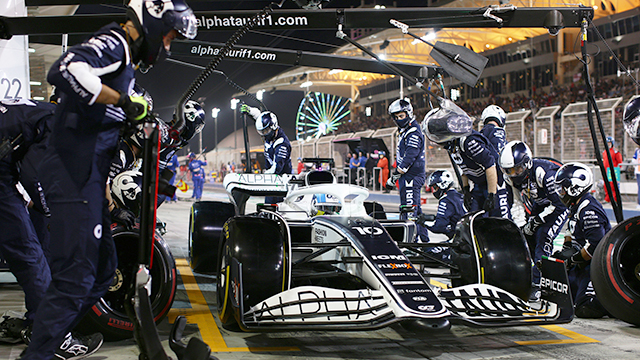
Scuderia AlphaTauri creates a top performing F1 car

Product: NX, Simcenter
Industry: Automotive and Transportation

The rise of Scuderia AlphaTauri

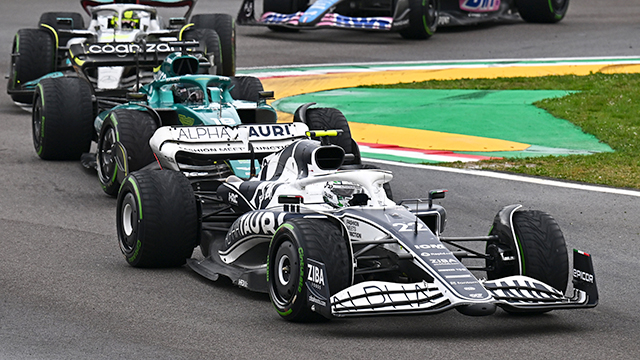
On February 23, 2022, the world got a taste of the new Formula One (F1) cars as they completed their pre-season test days in Barcelona. This was followed by testing days in Bahrain in early March 2022, where the drivers focused on getting comfortable driving the new cars before the race season began on March 21, 2022.

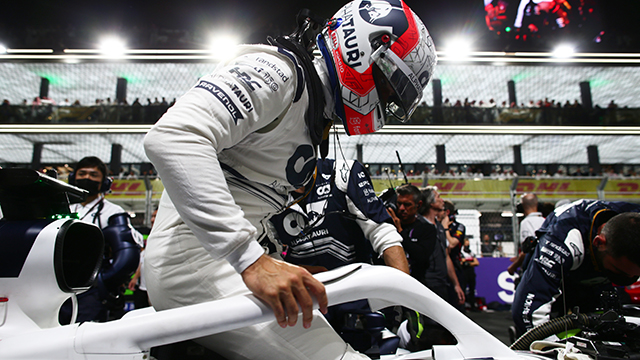
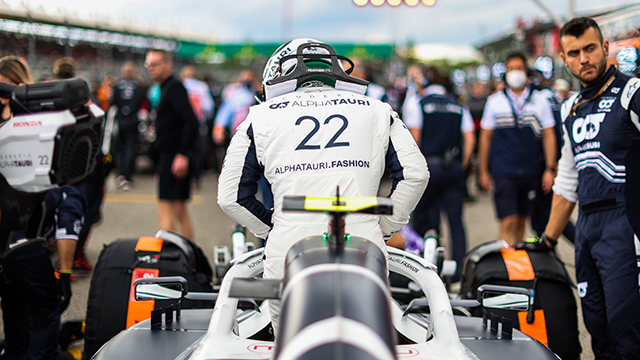
During the test days and the first few races, two young Scuderia AlphaTauri drivers, Pierre Gasly and Yuki Tsunoda, worked with the Scuderia AlphaTauri engineers to discover how the new car performed and fix the mistakes that occurred with the new design.

“There are new things to discover with this car every time we go out on the track so we have to make the most of each session and learn as much as we can before the first race here,” says Pierre Gasly, trackside during the test days in Bahrain in March 2022. “The feeling was unique. I was excited to discover these new cars and see how they felt on the track.”

That feel-on-the-track performance enhancer

In F1 racing, the driver and the car become one. This feel on the track comes from the part of the car that normally doesn’t get to be in the spotlight, the driver’s seat.

“The chassis is one of the most sophisticated parts of the car for safety and performance reasons. You need to start working on that part immediately even if you don’t have all of the information,” says Raffaele Boschetti, head of information technology (IT) and innovation for Scuderia AlphaTauri. “Before partnering with Siemens, we spent three months producing a good chassis. With Siemens software, we did this in one month. This saved us a lot of time and gave us many advantages.”

Aside from the chassis, the seat is important for driver safety and overall driver performance. Overall seat design is strictly regulated by F1 safety and crash test rules. If something goes wrong, drivers need to be able to exit the car quickly and safely. The safety marshal and medical teams need to be able to extract injured drivers from a crash effectively. Boschetti is quick to point out that there is much more to the seat in an F1 car than just safety.

“The seat is a part of the car that delivers performance. The driver feels all of the vibrations, accelerations and handling through the seat. On the track, we can modify the car settings to improve the car based on the driver’s needs,” says Boschetti. “In Formula One, you have a couple of tests in February or March. In this situation, the software and platforms Siemens provided us were vital to building the seat.”

One size does not fit all

Not every F1 seat is the same. Composite design engineers will tell you that half of the challenge isn’t the seat but how to fit the driver in the car.

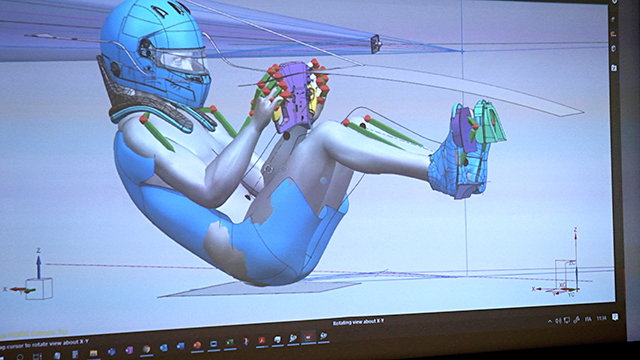
“It is like a tailored suit. You have to look at things in terms of helmet position, back position and you have to be as low as possible,” says Francesco Dario Picierro, senior composite design engineer for Scuderia AlphaTauri.

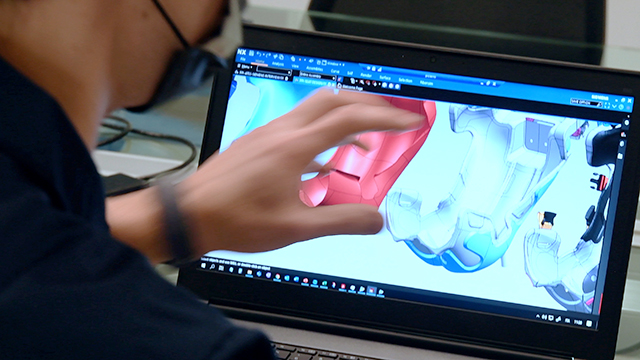
To ensure these critical performance aspects were correct, Picierro and his colleagues developed a unique seat-designing process. To start, they designed a slightly larger seat than necessary and then heated a batch of special resin and took a physical mold of the driver’s body in the ideal position. From the resin mold, they used NX™ software to create a complete scan to design the seat. NX, the Fibersim™ portfolio and Simcenter™ software are part of the Xcelerator portfolio, the comprehensive and integrated portfolio of software and services from Siemens Digital Industries Software.

“The process might seem simple, but thanks to Siemens’ products it becomes smarter,” adds Picierro.

Using digitalization for F1 success

With the complete design and chassis change in the 2022 model, the team had to simulate every detail in computer-aided design (CAD) from overall visibility to how the driver would fit into the chassis design.

Getting the driver to squeeze in, reach the pedals and obviously see – while considering the helmet, safety regulations and the new chassis and car design – is an engineering feat in itself. The team knows that digitalization is the only way to succeed in F1 these days. Using Siemens’ digitalization tools removed most of the grunt work from the design, engineering and production cycles.

“Using NX helped us with our digitalization efforts. For example, we can replicate the exact handwork on the steering wheel or the visibility using the driver’s camera. We can also scale the digital mannequin according to the measurements of the driver,” says Picierro.

Racing against the clock

While the composite design engineers are custom fitting the driver to the seat (a process that can happen several times per season based on the needs of individual drivers) other members of the Scuderia AlphaTauri engineering team are optimizing the new car design for driver performance in time for race day.

Aside from the tight deadline, the other challenge for every F1 engineer is weight. F1 engineering teams struggled to make the minimum driver plus car weight of 795 kilograms (kg), especially with the new safety regulations and ground effect pull. At the last minute, the teams reached a compromise to increase the weight to 798 kg.

“Of course it’s always difficult. It’s a completely new regulation. These cars are complicated and it is difficult to design everything to meet the weight limit requirements. As we can see, nearly all of the teams are overweight. We also have to consider costs. It is expensive to reduce weight. Considering the cost cap, our teams were able to come to a compromise,” says Franz Tost, team leader for Scuderia AlphaTauri.

Zooming around over 300km/h during a normal F1 race, drivers experience up to four or five lateral G’s routinely under braking and cornering and during acceleration on the long stretches.
One platform and a secret to success

As Tost explained, balancing design parameters is always a challenge for engineering teams. Using the same digital platform and software suite to examine the real behavior of the car helps the team make the right decisions for the races.

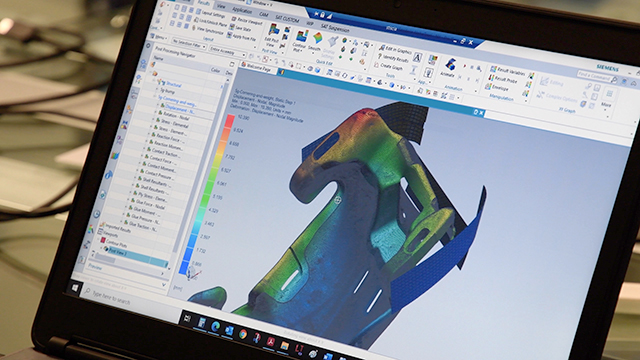
“Our job is to evaluate the strength and stiffness of the part. The driver’s seat needs to be strong enough to support the acceleration loads and stiff enough to make a proper interaction between the driver, the chassis and the rest of the car,” says Giuseppe Stiscia, a chassis group leader and structural engineer for Scuderia AlphaTauri. “We use Siemens Simcenter to generate the finite element model and generate the load model conditions.” Simcenter clearly shows the standard stiffness values of the structure via a color strip. Each color represents a state of stress or displacement of the part.

“Structural engineers use this information to understand the real behavior of the structure. Our goal is to make the part as strong and stiff as possible, but we need to optimize the weight first. He adds, “Simcenter helps us calculate the part faster and use the same platform for everyone involved in the project.”

Development time is gold

Andrea Rizzo, a research and development (R&D) digital layup group engineer, uses this same platform with his colleagues. They use Fibersim tools to finish the actual part.

“We use Fibersim to achieve a perfect connection between the FEA results and the real lamination,” says Rizzo. “With this material, you need to cut a shape in the ply to be laminated on the mold. Any extra or unnecessary material applied to the mold is an additional cost. We try to laminate with as little material as possible to save time and money.”

The Scuderia AlphaTauri engineering team also uses Fibersim to maintain the consistency of the customized parts. Unlike commercial vehicles, F1 cars contain many handmade carbon fiber parts created by carefully layering composite plies inside the laminate. Each part has unique structural characteristics. Although the team wouldn’t say for competitive reasons, one can guess that spare parts and replacement parts are created on an as needed basis.

Data is king: any piece of information the team can analyze will help them understand the performance behavior of the new car.
“Each carbon part is a laminate, so we need to make sure the first one is the same as the last one. This is why we use Fibersim. We save time during the production process with this comprehensive simulation. We can prepare plies to be the same for all laminations.

“With Fibersim, we know what is happening in the component. We know the quality standard of the plies. We follow every single ply during the process. We can prevent problems before they happen because we ‘live’ in the same platform from NX to Simcenter to Fibersim. And more importantly, we save time,” says Rizzo.

“The problem with F1 especially – but even for standard cars – is that you need to produce the same part with the same quality at the same time. If you use the same suite that calculates everything for you from the CAD part to the production line, then you end up with a quality part that will deliver performance on the track. That’s the goal,” says Boschetti.

Thanks to Siemens Xcelerator tools like NX, Simcenter and Fibersim, the team can customize each seat to the driver using layers of composite plies to create a hyper-light-weight laminate that performs well to achieve safety and design specifications for the new Scuderia AlphaTauri cars. This provides Gasly and Tsunoda with the ideal connection to the car they need to perform well. Thanks to some superb engineering from the team in Faenza, Italy, and help from the Siemens Xcelerator portfolio, the Scuderia AlphaTauri team is more than ready for the upcoming F1 season.

Modal Survey Testing for an unscathed journey to space

Product: Simcenter
Industry: Aerospace & Defense

All structures have natural frequencies, and it is often the most important feature of the structure, especially when it comes to dynamic response. Very often the vibrations must be investigated to quantify the structural response in some way, so that its implication on factors such as performance and fatigue can be evaluated.

Modal testing is a very useful and widely used technique to verify and investigate this behavior. It looks at the natural frequencies, mode shapes and damping of a structure and helps engineers understand how a design will respond to different dynamic loads.

In the space industry, this technique is also referred to as modal survey testing and is intended to calibrate and increase the accuracy of finite element (FE) structural dynamics model of spacecraft and space launchers. The validated models are important, among other things, for the prediction of the launcher vibrational characteristics, the aeroelastic stability and the dynamic environments to which payloads and on-board equipment are submitted to during the launch.

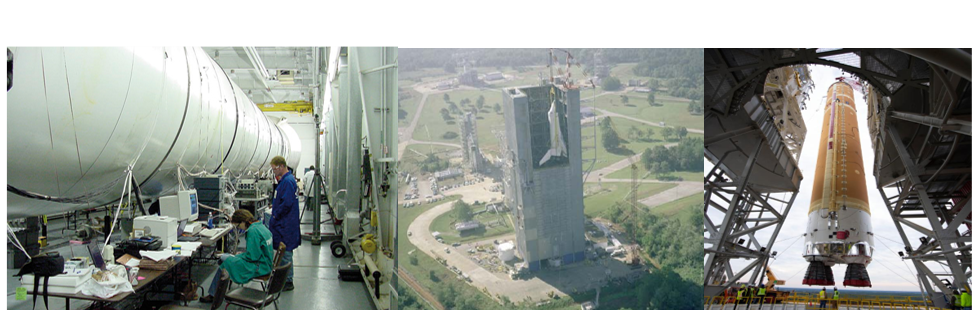
Courtesy NASA: Modal survey testing on Ares launch vehicle (left), Space Shuttle Challenger (middle) and SLS core stage (right)

A modal survey test consists of injecting forces, using electrodynamic shakers or in some cases also a modal impact hammer at a number of carefully chosen inputs. In the case of shaker excitation, burst random excitation is usually used because it is fast and efficient. When higher excitation levels are required, or for the assessment of nonlinear characteristics, stepped sine techniques are used. The forces are measured during the test, along with the response accelerations at many locations throughout the structure. During this test, the spacecraft is mounted in well-known boundary conditions, clamped or free-free, or a combination thereof. During the excitation, FRFs are measured.

After the test, modal curve-fitting technology is applied to extract modal information: resonance frequencies, damping values and mode shapes. The test results are used for the purpose of validating the entire FE model and correlating frequencies, mode shapes and damping assumptions. The significant mode shapes and frequencies are those that are primary contributors to launcher/spacecraft interface loads and internal loads.

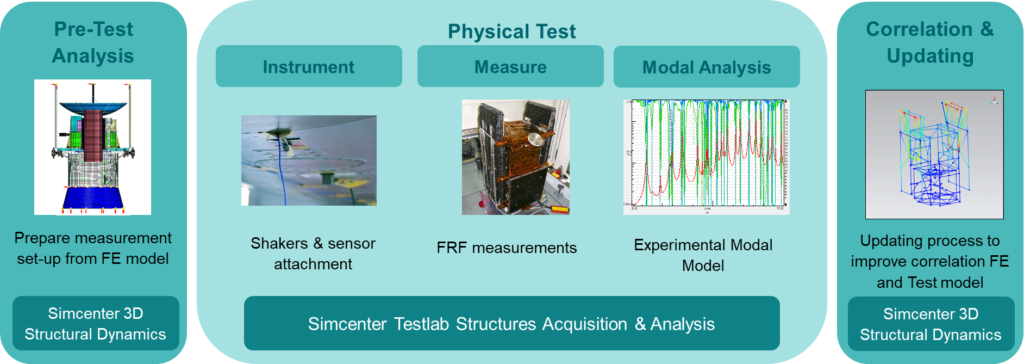
This process is illustrated schematically below. It shows how early FE models of the spacecraft can be used in Simcenter 3D Structural Dynamics to perform pre-test analysis and optimally design the test campaign. Simcenter Testlab and Simcenter SCADAS are then used to efficiently and reliably measure FRFs and accurately determine the best experimental modal model. Finally, the experimental results are further exploited to correlate the preliminary model with experimental results and to update the FE model to better reflect reality.

Different stages of the modal survey process: from test preparation, to the test execution, analysis and reporting.

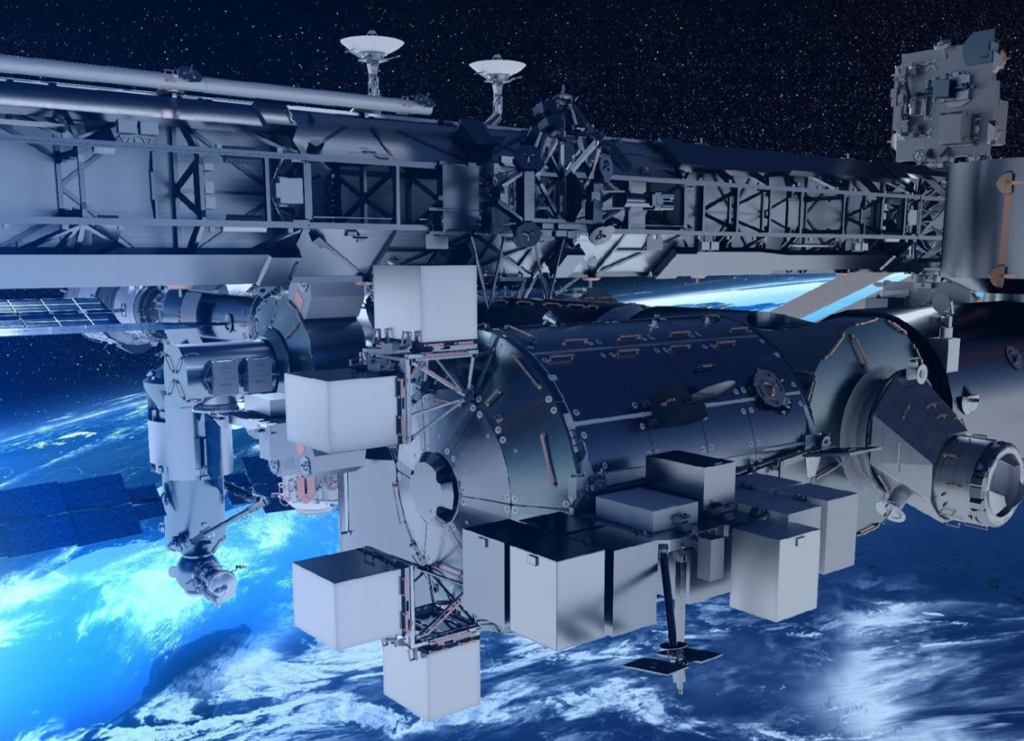
A good example of a program where a modal survey test was conducted is the Bartolomeo project from Airbus Defense & Space, carried out by Deutsches Zentrum für Luft- und Raumfahrt (DLR). Simcenter SCADAS Mobile hardware has been used as the critical measurement equipment for the modal survey test that was meant to update the FE simulation model of the Bartolomeo platform. This enabled the team to simulate and predict aspects that could only be done using simulation and analysis, such as how the platform would couple with the launcher.

×