

Industry: Construction and Manufacturing
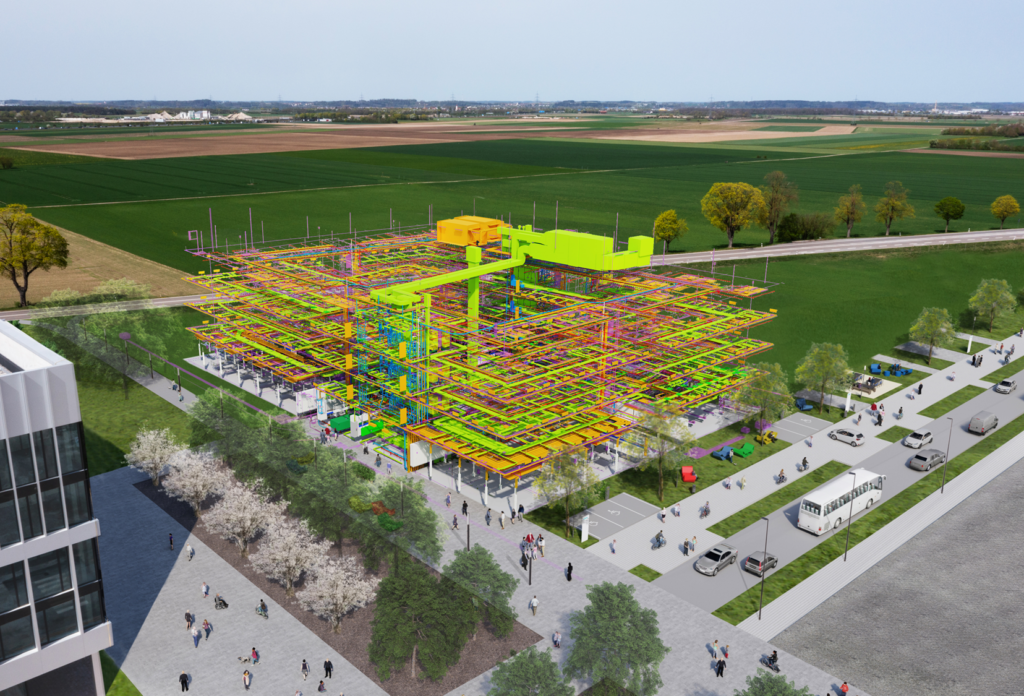
The integration of Building Information Modeling (BIM) with NX is transforming the way industrial plants and factories are designed. By combining the strengths of both tools, Siemens Real Estate and Siemens Digital Industries Software are streamlining workflows, improving collaboration, and enhancing efficiency in shop floor planning.
BIM and NX: A Powerful Collaboration
Siemens Real Estate (SRE), a global leader in corporate real estate management, is at the forefront of digitalization and innovation. With a “digital-first” approach, SRE mandates the use of BIM for all new construction projects. This methodology enables the seamless connection between the physical and digital worlds, laying the foundation for a digital twin of buildings and shop floors.
A prime example is the Digital Native Factory in Nanjing, which was fully planned and simulated using digital twin technology. By integrating factory data, shop floor layouts, and building performance data, SRE created a comprehensive digital representation of the facility. This success highlighted the need for more efficient processes to scale projects and integrate multiple teams.
Bridging the Gap Between BIM and CAD
Typically, BIM and mechanical CAD are managed by separate teams. BIM data, owned by Siemens Real Estate, is used to design buildings, while shop floor layouts are planned by engineers. The traditional workflow involves:
- Creating and updating BIM models in dedicated software.
- Importing BIM data into NX for shop floor planning.
- Revising and exporting design changes via IFC format to ensure updates are reflected in both environments.
Since design reviews occur frequently, this process demands constant data transfers between architects and engineers, increasing complexity and the risk of errors.
Challenges in BIM and CAD Integration
The manual process of exporting and importing data presents major challenges, including:
- Data Format Differences: BIM data is stored in single part files, while NX structures data as assemblies and components.
- Positioning Issues: BIM relies on a consistent coordinate system, which must align with NX models.
- Complexity in Data Translation: Converting large-scale BIM models into NX can be time-consuming, requiring hours of processing and generating thousands of parts.
To address these challenges, Siemens Real Estate collaborated with Siemens Digital Industries Software to develop better BIM data import solutions in NX. These solutions include preserving BIM structures, simplifying file conversions, and improving IFC translation to reduce errors and enhance usability.
The Future of BIM and NX Collaboration
Looking ahead, Siemens is working on real-time design updates between BIM and NX, reducing the need for manual transfers. The goal is to create a seamless, interconnected workflow, where engineers receive automatic alerts when changes occur.
Additionally, VR and Immersive Engineering are becoming integral to design collaboration. Siemens is exploring Sony’s XR head-mounted displays and the Industrial Metaverse to enhance shop floor planning and virtual decision-making.
Another significant advancement is the NX Translator for Revit, introduced in June 2024. This tool, available via token licensing, enables the direct recognition of identical components (e.g., doors, beams, windows), streamlining BIM data import into NX.
Ultimately, Siemens aims to develop a single source of truth for BIM and CAD data, eliminating inefficiencies and enabling fully digitalized, automated workflows. By continuing to innovate, Siemens Real Estate and Siemens Digital Industries Software are shaping the future of integrated industrial design.